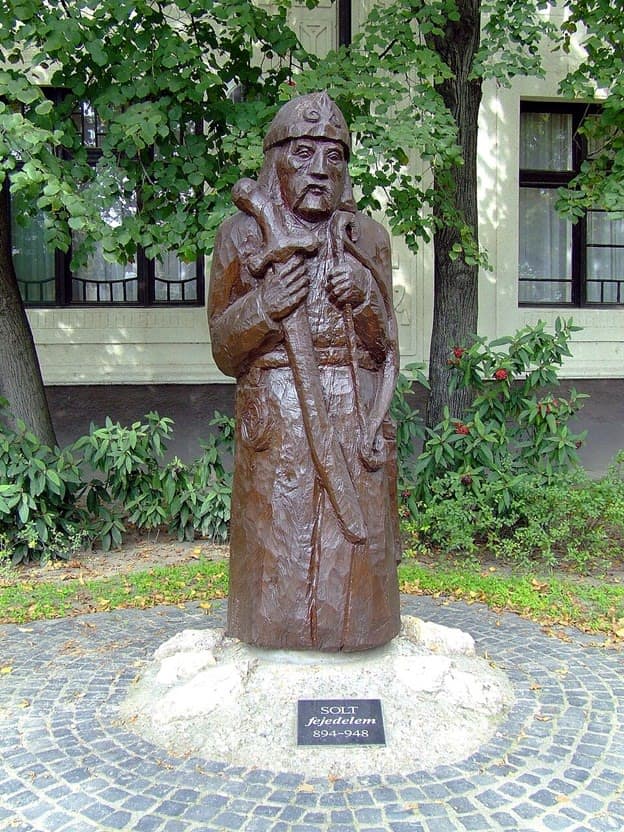

It all began in the fateful year of 907.
By this time, the tribes of the indomitable Magyars had already firmly established themselves in the fertile lands of former Roman Pannonia and Transylvania.
However, their presence inspired fear and fury among their neighbors.
Luitpold, Margrave of Bavaria, determined to put an end once and for all to the devastating Hungarian raids on German territories, assembled an army.
The decisive confrontation took place near the walls of Bratislava Castle.
The battle ended in catastrophe for the Bavarians — Margrave Luitpold was utterly defeated and fell on the battlefield.

But this magnificent victory came at an extraordinarily high price for the Hungarians.
Researchers have concluded that it was most likely during the bloodbath near Bratislava that the great chieftain Árpád and his elder sons lost their lives.
This conclusion is supported by the very circumstances of the succession.
Princely authority unexpectedly passed to Zsolt, Árpád's youngest son.
The fact that he bypassed three, or perhaps even four, elder brothers in the line of succession strongly suggests that none of them remained alive at the time of their father's death.
In that same year, 907, the new Grand Prince of the Hungarians was still little more than a child.
The death of the mighty Árpád and the young age of his successor meant that the Hungarian tribal confederation lost its former iron unity.
The confederation once again fragmented into the tribes and clans that had originally formed it, each pursuing its own interests.
For many years, the title of Grand Prince inherited by Zsolt became more of a nominal symbol than an effective instrument of centralized authority.
Despite losing strong central leadership, the scattered Hungarian tribes did not lose their warlike spirit.
On the contrary, the countries of Europe, as far away as Southern Italy and the Iberian Peninsula, remained virtually defenseless for decades against their swift mounted raids.
The Magyars themselves poetically referred to these expeditions as kalandozások, meaning "wanderings," and regarded them not merely as acts of plunder but as a natural and inseparable part of their semi-nomadic way of life.


The principal and most desirable targets of their devastating raids during Zsolt's reign were two of the wealthiest powers of the age — Germany and the Byzantine Empire.
In 924, Hungarian cavalry descended upon the German lands, inflicting a devastating defeat on the forces of King Henry I the Fowler.
However, amid the chaos of battle, the Germans managed to capture one of the most distinguished Hungarian military commanders.
This unexpected event changed the course of history.
Using the noble prisoner as a bargaining chip, Henry the Fowler succeeded in concluding a nine-year peace treaty with the nomads, agreeing in return to pay them generous annual tribute.

Both sides deserve credit for faithfully observing the terms of the truce.
The Hungarians regularly received their gold and refrained from attacking the borders.
But King Henry proved to be a farsighted strategist.
He made full use of these nine years of peace, reforming his army by creating powerful heavy cavalry capable of confronting the swift warriors of the steppes.
He also constructed a network of formidable fortified strongholds, known as burgs, along the eastern frontiers of his kingdom.
When Hungarian envoys arrived in Germany in 933, exactly nine years later, expecting to receive their customary tribute, they were met with a firm refusal.
Outraged, the Magyars immediately dispatched an advance punitive force to teach the defiant king a lesson.
But times had changed.
At the Battle of Riade, near modern-day Merseburg, Henry I decisively defeated the Hungarian vanguard.
Upon learning of this disaster, the main Hungarian forces, confronted by Henry's reformed and heavily armored army, dared not engage in battle and fled.

Nevertheless, this victory could not completely shield Europe from the Hungarian threat.
Having recovered, the Magyars launched an enormous raid in 937, sweeping through Franconia, Swabia, and Lorraine with fire and sword and reaching the very borders of France.
Even so, the fierce resistance of the Germans forced the leaders of the Hungarian tribes to reconsider their strategy.
They realized that plunder in the north was becoming increasingly costly in blood.
Consequently, they turned their attention southward, toward the fabulously wealthy Byzantine Empire.
For many years, relations between the Hungarians and the Byzantine Empire had been determined by geopolitical considerations.
During the reign of the powerful Bulgarian Tsar Simeon the Great (893–927), the Hungarians and Byzantines had been allies, united by a common and extremely dangerous enemy — Bulgaria.
But following Simeon's death, the Bulgarian state weakened and was forced to seek peace with Constantinople.
The common enemy disappeared, and with it, the Hungarian-Byzantine alliance collapsed.

As early as 934, swift Hungarian detachments broke into Thrace, inflicting terrible devastation upon the region.
The Byzantine emperor hastened to buy off the unwelcome invaders, concluding a nine-year truce with them — following precisely the same arrangement previously employed by Henry the Fowler.
Once again, the Magyars faithfully kept their word, while never forgetting to collect their agreed annual "gifts."
However, the Byzantines, led during these years by the usurper Romanos I Lekapenos, failed to learn from the German experience.
Unlike Henry the Fowler, Romanos I did not use the period of peace to strengthen the frontiers or reform the army.
The price of this negligence came in 943, when the treaty expired.
Thrace was once again subjected to merciless devastation, leaving the Empire with no alternative but to extend the humiliating peace agreement and the payment of tribute for another five years.

Relatively little is known about Zsolt's personal life.
As a pagan ruler, he had the right to maintain several wives and undoubtedly left behind numerous descendants.
Nevertheless, the sparse pages of medieval chronicles have preserved references to only one of his wives and one son.
This marriage was of enormous political importance.
While his father Árpád was still alive, Zsolt married a daughter of Menumorut, a pre-Hungarian ruler of a small principality that apparently occupied territories later incorporated into Bihar County.
This dynastic union made it possible to integrate Menumorut's possessions into the emerging Hungarian state smoothly and, most importantly, without bloodshed.
The only son of Zsolt known to historians was Taksony.
For a long time, it was believed that he had inherited the reins of government directly from his father after Zsolt abdicated.
But here, too, history presents a surprise.
A careful examination of certain medieval chronicles reveals that before Taksony emerged on the historical stage, the title of Grand Prince was held by another man — Fajsz, also known as Falicsi.
This mysterious ruler was the son of Jutas, who was Árpád's third or fourth son.
Exactly how power passed from Zsolt's branch of the dynasty to that of his deceased elder brother, and then returned to Taksony, remains another unsolved mystery of the turbulent 10th century.


