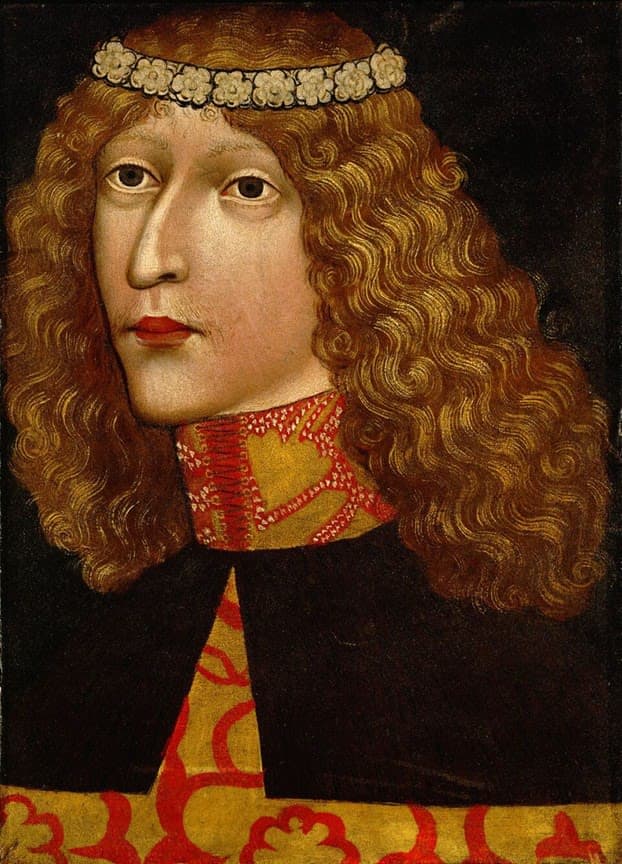
The future monarch was born on March 1, 1456, into one of the most powerful families on the European continent.
His father was Casimir IV, King of Poland and Grand Duke of Lithuania, a member of the illustrious Jagiellonian dynasty, while his mother was Elizabeth of Austria, daughter of Albert II of Habsburg.
This noble ancestry on both sides predetermined his destiny as an heir to great European powers.

His political career began remarkably early.
Following the death of the Bohemian ruler George of Poděbrady, the late king's widow proposed the young Polish prince as the most acceptable compromise candidate for the vacant throne.
Thus, on August 22, 1471, a coronation ceremony took place in Prague: the fifteen-year-old prince ascended the throne as King Vladislaus II of Bohemia.
Because of his young age, he remained heavily dependent on his entourage and numerous advisers during the first years of his reign.

However, the Bohemian crown did not come to him without a struggle.
His principal political and military rival was the ambitious King Matthias Hunyadi, also known as Matthias Corvinus, of Hungary, who likewise claimed authority over Bohemia.
The prolonged confrontation ended only in 1479 with the signing of the Treaty of Olomouc.
This document established a unique political compromise: both monarchs were permitted to use the title "King of Bohemia."
Actual authority, however, was divided.
Vladislaus retained control over Bohemia proper, while Matthias secured Moravia, Silesia, and both Lusatias.
The treaty also contained an important financial provision: upon Matthias's death, Vladislaus would be required to pay the enormous sum of 400,000 gold coins to reunite the historic Bohemian lands.
However, this condition was never destined to be fulfilled. It became irrelevant after Vladislaus himself inherited the Hungarian throne.

One of Vladislaus's most important achievements during his reign in Bohemia was the resolution of religious conflicts.
In 1485, the historic Peace of Kutná Hora was concluded, confirming freedom of religious worship in Bohemia.
This agreement granted equal rights to Catholics and Utraquists, the moderate Hussites, although its provisions did not extend to the community of the Bohemian Brethren.
Originally concluded for thirty-one years, the peace proved effective and was extended in 1512 "for all time," laying the foundations for religious tolerance in the region.
The death of Matthias Hunyadi in early 1490 radically transformed Europe's political landscape.
Several influential candidates immediately emerged to claim the vacant Hungarian throne, triggering an acute dynastic crisis.
The Hungarian national faction was represented by John Corvinus, the illegitimate son of the deceased king.
Although he was a powerful magnate and an outstanding military commander, he proved too weak a politician to succeed in such a sophisticated struggle.
A rebellion led by the dissatisfied John Corvinus erupted shortly after the electoral process began, but it was definitively suppressed by 1491.

The strongest legal grounds for claiming the throne belonged to Maximilian I of Habsburg, King of Germany and Archduke of Austria.
His rights were based on the mutual succession agreement of 1463, concluded between Matthias Hunyadi and Frederick III of Habsburg.
However, the Hungarian nobility, eager to expand its control over the state administration, categorically rejected Maximilian's candidacy.
They had good reason to fear his reputation as a strong and independent ruler.

Among the other claimants were the Jagiellonian brothers themselves — Vladislaus and John Albert.
Their claims carried considerable weight, since their mother was a granddaughter of the Hungarian king Sigismund and sister of Ladislaus V.
The diplomatic struggle escalated into military conflict, but Vladislaus demonstrated remarkable persistence.
Following several months of exhausting negotiations with the Habsburgs, the Peace of Pressburg was signed on November 7, 1491.
Under its terms, Hungary returned the occupied Austrian territories, while Maximilian officially recognized Vladislaus as King of Hungary.
The final chapter in the Jagiellonian family dispute came on January 1, 1492, when Vladislaus's forces decisively defeated the army of his brother John Albert near Prešov.
The brothers subsequently concluded a peace treaty.

Vladislaus's consolidation of power was accompanied by serious diplomatic difficulties along the kingdom's frontiers.
In 1490, the Croatian Parliament, representing a kingdom connected to Hungary through a personal union and enjoying extensive autonomy, categorically refused to recognize the new monarch.
The dispute concerned the wording of his accession charter, in which the state was described as the "Kingdom of Hungary and the regions under royal control."
The proud Croats regarded this formulation as a diminution of their status.
The conflict was resolved only in 1492, when the king agreed to replace the disputed wording with a more respectful formula:
"The Kingdom of Hungary, the Kingdoms of Dalmatia, Croatia and Slavonia, and the parts of Transylvania."
The Latin formulation was Regnum Ungariae cum caeteris regnis scilicet Dalmatiae Croatiae et Slavoniae et partibus Transylvanis.
Having successfully overcome these obstacles, Vladislaus officially assumed the Hungarian royal title on September 18, 1490, and was crowned under the name Wladislaus II, or Ulászló II.
But he had to pay a high price for this crown.
He agreed to sign a strict electoral capitulation that not only guaranteed the preservation of all the rights and privileges of the Hungarian magnates and nobility but also abolished the monarch's irregular taxes and compulsory loans.
The era of Wladislaus II's rule in Hungary entered history as a period of remarkable political calm against a background of profound structural changes.
Throughout his reign, not a single attempt to overthrow the monarch was recorded.
The explanation for this unprecedented stability was straightforward: the local aristocracy and nobility had effectively taken possession of the institutions of the state, bringing royal policy under their absolute control.
Wladislaus II deliberately continued to rely on the broad ranks of the nobility and never openly opposed their wishes.
His extraordinary compliance and reluctance to confront the aristocracy earned him the ironic popular nickname "Vladislaus Dobrze," or "Vladislaus Bene."
He supposedly responded to almost every request or demand with the same expression of agreement: "Good" — Dobrze in Polish or Bene in Latin.
Taking advantage of the crown's weakness, the Hungarian nobility rapidly expanded its privileges.
A royal decree was issued that dealt a severe blow to the urban economy.
From that point onward, all towns and settlements that did not possess the status of royal cities were required to pay a tithe of one-ninth of their produce to local feudal lords.
In 1482, the monarch's right to summon the nobility for military campaigns abroad was restricted by law.
In 1495, another law was adopted granting every nobleman the right to attend and vote personally at national assemblies.
This transformed such gatherings into an extremely powerful instrument of political pressure by the estates.
By 1498, this process had reached its climax.
The nobility had secured overwhelming influence within the Hungarian State Council and the royal judiciary.
That same year, a rule was established requiring any military taxation to be approved exclusively by the National Assembly, which was completely dominated by the nobility.
The inevitable result was the abolition of the military tax.
Deprived of funding, Wladislaus II was forced to disband the professional mercenary forces.
This fatal decision depleted the royal treasury and critically weakened Hungary's defensive capabilities at a time when the Ottoman threat was steadily increasing along its southern borders.
Every hesitant attempt by the king to persuade the assembly to restore the military tax encountered fierce resistance from the nobility.
At the turn of the fifteenth and sixteenth centuries, Hungary's economy was experiencing rapid growth thanks to high agricultural prices throughout Europe.
Seeking to maximize their profits from exports, the nobles launched an offensive against the rights of the peasantry.
Beginning in 1492, a series of laws was adopted under pressure from the elite, initiating the process known as the "Second Serfdom."
Peasants were legally bound to the land, and their obligations to perform forced labor for their landlords increased dramatically.
Previously, a progressive tendency had emerged toward replacing compulsory labor services with monetary rents.
Now, however, this development was completely reversed.
Wladislaus II's legislation on serfdom preserved outdated relations of production, undermined the social foundations of the monarchy, and planted a time bomb beneath the stability of the entire state.
The enormous strengthening of the lesser and middle nobility inevitably alarmed the great aristocracy.
In 1498, the National Assembly legally formalized the division within the ruling class.
An official list of forty-one of the kingdom's largest landowners was approved.
These selected magnates were granted both the right and the obligation to maintain their own private armies.
This definitively separated the magnate estate from the broader body of the nobility.
A fierce struggle for power developed between these two factions.
Historically, the magnates were commonly associated with a "pro-Habsburg" orientation, while the lesser nobility presented itself as the "national" party.
In practice, however, the alliances and political strategies of both sides frequently changed.
In 1503–1504, a sharp conflict erupted at the National Assembly over the appointment of the palatine.
Another crisis followed in 1504, involving a dispute over the enormous inheritance of the now-extinct House of Hunyadi, following the death of John Corvinus.
In this confrontation, the noble faction achieved a resounding victory.
Their candidate, John Zápolya, Voivode of Transylvania, acquired the inheritance and rapidly became the undisputed leader of the noble party.

The culmination of noble domination came in 1505, when an armed National Assembly gathered on the famous Rákos Field.
The nobles arrived fully armed and forced through the adoption of a radical law strictly prohibiting foreigners from inheriting the Hungarian throne.
This political challenge was directed personally against Wladislaus II and his plans for a dynastic alliance with the Habsburgs.
However, despite his outward submissiveness, the "King of Dobrze" nevertheless took a bold political step in the interests of his dynasty.
Ignoring the wishes of the armed assembly, he secretly concluded an agreement with Maximilian I in 1506.
The treaty confirmed that, should the male line of the Jagiellonian dynasty become extinct, the rights to the Bohemian and Hungarian thrones would pass to the Habsburgs.
News of this agreement provoked a storm of indignation among the Hungarian nobility and brought the country to the brink of rebellion.
The situation was unexpectedly saved by nature itself.
The long-awaited birth of the king's legitimate son, the future Louis (Lajos) II, immediately relieved the political tensions within the kingdom.

The final years of Vladislaus II Jagiellon's reign unfolded under the shadow of growing internal and external threats.
Although his rule remained nominally stable, the state was being torn apart by seemingly irreconcilable contradictions.
The unbearable oppression brought about by the "Second Serfdom" ultimately erupted into a massive peasant uprising led by György Dózsa.
Meanwhile, along the southern frontiers of a country deprived of its standing army, the forces of the Ottoman Empire continued to concentrate, preparing Hungary for the terrible ordeals that awaited it in the coming decade.