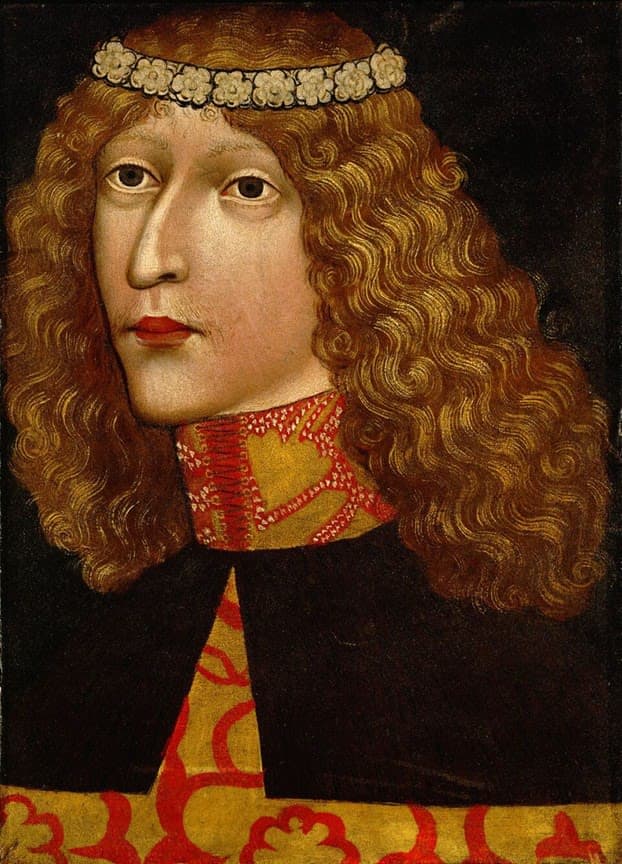
Matthias was born on February 23, 1443, in the Transylvanian city of Kolozsvár, now Cluj-Napoca in Romania.
He was the younger son of Elizabeth Szilágyi and the outstanding military commander John Hunyadi, who had earned enormous prestige throughout Europe by leading the struggle against the Ottoman Turks advancing into the Balkans.
Because of his father's constant military campaigns, the boy's education was primarily supervised by his mother.
However, the Hunyadi court was frequently visited by leading intellectuals from Central Europe. Under the influence of such mentors as Gregory of Sanok, a former tutor to the Polish king, and the thinker John Vitéz, Matthias absorbed the humanist ideals of the Renaissance from an early age.

Even as a child, he demonstrated exceptional abilities.
He read classical literature, developed a fascination with military treatises, and became a genuine polyglot.
The court historian Antonio Bonfini exaggerated when he claimed that the young man "knew all the languages of Europe."
Nevertheless, Matthias was indeed fluent in Hungarian, Latin, Italian, Polish, Czech, and German.
According to the Polish scholar Krzysztof Warszewicki, he also understood the Romanian spoken by envoys of the Moldavian ruler.
From an early age, the boy's fate became a bargaining chip in the great political struggles of his time.
Under an agreement concluded in 1451 between his father and the Serbian despot Đurađ Branković, Matthias was betrothed on August 7 to the despot's granddaughter Elizabeth (Erzsébet), daughter of the Slovenian count Ulrich of Celje.
Ulrich was a supporter of King Ladislaus V of Hungary, known as Ladislaus the Posthumous, and a political opponent of John Hunyadi.
Because of their rivalry, the marriage did not take place until 1455.
In practice, it amounted to a concealed exchange of hostages.
Elizabeth moved to the Hunyadi estates, where she died before the end of that same year, while Matthias was sent to the royal court.

In 1456, John Hunyadi achieved a historic victory at Belgrade, temporarily halting the Ottoman advance.
However, on August 11, less than three weeks after his triumph, he died of the plague that had broken out in the military camp.
The leadership of the powerful Hunyadi clan passed to Matthias's elder brother, Ladislaus.
The conflict between him and Ulrich of Celje reached its climax with the latter's murder on November 9, 1456.
Although the young King Ladislaus V, under pressure, promised not to seek revenge against the Hunyadi family, the assassination turned several influential barons against them.
Among these were Palatine Ladislaus II Garai, Judge Royal Ladislaus Pálóci, and Nicholas Újlaki, Voivode of Transylvania.
With their support, the king treacherously imprisoned the two brothers in Buda on March 14, 1457.
The royal council sentenced them to death for high treason.
On March 16, Ladislaus Hunyadi was beheaded, while the fourteen-year-old Matthias remained in captivity.

Matthias's mother and her brother Michael Szilágyi immediately launched a rebellion, seizing extensive territories east of the Tisza River.
Seeking to escape the civil war, King Ladislaus V fled to Vienna in mid-1457 and then to Prague in September, taking the captive Matthias with him.
Fighting between the barons and the rebels continued until the sudden death of the childless king on November 23, 1457.
Afterward, the noble prisoner passed into the custody of the Hussite ruler of Bohemia, George of Poděbrady.

With the death of Ladislaus V, Hungary found itself on the brink of another, potentially even more destructive civil war.
The late king's sister Anna and her husband, William III, Landgrave of Thuringia, claimed his inheritance, but the estates of the kingdom refused to support them.
In January 1458, a Diet was convened in Pest.
The papal legate, Cardinal Juan Carvajal, remembering John Hunyadi's achievements, launched an open campaign in favor of electing his son.
The election of Matthias became the only realistic opportunity to avoid a prolonged war.
Palatine Ladislaus Garai was the first to make concessions, reaching an agreement with the Szilágyi family.
Under its terms, Matthias would marry the palatine's daughter Anna, the former fiancée of the executed Ladislaus Hunyadi, while the Hunyadi family would renounce its blood feud.
The outcome of the election was decided by Michael Szilágyi, who arrived in Buda with an army of fifteen thousand men.
On January 24, 1458, the intimidated barons and the enthusiastic lesser nobility gathered directly on the frozen surface of the Danube and unanimously proclaimed the fourteen-year-old Matthias king.
His uncle Michael was appointed regent.
This was an unprecedented event: a member of the native Hungarian nobility, rather than one of Europe's ruling dynasties, had ascended the Hungarian throne.
The newly proclaimed monarch himself was still in Prague.
Szilágyi dispatched John Vitéz to negotiate with George of Poděbrady.
The Bohemian leader agreed to release the young man in exchange for an enormous ransom of 60,000 gold florins, paid by Matthias's mother, and a promise that Matthias would marry his daughter Catherine (Kunigunda).
On February 9, Matthias was handed over to the Hungarian delegation.
Five days later, he entered Buda in triumph.
He took his seat upon the throne in the Church of Our Lady, but he was not crowned.
The Holy Crown of Saint Stephen had been held for years by Holy Roman Emperor Frederick III of Habsburg.

From his very first days, the young king demonstrated an iron will and began governing independently.
A concealed struggle for power erupted at court.
The faction of the ambitious regent Michael Szilágyi was opposed by the humanist John Vitéz.
Vitéz emerged victorious and became the new chancellor.
Matthias deprived Szilágyi of his authority and sent him on a campaign against the Turks, from which he never returned.
The powerful Garai family was also removed from government.
The enraged barons — Ladislaus Garai, Nicholas Újlaki, and Ladislaus Kanizsai — offered the crown to Emperor Frederick III at Németújvár on February 17, 1459.
Frederick subsequently invaded western Hungary.

At the same time, a rebellion broke out in the north under John Jiskra of Brandýs, commander of the Bohemian Hussite mercenaries.
For several years, Matthias conducted an exhausting combination of diplomatic negotiations and military operations.
Only in April 1462 was peace finally reached with Frederick III.
In exchange for 80,000 gold florins, the emperor agreed to return the Holy Crown.
However, he also declared Matthias his adopted son and retained the Habsburgs' right of succession should the monarch die without a direct heir.
John Jiskra likewise laid down his arms.
In exchange for extensive estates, 25,000 florins, and a seat on the royal council, he surrendered his fortresses in Upper Hungary, corresponding to modern-day Slovakia.

The consolidation of Matthias's authority culminated in his coronation.
His first wife, Catherine of Poděbrady, whom he had married in 1461, died in childbirth in early 1464.
Despite his mourning, on March 29, 1464, Archbishop Dionysius Szécsi solemnly placed the recovered Holy Crown upon Matthias's head in Székesfehérvár, definitively establishing the legitimacy of his rule.
Having secured the throne, Matthias, with the support of John Vitéz, embarked upon an extensive program of reforms.
His objectives were to weaken the old aristocracy, create a state administration staffed by loyal members of the lesser nobility and the urban population, and centralize the kingdom's finances.
The king merged the highest judicial institutions into a single supreme court and appointed Albert Hangácsi as its head, significantly restricting the arbitrary authority exercised by regional barons.
In 1467, a radical tax reform was implemented.
The profits of the royal chamber began to be collected regularly into the royal treasury, while the traditional "thirtieth" was transformed into customs duties.
Old feudal exemptions were abolished.
The king placed a merchant and Jewish convert to Christianity, John Ernuszt, in charge of the treasury, entrusting him with collecting all ordinary and extraordinary taxes.
During Matthias's thirty-three-year reign, an "extraordinary tax" was imposed more than forty times.
The crown's annual revenues quadrupled, reaching an unprecedented 500,000 florins for the region and occasionally as much as one million.

The heavy taxation provoked an uprising by the "Union of the Three Nations" in Transylvania in August 1467.
Matthias acted with lightning speed.
The rebels surrendered, and their leaders were brutally executed, either by beheading or impalement.
Suspecting the Moldavian ruler Stephen III the Great of supporting the rebellion, Matthias invaded Moldavia.
However, on December 15, he suffered a serious defeat at the Battle of Baia, where he was wounded and forced to retreat.
Nevertheless, the increased royal revenues enabled the king to carry out a military revolution.
Feudal levies were replaced by a permanent national mercenary force — the famous Black Army.
It was one of the most advanced armies in Europe, with every fourth infantryman equipped with a matchlock arquebus.
With this force at his disposal, the king began imposing his terms upon neighboring rulers.

The Ottoman threat constantly loomed over Hungary.
In 1463–1464, Matthias fought in Bosnia, capturing Jajce and Srebrenica and establishing defensive banates that served as buffer zones.
In Wallachia, he intervened in the conflict between Vlad III the Impaler and his brother Radu the Handsome, arresting Vlad on charges of conspiring with the Turks.
However, Matthias understood that Hungary could not stop the Ottomans alone.
He needed a united Danubian monarchy encompassing Hungary, Bohemia, and Austria.
This ambition led to prolonged wars in the West, provoking the anger of part of the Hungarian nobility.
The humanists John Vitéz and Janus Pannonius, believing that the king had abandoned the Ottoman threat in pursuit of personal glory, organized a conspiracy in 1471.
They offered the Hungarian throne to the Polish prince Casimir Jagiellon.
Matthias suppressed the rebellion through political maneuvering.
Casimir fled, Pannonius died while on the run, and Vitéz was placed under arrest until his death.

The wars in Bohemia began in 1468.
Matthias turned against his former father-in-law, the "heretic king" George of Poděbrady, securing the support of the Bohemian Catholics, the pope, and Emperor Frederick III.
The fighting continued with mixed results.
The king himself was wounded and, on one occasion, even captured, managing to escape through deception by disguising himself as a Bohemian stableman.
On May 3, 1469, Matthias was proclaimed King of Bohemia in Olomouc.
Following George's death in 1471, the Bohemian Diet elected Władysław II Jagiellon as king.
Years of prolonged and bloody fighting over Silesia and Moravia finally ended with the Peace of Olomouc in 1478.
Both monarchs retained the title of King of Bohemia.
However, Władysław ruled Bohemia proper, while Matthias secured Moravia, Silesia, and Lusatia for himself.

On the Ottoman front, a fragile balance of power persisted.
Individual invasions were decisively repelled.
In 1479, at the Battle of Breadfield, the commanders Paul Kinizsi and Stephen Báthory inflicted a crushing defeat upon the Ottomans and the forces of the Wallachian ruler Basarab Țepeluș.
In 1476, with Hungarian assistance, Vlad the Impaler was briefly restored to the Wallachian throne, although he was killed in battle soon afterward.
The principal adversary of Matthias's final years was Emperor Frederick III, who had failed to pay the agreed compensation and continued intriguing against Hungary.
In 1477, Matthias besieged Vienna for the first time, forcing Frederick to recognize him as King of Bohemia.
The conflict erupted in earnest in 1482.
The Black Army systematically captured Austrian towns, including Bruck an der Leitha and Korneuburg.
On June 1, 1485, following a five-month siege, Matthias triumphantly entered Vienna at the head of eight thousand veterans and transferred his royal residence to the city.
In 1487, he assumed the title of Duke of Austria.
At the same time, in 1485, Matthias carried out a major codification of laws known as the Decretum Maius, reorganizing the administration of justice and restricting the authority of regional courts.
The reign of Matthias marked the height of Hungary's cultural flourishing.
Hungary became the first country outside Italy to embrace the Renaissance style.
A major catalyst was the king's marriage in 1476 to the Neapolitan princess Beatrice of Aragon, who introduced the refinement of Italian court culture.
Buda became known as the "Pearl of the Danube."
The monarch reconstructed the palaces of Buda and Visegrád, inviting outstanding Italian masters, including the sculptor Benedetto da Maiano and the engineer Aristotele Fioravanti.
A copy of the king's portrait by Andrea Mantegna has survived, while in 1485 Matthias commissioned a painting of the Madonna from Leonardo da Vinci himself.

A particular source of royal pride was the Bibliotheca Corviniana, the Corvinus Library.
Established around 1465 under the direction of the librarian Galeotto Marzio, it eventually contained as many as 2,500 illustrated codices, surpassed in scale only by the Vatican Library.
The king spent enormous sums commissioning Florentine manuscript illuminators and translators of ancient Greek texts.
Matthias Corvinus himself was exceptionally well educated.
He read Livy and Julius Caesar and engaged in philosophical debates with humanist scholars concerning Neoplatonism and theology.

Astrology also exercised considerable influence at the royal court.
Convinced that the destinies of nations were connected to the stars, Matthias appointed the astronomer Marcin Bylica as one of his advisers.
The great Regiomontanus established an observatory in Buda, equipped with globes and astrolabes.
In 1465, at the king's initiative, the Academia Istropolitana was founded in Pressburg (Bratislava), becoming the first university in present-day Slovakia.
The royal court was renowned for its magnificent musical culture, bringing together some of Europe's finest composers.
The growth of national consciousness was also encouraged.
In 1488, John Thuróczy's Chronica Hungarorum was published, portraying the Hungarians as descendants of the Huns and proclaiming the king a "second Attila."
By the late 1480s, the brilliant monarch had become increasingly suspicious and severe, showing no hesitation in executing or imprisoning even his former associates.
One such victim was Archbishop Peter Váradi, who was imprisoned in 1484.
The problem of royal succession also became increasingly urgent.
His marriage to Beatrice had produced no sons.
His only male heir was his illegitimate son John Corvinus, born in 1473 to his mistress Barbara.
Determined to secure the throne for his son, Matthias granted him enormous estates and the Silesian Duchy of Troppau, overcoming fierce resistance from Queen Beatrice.
During his final years, the king suffered from severe gout and eventually lost the ability to walk.
Beginning in the spring of 1489, he had to be carried in a palanquin.
He desperately negotiated with the Habsburgs, offering to return Austria in exchange for their recognition of John as King of Croatia and Bosnia.
In 1490, during the Palm Sunday celebrations in conquered Vienna, the monarch suddenly became ill after eating figs.
Following two days of severe agony, the great king died on the morning of April 6, 1490, at the age of forty-seven.
Officially, his death was attributed to a stroke, although rumors of poisoning circulated.
His funeral rites were solemnly performed in St. Stephen's Cathedral in Vienna, and he was buried with honors in Székesfehérvár.

The plan to transfer power to his son collapsed almost immediately.
The centralized state that Corvinus had created through his iron determination soon began to disintegrate under the weight of internal conflicts and mounting Ottoman pressure.
Nevertheless, Matthias I Hunyadi entered history as the last independent sovereign of a great Hungary.
In popular memory, he remained forever the "Just King."
For centuries, Hungarian peasants repeated a bitter proverb:
"Matthias is dead, and with him, justice has died."