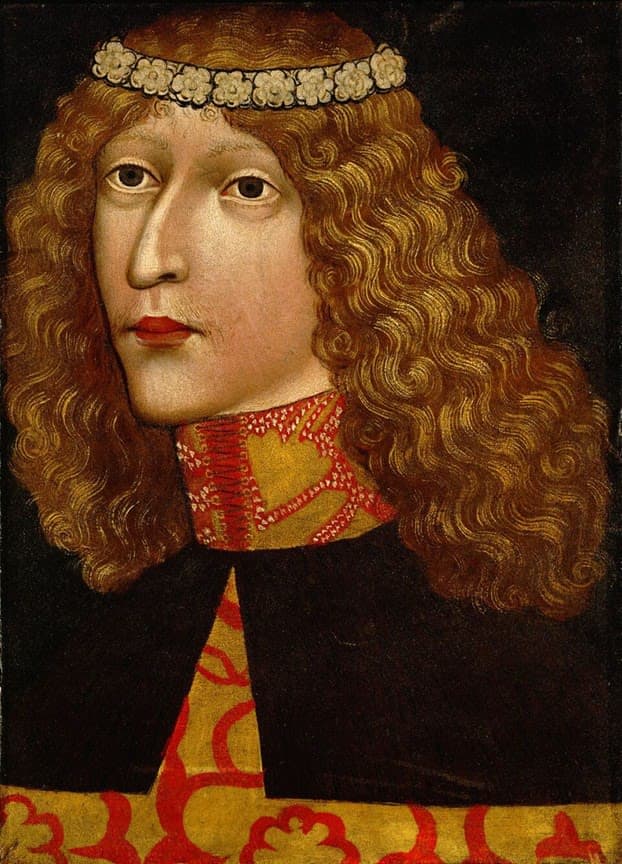
The story of Louis II is the tragedy of a young monarch whose fate, from the very moment of his birth, became hostage to the great political struggles of Europe.
This dynastic drama began on July 23, 1503, when Queen Anne of Foix gave her husband, King Vladislaus II Jagiellon of Hungary and Bohemia, their long-awaited first child — Princess Anne.
The birth of a daughter opened new diplomatic opportunities for the king, allowing him to address one of his most important foreign-policy challenges: improving his fragile relations with Holy Roman Emperor Maximilian I of Habsburg.
The emperor, renowned for his mastery of matrimonial diplomacy, immediately proposed that Vladislaus marry the newborn Anne to one of his grandsons.
Vladislaus readily accepted the proposal for a dynastic union.
The proud Hungarian nobility firmly opposed the very idea that the Crown of Saint Stephen might one day pass to a foreigner from the House of Habsburg.
Nevertheless, ignoring the barons' dissatisfaction, the king began both secret and open negotiations.

The Habsburgs were thinking far ahead.
As early as March 20, 1506, anticipating the possibility that Vladislaus might have a male heir, Maximilian I formally promised to marry his granddaughter Mary of Austria to the future prince.
And this calculation proved correct.
On July 1, 1506, Anne of Foix gave birth to her second child — a son named Louis (Lajos).
King Vladislaus had finally received his long-awaited heir.
The boy was born extremely weak, and his life hung by a thread. However, thanks to the efforts of his physicians, the infant survived.

The culmination of this political alliance came with a magnificent celebration held on July 22, 1515, beneath the vaulted ceilings of St. Stephen's Cathedral in Vienna.
An unprecedented double wedding ceremony took place there, although the arrangements remained conditional at the time.
The young Louis and his sister Anne were betrothed to Princess Mary of Austria and Prince Ferdinand, respectively. Ferdinand would later become Holy Roman Emperor, although his brother Charles had also been considered as a possible bridegroom.
These marriages permanently intertwined the destinies of the Jagiellonian and Habsburg dynasties.
Louis ascended the throne far too early.
By the time his father Vladislaus died, the boy was only ten years old.
Guardianship over the young monarch was assumed by his influential uncle, King Sigismund I of Poland.
The years of regency unfolded amid constant political intrigue until January 1522, when Louis was officially declared of age.
That same month, his solemn coronation took place in Székesfehérvár.
The young monarch inherited not only Hungary but also the Crown of Bohemia, which his father Vladislaus had obtained back in 1471.

However, like his father, Louis preferred to reside in the Hungarian capital of Buda, rarely honoring Prague with his presence.
Meanwhile, genuine chaos dominated the Bohemian political scene.
In the monarch's absence, a ruthless struggle for power erupted between powerful aristocratic clans.
At the summit of this political hierarchy, two figures confronted one another: Zdeněk Lev of Rožmitál, Supreme Burgrave of the Kingdom of Bohemia, who had effectively usurped the role of royal governor, and his sworn rival, Vilém II of Pernštejn, the former Supreme Hofmeister.

By 1520, their conflict had intensified to such an extent that Bohemia stood on the brink of full-scale civil war.
The king arrived in the troubled country only two years later, in 1522.
Realizing that the state was slipping from his grasp, the young Louis made a determined attempt to restore royal authority.
He sternly demanded that the nobility return the royal lands and castles they had illegally seized.
The monarch demonstratively refused to receive delegations of corrupt officials, including Zdeněk Lev of Rožmitál himself, who faced direct accusations of large-scale embezzlement from the royal treasury.
Louis appointed new, loyal officials to key positions.
During his absence, he established a government headed by Prince Charles of Münsterberg, grandson of the famous Bohemian king George of Poděbrady.
But the triumph of law and order proved short-lived.
As soon as Louis left Bohemia, the country immediately plunged back into the depths of internal conflict and arbitrary rule by the magnates.
The situation in Hungary itself was no better.
Even two years after the brutal suppression of the peasant uprising led by György Dózsa in 1514, the kingdom remained in a state of profound anarchy.
Royal authority was visibly melting away.
A powerful noble opposition formed against the young monarch, with Archbishop Tamás Bakócz of Esztergom and George, Margrave of Brandenburg-Ansbach, emerging as its informal leaders.

The nationalist-minded Hungarian nobility, deeply hostile to foreigners, went so far as to remove the legitimate governing institutions and establish a regency council of its own.
This council consisted of sixteen lesser nobles, six prelates, and six powerful barons.
The cumbersome government concerned itself almost exclusively with the redistribution of wealth, while ignoring the external threats gathering around the kingdom.
And the threat was deadly.
From the Balkans, a gigantic Ottoman army under Sultan Suleiman the Magnificent was relentlessly advancing toward Central Europe.
Louis sincerely attempted to organize the kingdom's defenses.
He received enormous support from his young wife, Mary of Austria — an intelligent woman with exceptional political abilities.
Yet even their combined efforts proved insufficient to overcome the selfishness of the barons.

The catastrophic pressure on Hungary's borders increased dramatically after 1521, when Suleiman the Magnificent captured the strategically vital fortress of Belgrade, effectively throwing open the gates to the very heart of Hungary.
Recognizing the scale of the crisis, the Hungarian Parliament finally approved the collection of an extraordinary tax in 1521 to finance the recruitment of a professional mercenary army.
But even this measure ended in disaster.
The lion's share of the collected funds was simply stolen by the nobility.
Deprived of an army of its own, Hungary could do little but hope for a miracle and assistance from foreign powers.
In early 1526, chilling rumors reached Buda: an enormous Ottoman army had departed from its winter quarters and was advancing northward.
Realizing that his kingdom was facing destruction, Louis began dispatching desperate letters pleading for assistance to the rulers of Europe.
He appealed to the pope, the Doge of Venice, King Henry VIII of England, his uncle King Sigismund I of Poland, and his relative Archduke Ferdinand of Austria.
Europe's response was tragically indifferent.
Any assistance that arrived came only in small quantities.
The papal curia did indeed send money to finance the recruitment of troops.
However, even at this critical moment, the Vatican imposed a cynical condition: part of the funds had to be spent not on defending Hungary against the Turks, but on combating the growing influence of Lutheranism within the kingdom itself.
Hungary was left alone to confront the seemingly invincible military machine of the Ottoman Empire.
Louis never succeeded in assembling an army capable of resisting the sultan.
Moreover, many Hungarian noblemen, blinded by their internal disputes, simply ignored the royal call to arms.
Only small auxiliary contingents arrived from Bohemia and Moravia.
The troops from Austria, which Archduke Ferdinand had firmly promised to provide, were hopelessly delayed.
The young king possessed neither sufficient military strength nor a clear strategic plan for confronting the well-trained Ottoman army, whose forces outnumbered the Hungarians by at least two to one.
On August 29, 1526, one of the darkest tragedies in European history unfolded on the fields of Mohács.
The battle turned into a merciless and rapid defeat.
The flower of Hungarian knighthood was swept away by Ottoman artillery and Janissaries.
Fleeing the battlefield after the disastrous defeat, the twenty-year-old King Louis II did not die from an enemy's blade.
Clad in heavy armor, he drowned while attempting to cross the swollen Danube.
His remains were discovered in the mud only two months later.
On November 10, 1526, the body of the last Jagiellonian monarch to occupy the Hungarian throne was solemnly buried in the basilica of Székesfehérvár, whose remains are now known as the Ruin Garden.


The death of Louis II in the waters of the Danube marked the end of an entire era and the beginning of a new, bloody struggle for the division of Europe.
Under the dynastic agreements of 1515, the Bohemian throne passed peacefully to Archduke Ferdinand I of Habsburg, husband of Anne, the deceased king's elder sister.
In Hungary, however, events took a catastrophic turn.
The proud Hungarian nobility categorically refused to recognize Habsburg rule.
In opposition to Ferdinand, they nominated one of their own countrymen for the throne — the powerful magnate John Zápolya.
This division led to a prolonged and devastating civil war.
As a result, Hungary, once one of the greatest powers of Central Europe, was torn apart and remained under the domination of the Ottoman Empire for a century and a half.