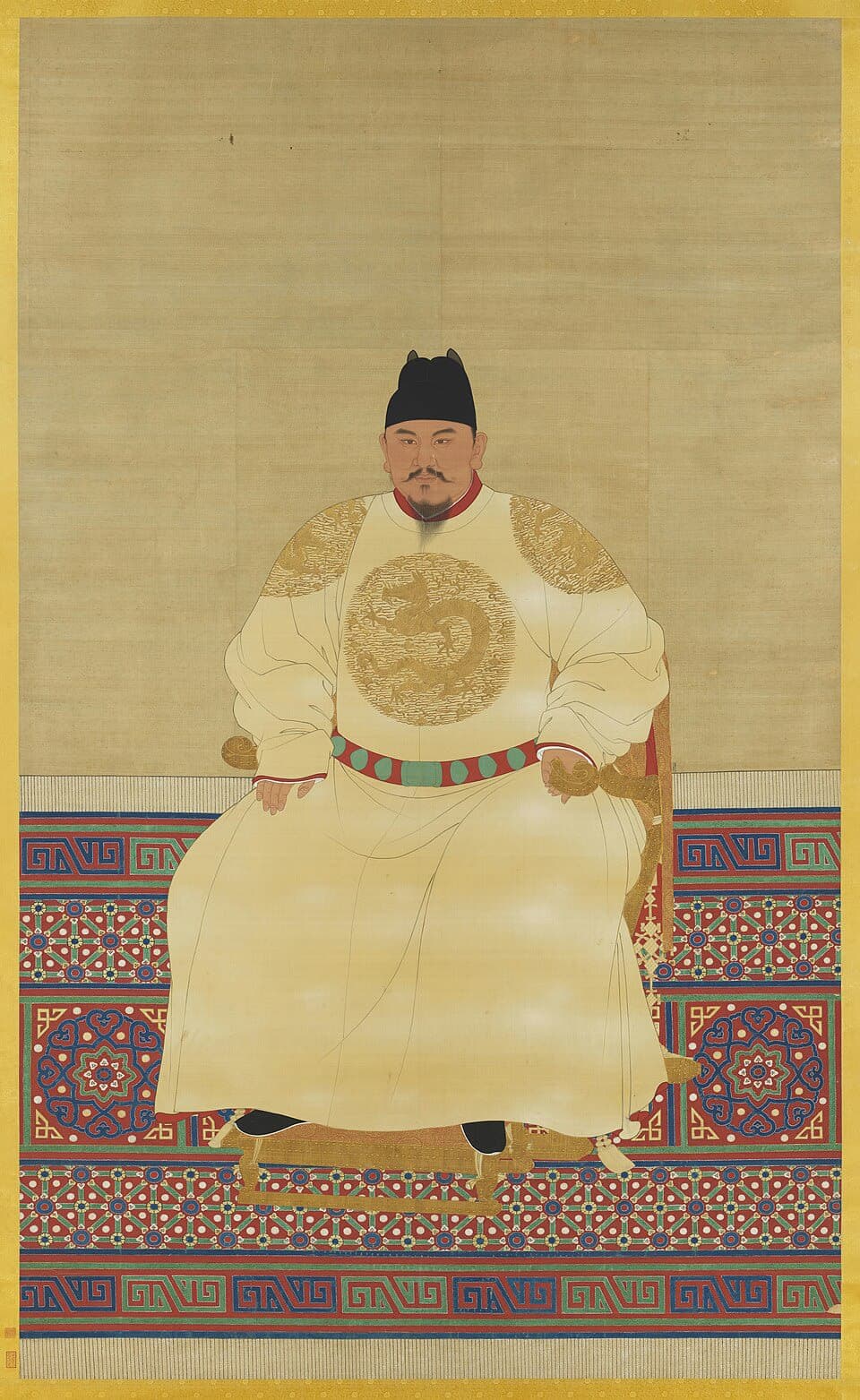
Zhu Yuanzhang (1328–1398) was born into a poor peasant family. His family fled heavy taxation to what is now Anhui Province. In 1344, during an epidemic, Zhu lost his parents and brothers. To avoid starvation he entered a Buddhist monastery, where he received an elementary education; after it closed, he survived by begging. This experience later gave him a deep understanding of the common people’s lives. He joined an outlaw band and, thanks to his leadership qualities, quickly became its chief.


In 1351, amid widespread discontent with the alien Mongol rule, the Red Turban Rebellion broke out. Zhu Yuanzhang joined it and swiftly won the favor of one of its leaders, Guo Zixing, who gave him his adopted daughter Ma (the future empress) in marriage.
After Guo Zixing’s death, Zhu Yuanzhang took command of his forces. On April 10, 1356, his troops captured Nanjing, which he made his base. In the 1360s he invited Confucian scholars into his service; they helped him shape ideas for a civilized state order. In 1363 he won a decisive victory over his chief rival Chen Youliang in the Battle of Lake Poyang, one of the largest naval engagements in history.
After the death of the rebellion’s nominal leader, Han Lin’er, Zhu Yuanzhang assumed full power. In 1368, at Chinese New Year, he proclaimed himself emperor of the new Ming dynasty and made Nanjing his capital. His armies seized the Mongol capital Dadu (present-day Beijing), restoring Chinese rule to the realm.

As the Hongwu Emperor (Zhu Yuanzhang’s reign title), he immediately embarked on radical reforms. He began by restoring the economy, allowing peasants to own the land they tilled and exempting from taxes those who opened up new fields. He also abolished slavery and serfdom for commoners to increase the number of laborers and taxpayers. In 1380, suspecting his first minister Hu Weiyong of conspiracy, he had him executed and abolished the post of chancellor, concentrating all power in his own hands. To combat dissent and corruption, he established the secret police known as the Jinyiwei (“Embroidered-Uniform Guard”), which, by some estimates, caused the deaths of up to 100,000 people.

Hongwu reorganized the army along the weisuo (guard garrison) system, modeled on the Tang imperial military, seeking to make it self-sufficient through land allotments to soldiers; in the end, this system failed. His distrust of officials led to frequent purges; in 1377 he even suspended the Confucian civil service examinations, only to restore them seven years later.
Hongwu imposed a stringent demographic and social policy. He sought to immobilize the population by restricting travel beyond 12 km (about 7.5 miles) and fixing social status by heredity: a soldier’s son had to become a soldier, a craftsman’s son a craftsman, and so on. He also enforced strict regulation of dress, speech, and writing. He tried to weaken the influence of merchants and wealthy landowners by imposing high taxes and forcibly resettling thousands of families to the environs of Nanjing. However, his measures had the opposite effect, encouraging the growth of itinerant traders and hired laborers and strengthening great landowners—results he had not intended.
In foreign policy, the Ming Empire’s chief objective was to prevent a renewed Mongol conquest. The emperor waged continual fighting with the Mongols of the Northern Yuan, successfully repelling their raids.


In 1381 he conquered vast territories in the southwest that had formerly belonged to the Kingdom of Dali and began large-scale resettlement of Han Chinese into these regions. Overall, his rule was marked by a tendency toward isolation; foreign trade was largely reduced to exchanges of gifts with envoys from other states.
Zhu Yuanzhang, who had 26 sons and 16 daughters, died in 1398. According to his will, he was buried without special ostentation, and 38 of his concubines followed him into the grave. Though harsh and despotic, his reign laid a solid foundation for the subsequent prosperity of the Ming dynasty.


