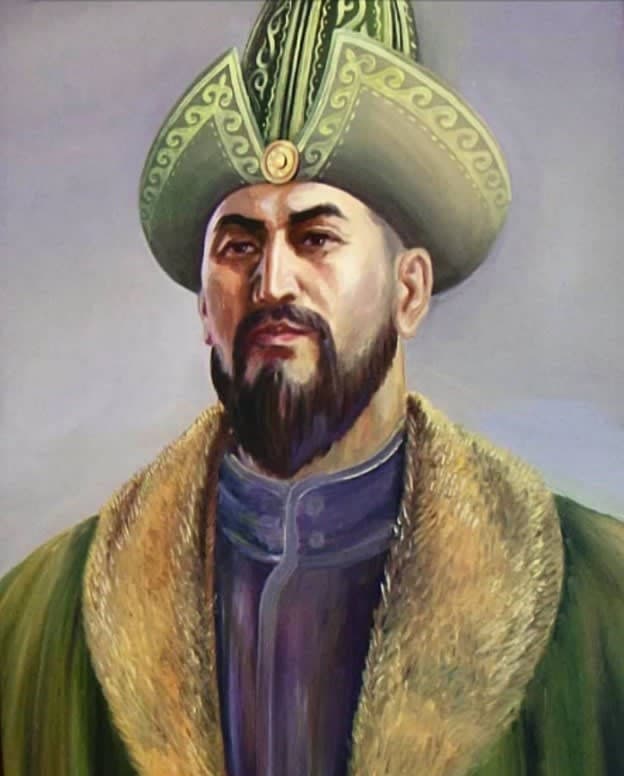

Yesim Khan was the son of Shygai Khan and Yahshim-Bigim Khanym. He ascended to the throne of the Kazakh Khanate at a critical moment during a campaign against Bukhara, following the death of his brother Taukeel Khan. For his bravery in repelling external aggression, he earned the popular nickname “Yesim the Brave Giant.” His reign marked the third golden age of the Kazakh Khanate, following those of Kasym Khan and Khaknazar Khan.
Yesim Khan moved the capital from Sighnaq to Turkestan. He concluded peace with the Bukhara Khanate, under which the Kazakh Khanate gained not only Samarkand but also all the cities of the Fergana Valley, including Tashkent, Andijan, and Kokand. One of his primary goals was to turn the Kazakh Khanate into a centralized state, and he devoted particular attention to strengthening its military power.

Yesim Khan actively intervened in the political affairs of neighboring Moghulistan. In 1618, he became a mulazim (vassal) of the Moghul ruler Abd ar-Rahim Khan and even married his daughter.
Relations with the Kalmyks (Oirats) were tense. In the early 17th century, the Oirats raided Kazakh lands. Their first campaign to Khwarezm in 1603–1604 ended in failure. The Kalmyks often suffered defeats at the hands of the Kazakhs and Nogais, forcing them to seek protection from the Russian state. Yesim Khan, who controlled the border regions near the Kalmyks, waged continuous wars against them. This set him apart from another Kazakh ruler, Tursun Khan, who ruled from Tashkent and was located farther from the main Kalmyk nomadic areas.
Conflicts with the Ashtarkhanids, rulers of Bukhara, also continued. In 1607, Yesim Khan recaptured Tashkent from them, and in 1611, together with his nephews and son, supported Imam Quli Khan in his struggle for power. For this assistance, Imam Quli Khan recognized Yesim’s rights to Tashkent and part of the cities of Turkestan. Nevertheless, the Bukharan attempts to reclaim the city persisted but were repelled each time.
Within the Kazakh Khanate itself, a conflict was brewing between Yesim Khan and his rival, Tursun Khan, who ruled from Tashkent and sought sole power. In 1627, while Yesim Khan was waging war against the Dzungars, Tursun Khan seized the capital, Turkestan, and captured Yesim’s family. Upon learning of this betrayal, Yesim Khan gathered an army and defeated Tursun Khan in the Battle of Sayram. Tursun Khan was killed by his own men and handed over to Yesim Khan.
This conflict, known as the “Katagan Massacre,” had brutal consequences. Yesim Khan ordered the extermination of the entire Katagan clan that supported Tursun Khan. All men taller than the height of a cart were executed, while women, the elderly, and children remained within the Kazakh people under the new tribal name “Shanyshkyly.”
Yesim Khan entered history as a great reformer. He succeeded in suppressing internal strife and strengthening national unity. His greatest achievement was the fundamental transformation of the political system of the Kazakh Khanate. He curtailed the power of the hereditary aristocracy (tore) and transferred authority to biys (judges) and clan elders. This was a kind of “biy revolution” that granted greater rights to local communities and their leaders.
These changes were codified in a new legal act known as “The Ancient Path of Yesim Khan,” which became an addition to Kasym Khan’s code. The document clearly defined the powers of the khan, biys, and batyrs (warriors). The supreme legislative body remained the Maslikhat (council), composed of representatives of all Kazakh clans.


In the early 17th century, the juz system was introduced, dividing all Kazakh lands into three large economic and territorial associations the Junior, Middle, and Senior juzes. The heads of the juzes (biys) held significant power, which was based on their personal authority.
Like his brother Taukeel, Yesim Khan was a deeply religious man. He supported Islamic scholars and Muslim education, and his laws were based on the local Hanafi legal tradition.
After Yesim Khan’s death in 1628, his son Janibek succeeded him as khan.


