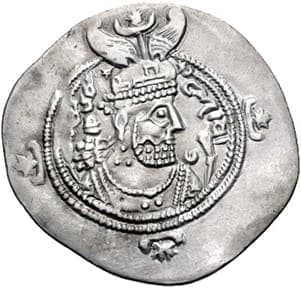
After a period of unrest and usurpations in the Sasanian Empire, the youthful Yazdegerd III ascended the tottering throne in late 632 or early 633. He was the grandson of Khosrow II Parviz and Shirin, and his father was the prince Shahryar. The coronation took place in the dynastic temple at Stakhr, since the capital, Ctesiphon, had been seized by his opponents.


According to legend, his grandfather Khosrow II received a prophecy that the kingdom would fall in the time of his grandson who had a physical defect. Seeing that little Yazdegerd had a defect on his thigh, Khosrow ordered him killed, but Shirin saved the boy. He was secretly sent to Stakhr, where he lived through the turbulent years of civil strife and in the end turned out to be the only legitimate contender for the throne.
At the beginning of Yazdegerd III’s reign the empire was divided and weakened. The de facto ruler was the spahbed of Khorasan, Rustam, and the troops were split into three parts. At that very time the Arab conquests began.

At the beginning of Yazdegerd III’s reign the Muslims, under the leadership of talented caliphs, invaded the domains of the Sasanians. The Persian forces, consisting of local levies, were defeated. In May–June 633 the Arabs seized Hira, and then other strategically important cities. Despite isolated Persian successes, such as in the Battle of the Bridge in 634, the overall situation of the empire was catastrophic.
The most terrible blow to the Sasanian state was the Battle of al-Qadisiyyah in December 636. The Persians gathered a huge army, but in the course of a fierce four-day battle were routed. Their best commanders were killed, including Rustam, the main support of Yazdegerd III. This battle was a double tragedy for Iran, depriving it of both its army and its commanders.
After al-Qadisiyyah the Arabs continued their advance. In March 637, having crossed the flooded Tigris River, they captured the capital of the empire, Ctesiphon. Shah Yazdegerd III fled, leaving countless treasures in the hands of the Arabs.
The next military catastrophe was the Battle of Jalula. The Persians gathered the remnants of their army, but were once again defeated. Yazdegerd III, having no army, was forced to flee, moving from city to city.
The last attempt to stop the Arabs was undertaken at the Battle of Nahavand in 642. The last forces of the empire gathered there, but the Persians were again routed. This defeat marked the end of organized resistance.
After Nahavand Yazdegerd III lost any real power. He turned into an exile wandering through the provinces, which one after another recognized the authority of the Arabs. He moved from one local ruler to another, demanding money and troops, but his arrogance and detachment from reality alienated his last supporters.
His wanderings led him to the edge of the empire, to the city of Merv. The local marzban Mahuye organized a lavish reception for him, but, according to legend, his true aim was to seize the shah’s treasures. Yazdegerd III insulted a Turkic prince who had offered him help, and the latter entered into a conspiracy with Mahuye.
The tragic and inglorious death of Yazdegerd III came in 651. The Turks attacked his small retinue. The shah, seeking to save himself, took refuge in a mill, but the miller, tempted by his jewelry, stabbed him in his sleep. The funeral of the last Sasanian shah was organized by a Nestorian bishop, remembering his Christian grandmother Shirin.
The Sasanian Empire, one of the two greatest powers of that time, fell in just a few years, and all its territory became part of the Rightly Guided Caliphate.

The reign of Yazdegerd III lasted 20 years, 16 of which passed in endless battles and wanderings. His death became a symbol of the end of the great dynasty that had ruled Iran for more than four hundred years.


