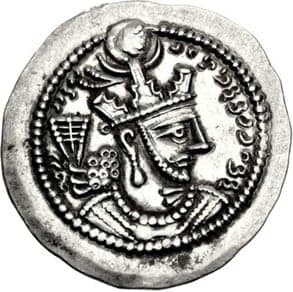

Yazdegerd II came to power in 440 and, unlike his father Bahram V, was a restrained man deeply devoted to Zoroastrianism. He did not take part in feasts and amusements, preferring to lead a more stoic way of life. It was precisely his fanatical adherence to Zoroastrianism and his desire to strengthen central authority that became the main features of his reign. For the first time on Sasanian coins the title “Kayanid” appeared, which emphasized his kinship with the mythical ancient Iranian kings.

His reign was marked by large-scale persecutions of Christians and Jews. Islamic sources describe him as a ruthless ruler, while Christian and Jewish traditions remember his years as a period of privations. Yazdegerd II considered adherents of other faiths unreliable. In 447–448, during a campaign to the “land of Chor,” he expelled all Christians from his army. After this, repressions began: he executed his sister and many dignitaries, and eighteen thousand people were castrated. He also abolished the ancient custom that allowed the nobility to lodge complaints against the king, which underscored his striving for absolute power.
The Armenian historian Yeghishe, a contemporary of those events, described him with hatred as “impious” and “rebellious,” who declared the Christians his enemies. Yazdegerd II indeed issued a decree on the universal adoption of Zoroastrianism and the worship of the sun, fire, and water, extending it to all his dominions. At the same time, according to Jewish sources, he persecuted the Jews, forbidding them openly to celebrate the Sabbath, closing schools, and executing leaders. These measures were part of his program to create a single religious identity which, as he believed, would help the centralization of the state.
Yazdegerd II’s reign was filled with military conflicts. He began a war with Byzantium in 441, since the Byzantine emperor Theodosius II refused to pay the tribute which, Yazdegerd asserted, his father had previously received. The Sasanian troops, commanded by Mihr-Narseh, ravaged Roman possessions near Nisibis, and then concluded peace on terms favorable to Persia, receiving “gold and gifts.” However, the shah’s subsequent demands for payments invariably met with refusal.
The most significant military and political undertaking of his reign was the attempt to impose Zoroastrianism on Armenia. He imposed taxes on Armenian churches and sent their best troops to the eastern borders. Then, in a letter to the Armenian nobility (nakharars), he openly declared his goal: “When you profess our religion, the Iberians and the Albanians will not dare to oppose our will.”
However, the Armenian nobility refused him. After the Armenians slaughtered the mobeds (Zoroastrian priests) who had been sent, an open uprising broke out. On May 26, 451, near the village of Avarayr, a bloody battle took place. Although the Armenians, led by Vardan Mamikonian, were defeated, their resistance proved so fierce that Yazdegerd II was unable fully to subjugate Armenia and eradicate Christianity.


In parallel with this, Yazdegerd II waged constant wars in the northeast with the nomadic tribes of the Kidarites and the Hephthalites. In 443–451 he moved his residence to Khorasan for seven years in order to be closer to the theater of military operations. In 456 he undertook a decisive campaign, but despite successes he was never able completely to subdue the enemy.
Yazdegerd II also paid enormous attention to strengthening the Caucasian frontier. He successfully repelled a Hunnic invasion in 441 and undertook large-scale construction works in the region of Derbent, where, according to the sources, he erected walls and fortifications to protect against the northern peoples. This is confirmed by archaeological data.
Yazdegerd II died in 458 in the province of Pars, leaving behind a country torn by religious conflicts and war. His reign lasted about 17 years and 4 months. After his death his widow Denak became regent. Yazdegerd II left a complex mark in history, for on the one hand he was a strong and single-minded ruler who tried to centralize the empire, and on the other a fanatical persecutor of those of other faiths, whose cruelty led to major uprisings and the weakening of the state.


