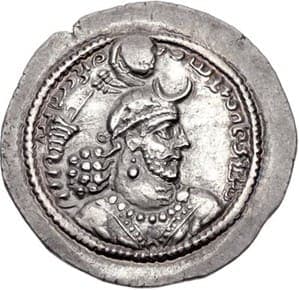

Yazdegerd I, whose name translates as “Made by God,” became shahanshah of Persia in 399, after the murder of his predecessor, Bahram IV. Historians disagree about his parentage: some consider him the son of Shapur II, others of Shapur III, although this is probably simply a confusion with later rulers.
From the very beginning of his reign Yazdegerd I entered into a fierce struggle with the Persian nobility. By the 5th century large landowners and the Zoroastrian priesthood had accumulated enormous power, which led to the growth of separatist sentiments. Seeking to strengthen central authority, Yazdegerd I introduced severe punishments for aristocrats who dared not to submit to his will. Muslim authors, retelling Persian traditions, describe him as a ruthless tyrant who “shed more and more blood” and “destroyed the great houses.” For his policy he even received the nickname Bazagar (“Sinner” or “Apostate”).
However, Christian sources, on the contrary, speak of him much more positively. This divergence of assessments suggests that the image of a “tyrant” was created by his opponents among the aristocracy, whose power he sought to limit. Nevertheless, Yazdegerd I did not annihilate the nobility completely; he merely repressed the unreliable and promoted to high posts those loyal to him. One of his closest associates was Mihr-Narseh, a representative of a noble family who, according to the sources, tried to soften the shahanshah’s cruelty.
In his struggle with the nobility Yazdegerd I found an unexpected ally in the Christian minority. Unlike his predecessor Shapur II, who harshly persecuted Christians, Yazdegerd I was tolerant toward them. In 409 he officially allowed them to openly profess their faith, to restore ruined churches, and to bury their dead in the ground, which was a violation of Zoroastrian traditions.
The shahanshah strove to unite the Iranian and Byzantine churches. In 410 a church council was convened in Seleucia, headed by Bishop Marufa, who had arrived from Byzantium. The council adopted the Nicene Creed and reorganized the church hierarchy, establishing the office of “Catholicos” with its seat in Ctesiphon. Iranian Christians were granted the right to move freely about the country and to conduct their worship. In gratitude for his mercy, they proclaimed: “We all unanimously beseech our Merciful God that He may prolong the days of the victorious and famous king Yazdegerd.”


Yazdegerd I trusted Christian leaders, entrusting them with important missions. Thus, Catholicos Ahay settled a conflict between the shah and his brother, and his successor Yebelah was sent for negotiations with the Byzantine emperor Theodosius II. This policy made Christians a link between Iran and Byzantium, which contributed to the revival of the church in Persia.
However, by the end of his reign Yazdegerd I changed his attitude toward Christians. This may have been caused both by his desire to compromise with the Zoroastrian priesthood and by fears that the Christians and the Byzantium standing behind them could become a new threat to his power. Some Christians, such as the bishop of Susa, Avda, destroyed a fire temple and refused to restore it, which aroused the shahanshah’s anger. As a result, Yazdegerd I renewed repressions against Christians.

Yazdegerd I’s reign was marked by a long peace with Byzantium, rare for that time. According to the historian Procopius of Caesarea, the Byzantine emperor Arcadius, upon dying, appointed Yazdegerd guardian of his minor son Theodosius II, fearing conspiracies on the part of the Constantinopolitan nobility. Procopius asserted that Yazdegerd fulfilled this duty with honor, protecting Theodosius II from the machinations of enemies and maintaining unbreakable peace. Many historians dispute this version, but do not exclude its full plausibility.

In 413–414 Iran and Byzantium concluded a peace treaty which probably included joint expenditures for the construction of a fortress to protect mountain passes from the Huns, which underscores their mutually beneficial cooperation.
In relations with Armenia Yazdegerd, I also strove for stabilization. After the death of King Vramshapuh in 414 he restored Khosrov III to the throne, and after the latter’s death in 416 he appointed his own son Shapur as ruler. However, the local nobility and the people met him with hostility, and Shapur was never able to win their full support.
Yazdegerd I’s reign ended under mysterious circumstances. He died during a journey to Gurgan, allegedly from a blow of the hoof of a miraculous “water horse.” This legend was most likely created by the nobility to conceal the fact of his murder. Historians suppose that a conspiracy was organized against the shahanshah, who had made many enemies among the aristocracy and the Zoroastrian clergy. After his death the grandees also killed his son Shapur, who ruled in Armenia, and raised to the throne a representative of a collateral branch of the Sasanians.

Yazdegerd I’s reign, lasting, according to various data, from 21 to 22 years, became an important period in the history of the Sasanian Empire. He attempted to reform the state by relying on central authority and on the Christians, but ultimately fell victim to internecine strife, which led to further instability.


