
When William I the Bad died in May 1166, the crown of Sicily became a heavy burden upon the head of his son, William II, who had not yet turned thirteen. Until he reached adulthood, Sicily was to be governed by his mother, Queen Regent Margaret of Navarre. She began her regency with an act of mercy: she declared a general amnesty for political exiles and abolished the devastating "redemption payments" that her late husband had imposed on rebellious cities.

However, the queen's inexperience in the intrigues of the Norman court nearly cost her the throne. Seeking reliable support, she surrounded herself with three very different individuals: the cunning chief notary Matthew of Ajello, the ambitious Bishop of Syracuse Richard Palmer, and a converted Arab eunuch named Peter.
When Margaret decided to place her trust in Peter, the royal court erupted in outrage. The Christian barons, whose leading spokesman was the queen's cousin, Count Gilbert of Gravina, refused to submit to a former Muslim.
To balance the competing factions, Margaret summoned the powerful Count Richard of Molise to the capital. Palace intrigues intensified to such an extent that Peter, realizing he was in mortal danger, fled from Sicily to Tunisia. There, he abandoned his Christian identity, returned to Islam, adopted the name Ahmad al-Siqilli, and would later repeatedly command Muslim squadrons in raids against Christian shores.

Having lost her principal supporter, Margaret took a desperate step. In September 1166, her cousin, the twenty-year-old French nobleman Stephen du Perche, arrived on the island while traveling to the East. Margaret persuaded him to remain in Sicily.
The young man's career was meteoric: by November, he had become chancellor, the position Matthew of Ajello had long coveted, and in the summer of 1167, he was appointed Archbishop of Palermo, a position Richard Palmer had also desired.
Stephen's arrogance and the behavior of his French entourage immediately united those who had previously been bitter enemies.
The conspiracy against the ambitious newcomer was led by the queen's own brother, Henry of Montescaglioso. However, the young Stephen proved quicker than his opponents.
In December 1167, he moved the royal court to Messina, where a trap prepared by Gilbert of Gravina was already awaiting the conspirators.
During a council meeting, Henry of Montescaglioso arrogantly demanded that the Principality of Taranto be granted to him. In response, Gilbert of Gravina, speaking on behalf of the queen, accused Henry of plotting to assassinate the chancellor.
Henry was immediately thrown into prison, while his accomplices found themselves under siege. Stephen spared their lives in exchange for permanent exile.
In March 1168, Stephen du Perche triumphantly returned to Palermo. His enemies — Henry of Montescaglioso, Richard of Molise, and soon Matthew of Ajello — were imprisoned.
However, his triumph collapsed because of the foolish actions of his own entourage.
The abuses of one of the French courtiers sparked a rebellion in Messina. The insurgents captured Reggio, Rometta, and Taormina, freed Henry and Richard, and marched toward the capital.
Palermo erupted in revolt as well. Matthew of Ajello, who had escaped from prison, joined forces with the palace qaid Richard and stirred the population into rebellion.
Stephen and his French followers found themselves trapped inside the bell tower of Palermo Cathedral.
Realizing that no help would come, Stephen negotiated safe passage aboard a ship and left Sicily forever.
Following his expulsion, the victors — Matthew of Ajello, Qaid Richard, Richard Palmer, Walter of the Mill, who became the new archbishop while Stephen was still alive, and Richard of Molise — simply divided control of the Royal Council among themselves, completely excluding the queen mother from government.
The queen's brother returned to Navarre, while Gilbert of Gravina was exiled.
This "council of oligarchs," having satisfied its ambitions, established strict order throughout the kingdom, which lasted until 1189.
The young King William had little to do with this peace, but grateful later generations would attribute these tranquil years to his wisdom, giving him the title "the Good."

Enjoying economic prosperity and peace at home, the now-adult William II turned his attention overseas.
Unlike Guiscard or his grandfather Roger I, he disliked the clash of swords and the clatter of armor, preferring to remain in his palaces in Palermo.
Nevertheless, he longed for the glory of a great military commander.
Between 1168 and 1171, a catastrophe unfolded in the East: the military commander Shirkuh and his nephew, the legendary Saladin, took control of Egypt.
The Kingdom of Jerusalem found itself trapped between the forces of a united Muslim empire. King Amalric I of Jerusalem desperately appealed to Europe for assistance.
Only William II responded.
He assembled a massive fleet of 200 ships under the command of his cousin, Tancred of Lecce.
In late July 1174, the Sicilian fleet approached Alexandria.
But the opportunity had already been lost. King Amalric had died, while Saladin had ruthlessly suppressed the rebellions in Egypt.
The Sicilians landed and began their siege entirely on their own.
The inhabitants of Alexandria launched a daring sortie and burned the Sicilian siege engines, while Saladin's army was already racing toward the city from Cairo.
Realizing that the situation was hopeless, Tancred ordered the retreat to be sounded.
The fleet departed, abandoning approximately 300 knights on the shore. After a heroic but hopeless battle, they were taken prisoner.
The expedition had failed, but Europe applauded William as a defender of the Holy Sepulchre.
This strategy of striking Egypt would later become the foundation of the Fifth and Seventh Crusades.
Ten years later, the king set his sights on Byzantium.
During the winter of 1184–1185, an enormous fleet was secretly prepared in Messina.
To catch Emperor Andronikos I by surprise, William deliberately spread false rumors.
As usual, the king himself remained at home, entrusting the fleet to Tancred of Lecce and the land army to Richard of Acerra and the commander Baldwin.
On June 11, 1185, the fleet set sail. By June 24, Dyrrhachium (modern-day Durrës) had fallen.
The Sicilians rapidly crossed the Balkans and, on August 6, laid siege to Thessaloniki, the second most important city in the Byzantine Empire.
On August 15, Tancred's fleet arrived, completing the encirclement.
On August 24, 1185, the city was captured.
The massacre that followed horrified the Eastern Christian world: the Sicilians slaughtered 8,000 Greeks, desecrated Orthodox holy sites, and raped inhabitants of the city.
But retaliation came swiftly.
As the Sicilian army advanced toward Constantinople, a rebellion erupted in the Byzantine capital.
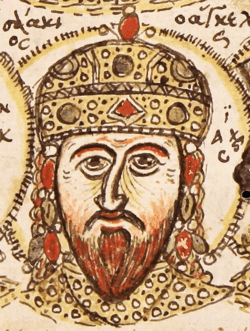
The tyrant Andronikos was torn apart by an enraged crowd, and the new emperor, Isaac II Angelos, united the Greek forces under the command of Alexios Branas.
The Sicilians, made complacent by their easy victories, were defeated near Mosynopolis.
Then, deceived by a false truce offered by the Greeks at Demetritzes, they were caught by surprise and completely destroyed.
Richard of Acerra and Baldwin were taken prisoner.
Only Tancred's fleet returned home unharmed.
And once again, despite the disastrous defeat, flatterers compared William, who had remained comfortably in his palace, to Robert Guiscard himself.

William's genuine contribution to the defense of Christianity came later.
When Jerusalem fell on October 2, 1187, the Sicilian king was the first to respond to Pope Gregory VIII's appeal.
Without waiting for the monarchs of Europe, to whom he generously offered the use of his ports, William dispatched a squadron of 60 ships in 1188–1189 under the command of the brilliant admiral Margaritus of Brindisi.
Margaritus performed extraordinary feats at sea. His lightning-fast maneuvers forced Saladin to lift the sieges of Tripoli, Krak des Chevaliers, Latakia, Margat, and Tyre.
It was this fleet that preserved the coastal strongholds that would serve as bases for the crusaders of the Third Crusade.
On the European political chessboard, William II initially opposed the German emperor Frederick Barbarossa, providing financial support to Pope Alexander III and the Lombard League.
At the grand Congress of Venice in 1177, Sicilian ambassadors celebrated as they watched Barbarossa humble himself before the pope.
Meanwhile, the royal court searched for a suitable bride for William.
After rejecting Barbarossa's daughter, William attempted to establish a marriage alliance with Byzantine Emperor Manuel I.
However, the Greeks publicly humiliated him: on the appointed day, the Byzantine princess Maria simply failed to arrive in Italy, offering no explanation.
Ultimately, on February 13, 1177, William married Joan, the daughter of the powerful English king Henry II Plantagenet.
The marriage was happy and elevated Sicily into the highest circles of European diplomacy, but it produced no children.

By 1183, the political winds had shifted.
Barbarossa had reconciled with the Lombard cities through the Peace of Constance and restored his power in Italy.
William, who was preparing an attack against Byzantium, needed a secure political position in Europe.
And so he committed a fatal mistake — one that would prove disastrous for his dynasty.
On January 27, 1186, William arranged the marriage of his own aunt and legitimate heir, Constance of Sicily, to Barbarossa's son, Henry of Hohenstaufen.
William II the Good died on November 18, 1189, in the midst of preparations for the Third Crusade, leaving no children.
Rumors concerning a son named Bohemond, supposedly born in 1182, were merely inventions of northern French chroniclers.
Constance, the wife of the German prince, remained the only legitimate heir.
During his lifetime, William had compelled the barons to swear allegiance to her.
But the moment the king closed his eyes, a political storm erupted.
The shrewd Matthew of Ajello and the Norman barons categorically refused to surrender their kingdom to their longtime enemies, the Hohenstaufens.
The country became divided: some supported Count Roger of Andria, while others backed the illegitimate Tancred of Lecce, who was ultimately crowned in January 1190.
The kingdom descended into chaos from which it would never fully recover.
Yet in the memory of the people and chroniclers, William remained almost a saint.
The great Dante Alighieri placed him in Paradise in his Divine Comedy:
"That one who shines below, a pious light... Now he knows how Heaven honors righteous kings..."
The people mourned him as the creator of a "Golden Age."
William owed his lasting fame to architecture.
During his reign, the magnificent mosaics of the Palatine Chapel were completed, and the suburban palace known as La Cuba was constructed.
But the crowning achievement of his era was the grand Benedictine Cathedral of Monreale — an unparalleled masterpiece of Arab-Norman architecture.
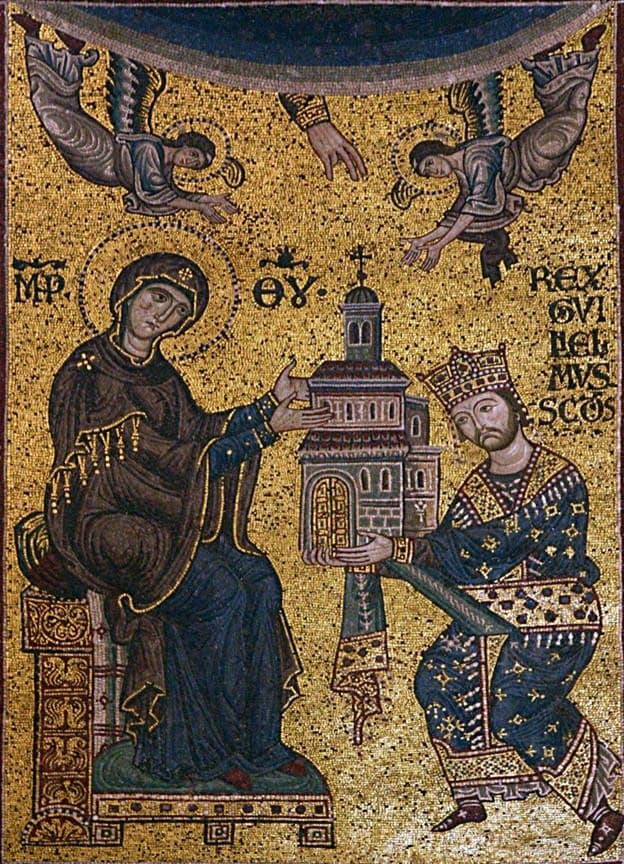
From the cathedral's mosaics, William gazes into eternity: in one, Christ Himself places a crown upon his head; in another, the king reverently presents the church to the Virgin Mary.
William transferred the remains of his parents to this cathedral, where he himself was eventually buried, despite disputes among the archbishops.
Only in 1575 were his remains placed in a magnificent Baroque sarcophagus.

But history is merciless toward illusions.
A closer examination of his reign challenges the legend of a wise monarch.
William II the Good was lazy and apathetic, preferring the pleasures of an Oriental harem to diplomacy and legislation. The existence of this harem undermines the myth of his ideal Catholic marriage.
He dragged the kingdom into pointless and bloody overseas military adventures.
The internal "peace" of his reign was merely the result of his decision to surrender real authority to competing aristocratic factions.
But his greatest offense against his country was his alliance with Germany.
By forcing the barons to swear allegiance to Constance, William effectively handed the keys to Southern Italy to the Hohenstaufen Empire with his own hands.
Only five years after his death, the independent Kingdom of Sicily, forged through the blood and labor of his great-grandfather, would disappear forever from the political map of Europe.


