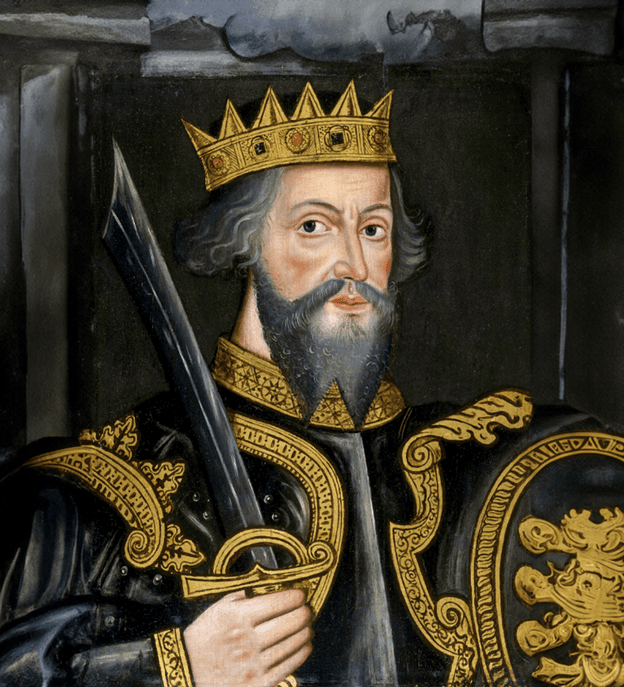
William I the Conqueror was born in 1027 or 1028 in the Norman town of Falaise. He was the illegitimate son of Duke Robert II “the Devil” and his mistress Herleva. Although extramarital unions were common among the Norman nobility, this circumstance became a source of mockery and the contemptuous nickname “the Bastard,” which dogged him all his life.


In 1035, as he set out on pilgrimage to Jerusalem, Duke Robert declared his seven-year-old son his heir. Robert’s death that same year at Nicaea plunged Normandy into chaos. For years the young William struggled to survive. His guardians were killed, and he himself repeatedly escaped assassination attempts. Yet despite these hardships, the ducal administration was not completely destroyed, and traditional respect for ducal authority kept Normandy from disintegrating.
In 1042, when William was about fifteen, he was dubbed a knight by the French king Henry I and began to rule in his own right. His harsh childhood steeled his character: he became suspicious and secretive, yet also despotic and resolute.
In the first years of his rule William devoted himself to suppressing revolts and consolidating power. In 1047, with the help of King Henry I, he defeated the rebel barons at the Battle of Val-ès-Dunes—a turning point. He then besieged the castle of Brionne, which he took only after three years. In 1052 he put down another rebellion led by his uncle, the Count of Arques, and expelled him from Normandy.
William also pursued an active foreign policy. In the 1050s he faced formidable opponents—King Henry I of France and Geoffrey II Martel, Count of Anjou. Through a series of wars William successfully defended his domains, and after Henry and Geoffrey both died in 1060, his position improved markedly. In 1063 he conquered the County of Maine, and his standing among Europe’s rulers rose to unprecedented heights.

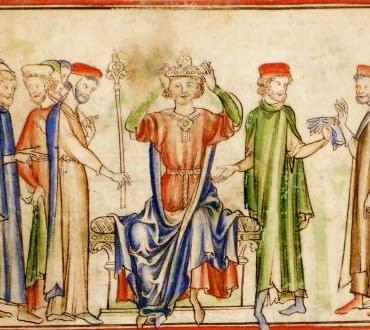
The pivotal event in William’s life was the conquest of England. His claims to the English throne—based on a promise by the childless King Edward the Confessor were rejected after Edward’s death in January 1066, when the English Witenagemot elected Harold Godwinson king.
William, having secured papal support and assembled an army of knights from across northern France, landed on England’s coast in September 1066. On 14 October, at the Battle of Hastings, his force composed of knightly cavalry, infantry, and archers inflicted a crushing defeat on the Anglo-Saxon army of King Harold, who was killed in the fighting


Victory at Hastings was a turning point. William soon marched on London and, on 25 December 1066, was crowned king of England.
After the conquest William faced Anglo-Saxon resistance, especially in the north. In the “Harrying of the North” (1069–1070) his forces utterly devastated the northern shires, suppressing any prospect of renewed uprisings. He confiscated the lands of the Anglo-Saxon nobility and granted them to his Norman barons and knights, establishing a centralized feudal monarchy with strong royal authority.

William enacted reforms aimed at purifying the church while keeping it firmly under his control, refusing to allow papal interference in his affairs. He separated secular and ecclesiastical jurisdiction, laying foundations for canon law.
One of the greatest achievements of his reign was the realm-wide land survey of 1086, whose results were recorded in the two-volume Domesday Book. This document became an invaluable source on the condition of Anglo-Norman society.
William spent his final years campaigning in France. In 1087, during the siege of the French town of Mantes, he was mortally wounded. On 9 September 1087 William died at the Abbey of Saint-Gervais, leaving the English throne to his second son, William II, and the Duchy of Normandy to his eldest son, Robert Curthose.
William I the Conqueror despite his severity and illegitimate birth became one of the most influential monarchs in English history. His conquest brought sweeping changes to the political, social, and cultural life of the country, laying the foundations for its future greatness.



