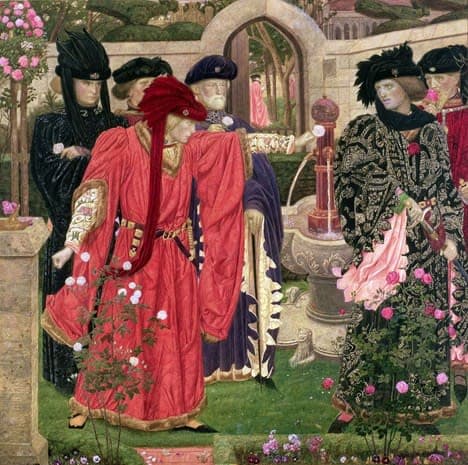

The Wars of the Roses were not merely a struggle for the throne, but a protracted conflict triggered by a whole complex of causes. Chief among them were:
Unstable rule of Henry VI. The king, who had ascended the throne as an infant, was weak and indecisive, and in adulthood suffered periodic bouts of insanity. This created a power vacuum that powerful court factions exploited.

Dynastic rivalry. The legitimacy of Lancastrian rules the party of the Red Rose was questioned, since its founder, Henry IV, had seized the crown from Richard II. This gave Richard, Duke of York—leader of the White Rose party grounds to challenge Henry VI’s rights. Richard had the stronger hereditary claim through the female line from Lionel of Antwerp, the second son of Edward III, whereas Henry VI descended from the third son, John of Gaunt.
There were also economic problems. Defeat in the Hundred Years’ War led to a financial crisis in England. The treasury was empty and trade with the Continent had weakened. This intensified the struggle for power and patronage among the aristocracy.
“Bastard feudalism” and the presence of professional armies. After defeat in France, thousands of mercenaries were left without employment and hired themselves out to great barons. This greatly increased the military power of the nobility and weakened central authority, leading to more rebellions and betrayals within the realm.
The name “Wars of the Roses” became popular only in the nineteenth century, thanks to Sir Walter Scott and William Shakespeare. In reality, during the war roses were not the only symbols. The Lancastrians may have used the Red Rose and the Yorkists the White Rose, but most participants fought under the banners of their feudal lords. For example, Richard III’s army fought under the badge of the white boar, and Henry VII Tudor under the red dragon.
The war began in 1455 with the First Battle of St Albans, won by the Yorkists. Duke Richard of York became Protector of the Realm. However, in 1460 he was killed at the Battle of Wakefield.
His son, Edward IV, carried on the fight and in 1461 won the Battle of Towton, which secured the throne for him. Henry VI was captured and confined in the Tower, while his wife, Queen Margaret, fled the country.


In 1470 the “Kingmaker” Richard Neville, Earl of Warwick formerly an ally of Edward IV went over to the Lancastrians and restored Henry VI to the throne. But in 1471 Edward IV returned to England, defeated Warwick at the Battle of Barnet, and regained the crown. Soon afterward, at the Battle of Tewkesbury, Henry VI’s only son, Prince Edward, was killed, ending the direct Lancastrian line. Henry VI was murdered in the Tower on 21 May 1471, cementing the Yorkist victory.

After Edward IV’s death in 1483, his brother Richard III took the throne. His reign proved short. In 1485 Henry Tudor, the last Lancastrian claimant, landed in Wales and at the Battle of Bosworth killed Richard III, ending the Yorkist dynasty and beginning the Tudor line. After the war Henry Tudor was crowned Henry VII and united the roses of the two dynasties into the single Tudor Rose to symbolize peace and unity.
In 1487 the Earl of Lincoln, a nephew of Richard III, tried to restore the crown to the Yorkists, but was killed at the Battle of Stoke Field, thus bringing the Wars of the Roses to an end.

The Wars of the Roses had catastrophic consequences for the English aristocracy. A significant portion of the nobility and knighthood perished on the battlefield, on the scaffold, and in prisons, bringing about the collapse of “bastard feudalism” and the establishment of a strong, centralized monarchy.


