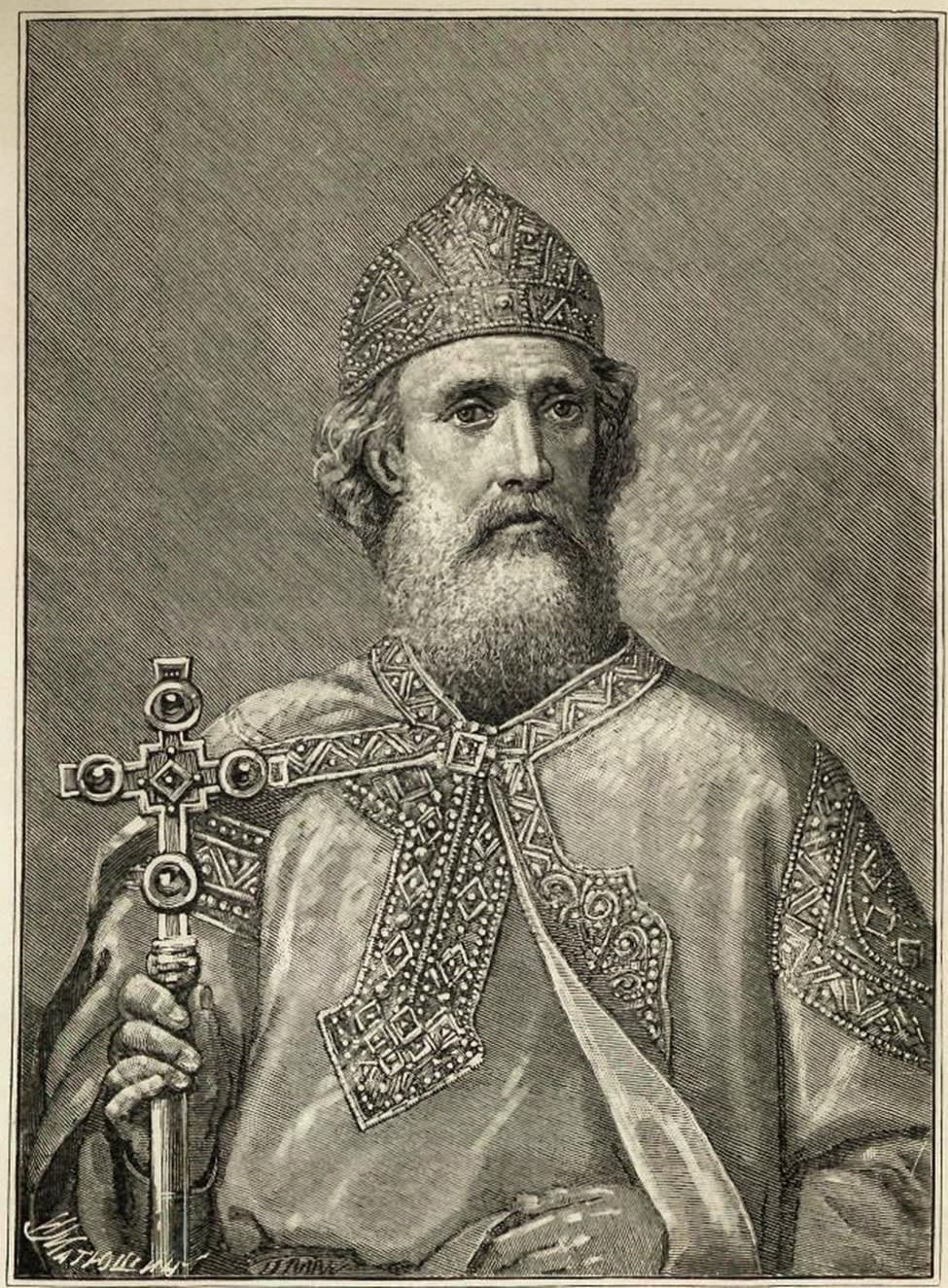

Vladimir Sviatoslavich, the future grand prince, was born to a concubine, the housekeeper Malusha from Lyubech. She served Princess Olga, mother of his father, Prince Sviatoslav Igorevich. This origin—later pointed out by Princess Rogneda when she called Vladimir a robichich (“son of a slave woman”) set him apart from his two elder brothers, born to Sviatoslav’s lawful wives.
The exact year of Vladimir’s birth is unknown. Historians suppose he was born around 960.
According to the Tale of Bygone Years (Primary Chronicle), Vladimir was Sviatoslav’s third son, after Yaropolk and Oleg. His father sent him to rule in Novgorod, where his mentor and military commander was Dobrynia.
Scandinavian sagas relate that it was under the protection of the young Vladimir in Novgorod that the future king of Norway, Olaf I Tryggvason, spent his childhood. Vladimir ransomed him from slavery and took him into his retinue.


After the tragic death of Prince Sviatoslav in 972, Yaropolk ascended the Kievan throne. In 977 a fratricidal war broke out between him and his brother Oleg, leading to Oleg’s death. Learning of this, Vladimir, fearing for his life, fled “over the sea” to the lands of the Varangians to raise an army there. Upon returning, he expelled Yaropolk’s governor from Novgorod.
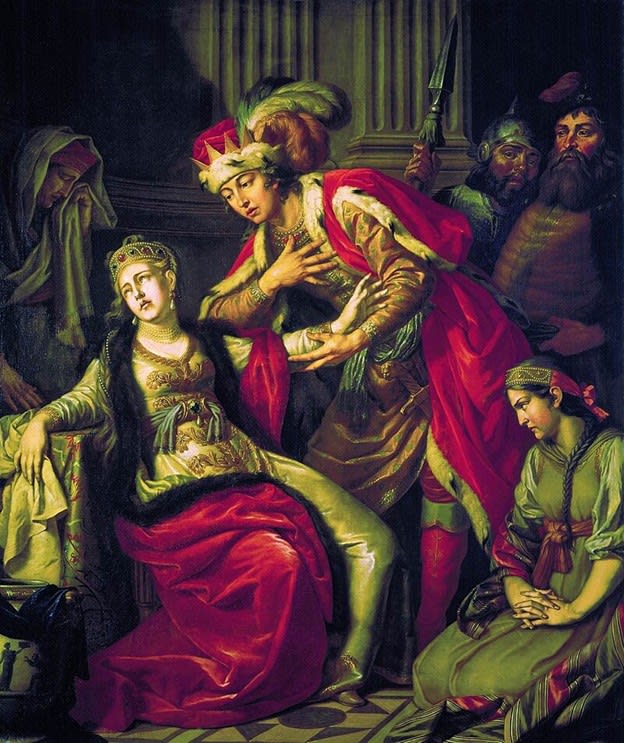
Having gathered a strong Varangian host, Vladimir began his campaign on Kiev. On the way he seized Polotsk, whose ruler, Prince Rogvolod, had refused him the hand of his daughter Rogneda already betrothed to Yaropolk. Rogneda deemed it humiliating to marry a concubine’s son, declaring: “I will not unshoe a robichich.” In retaliation, on the advice of his uncle Dobrynia, Vladimir not only raped the princess before her parents’ eyes but also killed her father and two brothers.

Vladimir then laid siege to Kiev, where Yaropolk had shut himself in. Bribed, Yaropolk’s commander Blud betrayed his prince, who was forced to flee. Vladimir lured his brother to negotiations and ordered the Varangians to kill him. He also took as a concubine Yaropolk’s pregnant wife, a former Greek nun. Thus in 978 Vladimir secured himself on the Kievan throne.
Upon becoming grand prince, Vladimir attempted to reform the pagan cult. In Kiev he erected a shrine with idols of six gods: Perun, Khors, Dazhbog, Stribog, Semargl, and Mokosh. It is supposed that this reform was part of a “pagan reaction” countering Christianity, which had begun to gain a foothold under his brother Yaropolk. In this period the first Russian Christian martyrs the Varangians Theodore and his son John were killed.


The chronicles describe Vladimir at this time as extremely dissolute. He had several wives and hundreds of concubines in various cities. Some historians see in this depiction not merely historical fact but an attempt to compare Vladimir with the biblical King Solomon, so as to emphasize how the acceptance of Christianity saved him from sin and made him great.
The chronicle narrative of Vladimir’s “choice of faiths” is legendary in character. Preachers from various lands of Islam, Judaism, Western and Eastern Christianity came to his court. In the end, after a conversation with a “Greek philosopher,” Vladimir settled on Orthodoxy. This decision also had a historical basis, since his grandmother Olga had already had contacts with Christian rulers.

According to Byzantine and Arabic sources, Vladimir’s baptism was connected to a military-political alliance. In 987 the Byzantine emperors Basil II and Constantine VIII asked the prince for help in suppressing the rebellion of the general Bardas Phokas. In exchange for military support, they promised Vladimir the hand of their sister, Princess Anna, on the condition that he and all his people accept baptism.
The Syrian historian Yahya of Antioch confirms that Vladimir agreed to this condition. Soon a six-thousand-strong Rus’ contingent arrived in Byzantium and played a decisive role in defeating Bardas Phokas at Chrysopolis and Abydos in 988–989.
After the alliance was concluded, Vladimir laid siege to the Byzantine city of Korsun (Chersonesus) in Crimea. Historians debate the reasons for this campaign: some believe it was undertaken to hasten the Byzantines’ fulfillment of their promises; others that it was part of a joint operation against the rebels. In any case, Anna was sent to Korsun, where Vladimir received baptism, taking the name Basil in honor of Emperor Basil II. After this he married Anna and returned to Kiev.
In 988 Vladimir ordered the pagan idols toppled and the people of Kiev baptized in the waters of the Dnieper. In Kiev this proceeded relatively peacefully. In other cities, however such as Novgorod, where his uncle Dobrynia oversaw the baptism, it met fierce resistance and was accompanied by the suppression of uprisings. In remote territories such as the Rostov–Suzdal land, paganism endured for a long time.


With the adoption of Christianity, Rus’ became one of the metropolises of the Patriarchate of Constantinople. Vladimir did not hinder the activity of Western missionaries either, which speaks to his religious tolerance. He even allowed the German missionary Bruno of Querfurt to establish a diocese for the Pechenegs.
Having come to power, Prince Vladimir immediately showed himself to be an active and ambitious ruler. His campaigns aimed to strengthen and expand the borders of the Old Rus’ state.
In 981 he fought the Polish duke Mieszko I over the borderland of Cherven Rus’, seizing Cherven and Peremyshl (Przemyśl). In 981–982 he managed to levy tribute on the Vyatichi, and in 984 he finally subdued the tribe of the Radimichi. These campaigns strengthened Kiev’s authority over the East Slavic tribes.

In 983 Vladimir successfully campaigned against the Balto-Lithuanian Yatvingians, ravaging Sudovia and putting an end to their raids on Rus’ lands. One of his most significant campaigns, apart from those against Slavic tribes, was the expedition of 985 against the Volga Bulgars, undertaken in alliance with the nomadic Torks. Having won, Vladimir concluded a peace favorable to Rus’. In the same year he campaigned against the remnants of the Khazar Khaganate and imposed tribute upon it. For these successes, Metropolitan Hilarion later called Vladimir a khagan, emphasizing his grandeur.
A constant problem for Rus’ remained the raids of the Pechenegs. To defend the southern frontiers, Vladimir built defensive lines and fortresses along the Ros’ and Sula rivers, known as the Serpent’s Ramparts. The German missionary Bruno of Querfurt, a guest of Vladimir in 1006–1007, wrote that the prince had surrounded his borders “with a stout palisade over a very great distance.”
With the adoption of Christianity, Vladimir began sweeping reforms affecting all spheres of state life.
The prince relied on a council consisting of his retinue and the city elders. He is credited with the “Church Statute,” which defined the jurisdiction of ecclesiastical courts. Vladimir abolished the death penalty, replacing it with the old punishment of vira (a fine).
Vladimir was the first Rus’ prince to mint his own coins gold zlatniki and silver srebreniki. Their issue was less economic than political, symbolizing the sovereignty of the Christian state. The coins bore the prince’s image and the inscription “Vladiměrŭ na stolě” (“Vladimir on the throne”). Thanks to these coins we have life-era images of Vladimir as well as his princely emblem, the trident.

Vladimir’s reign was a time of flourishing literacy and stone architecture. He ordered the sons of the “best people” to be gathered and given “book learning.” In this period new towns were founded Vladimir-on-the-Klyazma in 990, Belgorod in 991, Pereyaslavl in 992, and others.
Vladimir was known for his generosity and attentiveness to the people and to his retinue. Every Sunday he held feasts for the citizens of Kiev, and for the infirm and sick he had food delivered throughout the city. He valued his retinue, saying, “With silver and gold I shall not find myself a retinue, but with a retinue I shall win silver and gold.”
Toward the end of his life, Vladimir likely planned to change the order of succession, transferring power to his favorite son, Boris. But death thwarted his plans. His son Sviatopolk organized a conspiracy, but it was uncovered and he was imprisoned. Meanwhile Yaroslav, ruling in Novgorod, stopped paying tribute to Kiev. Vladimir gathered his retinue to bring his son to heel, but he died on July 15, 1015, at his country residence in Berestovo.
The prince’s entourage secretly conveyed his body to Kiev so that Sviatopolk would not have time to seize power. Vladimir was buried in a marble sarcophagus in the Church of the Tithes, which he himself had built.
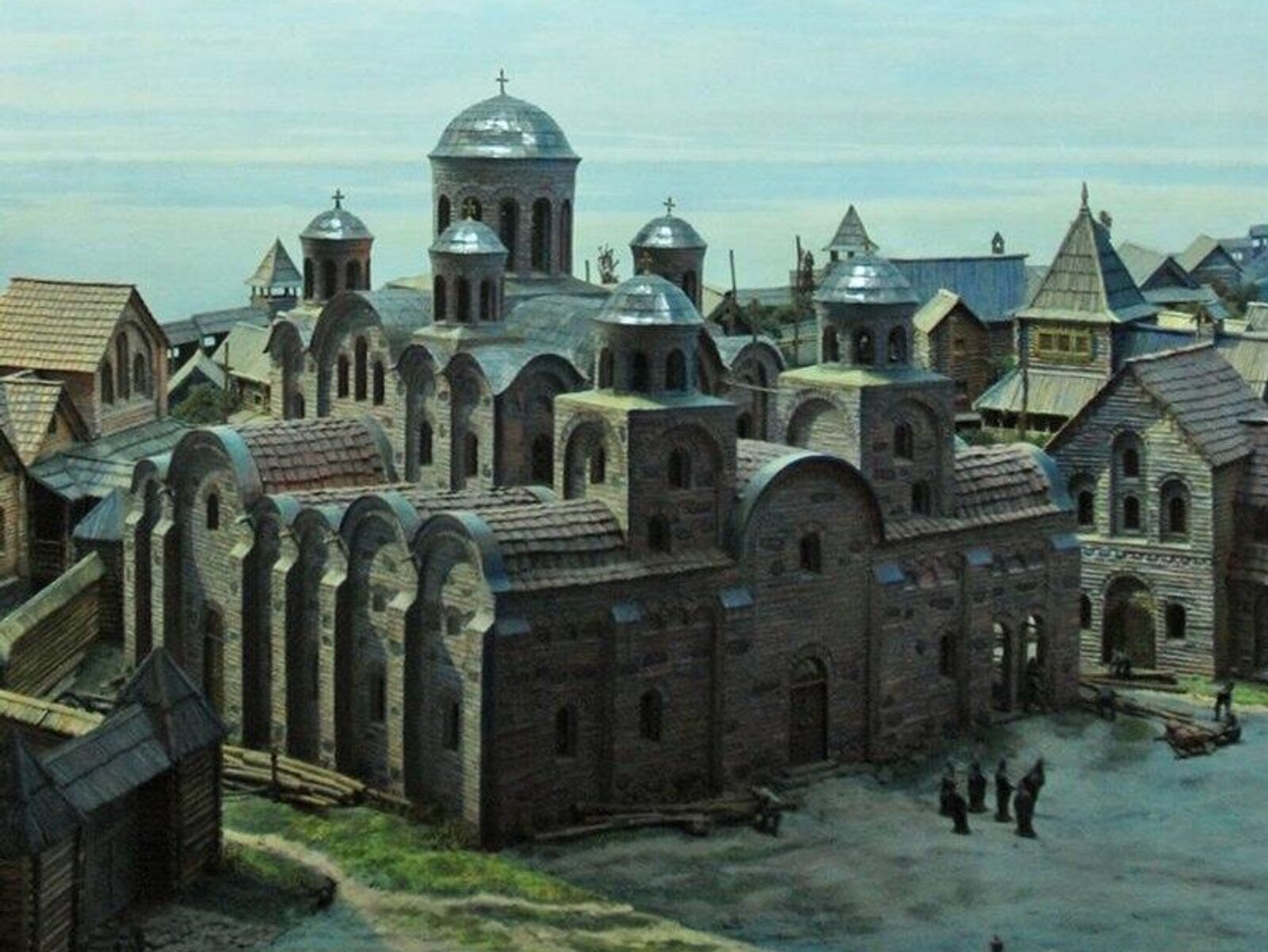

The fate of the prince’s remains remains not fully clear. In 1635–1636 Metropolitan Petro Mohyla, while clearing the ruins of the Church of the Tithes, discovered sarcophagi which he took to be the burials of Vladimir and his wife. Subsequently, part of the presumed relics was sent to Moscow.


