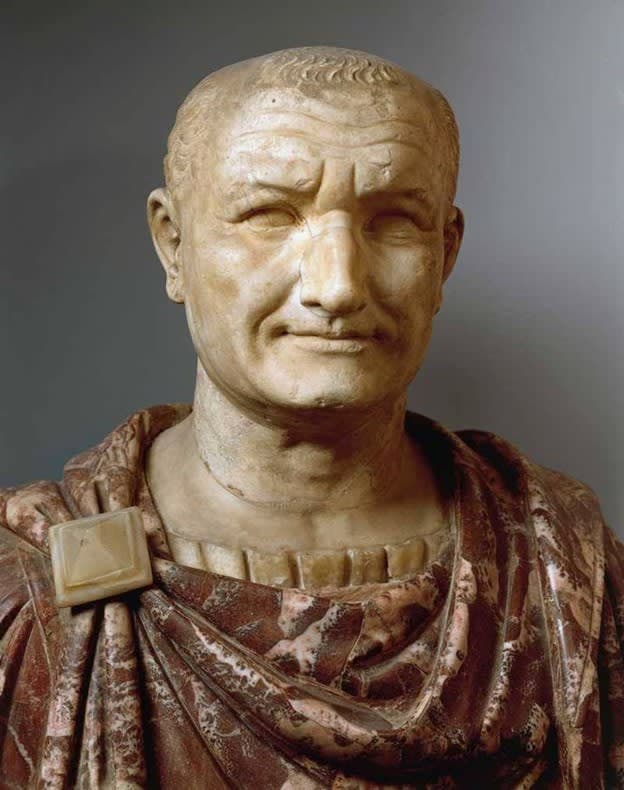

Vespasian was born on November 17, 9 CE, in the village of Falacrinae. As a child he lived on the estate of his grandmother Tertulla, whose memory he cherished all his life. In youth Vespasian was slow to pursue a public career, but under his mother’s pressure he began seeking office. He followed a long and difficult path: first a military tribune in Thrace, then quaestor, and later aedile where he placed sixth (last) and only after that did, he readily attain the praetorship. Under Caligula he did everything he could to ingratiate himself and was once punished by the emperor for poor performance of his duties.

Under Emperor Claudius, Vespasian received command of Legio II Augusta and in 43 took part in the conquest of Britain. He distinguished himself in thirty engagements, subdued two powerful tribes, and conquered the island of Vectis (Wight). For his merits he was awarded triumphal ornaments and enrolled in two priestly colleges. In 51 he became suffect consul.
After Claudius’s death in 54, when Nero came to power, Vespasian’s fortunes changed sharply. Nero and his mother Agrippina were hostile to the friends of Narcissus, Vespasian’s patron. Moreover, Vespasian may have been a supporter of Claudius’s son, Britannicus. He had to retire; Suetonius even says he lived in poverty.

In 63 or 64 Vespasian was appointed proconsul of Africa. His administration was controversial: Tacitus says he was remembered “with hatred,” while Suetonius claims he governed honestly—though once he was pelted with turnips. Back in Rome, he was forced to trade in mules, considered degrading, earning him the nickname “the Muleteer.”
In 66 Vespasian accompanied Nero to Greece. There he incurred the emperor’s displeasure by leaving during, or falling asleep at, Nero’s performances. For his friendships with members of the “Stoic opposition,” he had to leave Rome for fear of his life.
At that time Judea was in turmoil, provoked by tax policy and the arbitrariness of governors; in 66 this flared into a major revolt. After the Syrian governor’s defeat, Nero sent Vespasian—an experienced commander whose low birth made him, or so the emperor thought, politically harmless.
With an army of 60,000, Vespasian invaded Galilee in 67. His strategy blended severity with clemency: he burned cities but spared those who surrendered. His chief success was the siege and capture of Jotapata, defended by Joseph ben Mattathias. After nearly two months, the Romans slaughtered 40,000 inhabitants. Joseph surrendered and prophesied that Vespasian would become emperor; he then went over to the Romans and took the name Flavius Josephus.

Vespasian then subdued other Galilean towns. He seized Jaffa and massacred Samaritans. He stormed Tarichaea, where 30,000 Jews were sold into slavery. He was wounded in the fighting. He wintered 67–68 at Caesarea, preparing to march on Jerusalem. He secured the surrounding territories, but when ready to advance he learned of Nero’s death and paused operations.
The years 68–69 brought chaos and civil war to Rome. Nero killed himself; his place was taken by Servius Sulpicius Galba, soon murdered by the praetorians. His successor, Marcus Salvius Otho, could not hold power and yielded it to Aulus Vitellius.

Vespasian, governor of Judea, bided his time. He had a powerful army, backing in Egypt (vital for Rome’s grain supply), and a brother who controlled the capital. At first Vespasian recognized Galba and even sent his son Titus to him; rumor had it Titus was to persuade Galba to adopt him to secure succession, but on hearing of Galba’s death Titus returned. Vespasian then swore allegiance to Otho and later to Vitellius. His legions, however, resented that the empire’s fate was being decided in the West and wished their own commander to be emperor.
Meanwhile Gaius Licinius Mucianus, governor of Syria, quietly fanned rebellious feeling in Vespasian’s army. Not seeking power for himself, Mucianus urged Vespasian to launch a war, seeing him as a suitable candidate for the throne and counting on being the most influential man under the new emperor.
In Alexandria on July 1, 69, the prefect of Egypt proclaimed Vespasian emperor, supported by two legions. Three days later Vespasian’s own army joined them, and on July 15 Mucianus’s Syrian army followed. Thus, Vespasian won the backing of nine legions, client kings, and the entire East.
The plan was for Mucianus to move into the Balkans and block Italy from there, while Vespasian would cut off Rome’s grain supplies from Egypt to force Vitellius’s capitulation without battle. Events overtook the plan: the legions of Moesia, Pannonia, and Dalmatia former Othonian supporters went over to Vespasian and marched on Italy. On October 24, 69, they crushed Vitellius’s forces in the second battle of Bedriacum.
The united Flavian forces entered Rome, and on December 20 Vitellius was killed.

After Vitellius’s death, anarchy reigned in Rome, but the situation gradually stabilized thanks to Gaius Licinius Mucianus, who assumed power. He ordered the riots suppressed, reorganized the praetorian cohorts, and secured grain shipments from Egypt. The Senate acknowledged Vespasian as emperor without resistance and, in absentia, granted him and his elder son Titus the consulship. His younger son, Domitian, became his nominal representative in the capital. Vespasian himself arrived in Rome only in October 70, ten months later.
At his order the Senate began restoring order; for example, lands confiscated during the war were returned to their lawful owners. Many informers who had thrived under Nero were condemned.
Vespasian immediately adopted a new name Imperator Caesar Vespasianus Augustus emphasizing continuity with Octavian Augustus. He was the first emperor to use “Caesar” not as a family name but as a title. Official propaganda placed him alongside the founder of the principate as the man who freed Rome from tyranny and established peace.
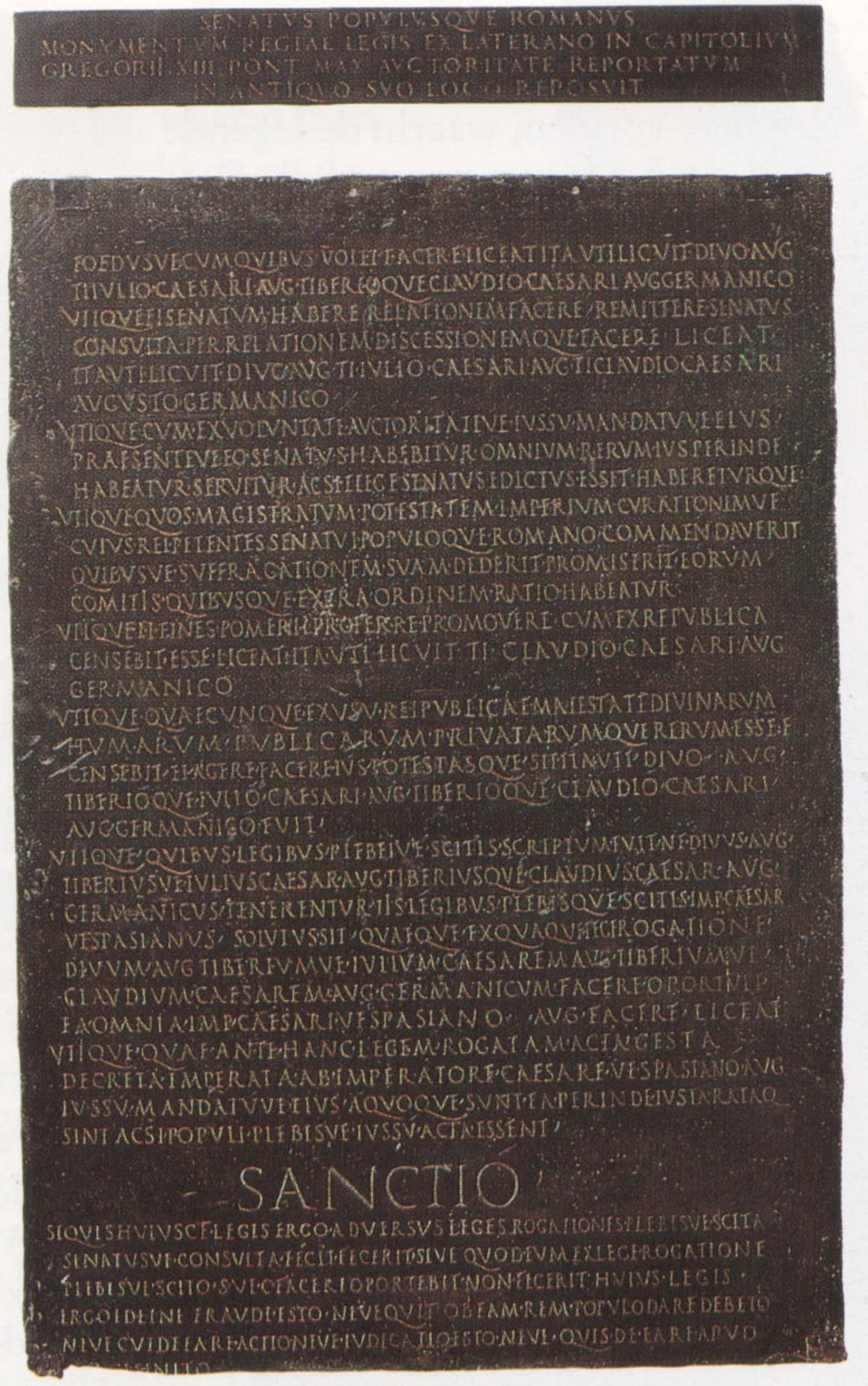
On December 22, 69, the Senate passed the lex de imperio Vespasiani, which vested all powers in the emperor. This document was perhaps the first of its kind, making the emperor’s power not merely personal but institutionalized and formalized.

Vespasian held the consulship eight times in ten years more often than any predecessor and always with his sons. He also served as censor with Titus in 73, underscoring his intent to establish a dynastic rule. He openly declared that his successors would be his sons—or no one.
His elder son, Titus, became co-ruler: he led the army in the Jewish War, shared tribunician power with his father, and served as praetorian prefect. The younger son, Domitian, received the title princeps iuventutis (“Prince of Youth”). Both sons struck coinage, further highlighting the dynastic character of the regime.

Vespasian sought peaceful coexistence with the Senate. There were no mass repressions under him. He conspicuously respected senators, looked to their welfare, and ignored informers. Even so, his humble origins and the practice of placing his sons in top offices made the nobility wary.
To replenish the Senate’s ranks after Nero’s purges and the civil war, Vespasian admitted many provincial notables from Italy, Gaul, and Spain. By some estimates, up to a third of senators were provincials. As a result, families came to power from which later emperors such as Trajan and Hadrian would emerge.
Vespasian promoted equestrians to key posts, rather than freedmen as under Claudius. He expanded their privileges, seeking the order’s support.
Despite outward harmony, discontent simmered in the Senate. Particularly contentious was naming Titus heir, given his mixed reputation. Several conspiracies were uncovered, including that of Titus Clodius Eprius Marcellus and Aulus Caecina Alienus, who were executed.
Vespasian also faced the “Stoic opposition.” Its leaders, headed by Gaius Helvidius Priscus, criticized him for abandoning old republican values and establishing hereditary rule. Helvidius was exiled and later killed.
After the civil war of 68–69, Rome was flooded with soldiers from various armies, a potential threat to the new regime. Vespasian and his allies foremost Mucianus set about reorganizing them: legions were returned to their provinces, unreliable units disbanded, and recalcitrant commanders executed or removed. Mucianus, for instance, secured the retirement of Antonius Primus, who withdrew from public life.
Of the thirty legions then in existence, Vespasian disbanded three or four. In their place he created three new ones: II Adiutrix, IV Flavia Felix, and XVI Flavia Firma. He laid special stress on discipline, ushering in a century of relative calm in the army.
Under Vespasian began the “provincialization” of the army, with legions recruited primarily from the provinces rather than Italy. Some historians link this to his distrust of Italian legionaries; others to Italy’s exhausted manpower likely both played a role. The importance of auxiliary forces, recruited from provincials, also grew. To prevent a repeat of the Batavian revolt in which auxiliaries were a main force such units were now stationed far from their homelands.
Vespasian also reformed the praetorian guard, increasing it to nine cohorts and filling it with veterans proven loyal to him. Thanks to these measures, the guard remained faithful to the emperor and his sons until the end of their rule.
Vespasian’s victory rooted in the eastern provinces convinced Romans for the first time of that region’s importance. Yet instability from civil war demanded urgent measures.
Pontus was in revolt: the freedman Anicetus declared for Vitellius and turned pirate on the Black Sea. Vespasian sent troops; the revolt was crushed. At the same time the Dacians raided Moesia, and he dispatched forces there.
The most serious eastern conflict remained the Jewish War. Vespasian had paused it to fight for power in Rome. In the interval the rebels fortified Jerusalem. In April 70, his eldest son Titus began the siege. After months of fierce fighting, in September the city was destroyed and about 100,000 people enslaved. The last stronghold, Masada, fell in 73.


Judea lost religious autonomy. Its great temple was destroyed, and Jews were forbidden to rebuild it. In 71 Vespasian and his sons celebrated a lavish triumph in Rome to highlight the dynasty’s role in pacifying the empire. The Arch of Titus was erected in commemoration.

To strengthen the eastern frontier, Vespasian combined Cappadocia with Galatia and stationed two legions there. In 72 he annexed Commagene, accusing King Antiochus IV of ties with the Parthians. These measures greatly reinforced the empire’s eastern border, laying groundwork for Trajan’s future conquests.
In the West the Rhine provinces were most unstable. There the Batavian revolt broke out under Julius Civilis, who at first declared for Vespasian but after Vitellius’s death continued the fight, calling for a “Gallic empire.” Mucianus, still in Rome, sent eight legions; the revolt was suppressed.
Vespasian continued the Romanization of Gaul, increasing the number of Gallic nobles in the Senate. In Germany he strengthened the frontier and built a chain of forts, a prelude to later expansion.
In Britain, Flavian governors including Quintus Petillius Cerialis and Sextus Julius Frontinus quelled the Boudiccan aftermath and pushed conquest. Gnaeus Julius Agricola, Tacitus’s father-in-law, consolidated Roman control in Wales and began the advance into Caledonia.
In Africa Vespasian suppressed a Garamantian uprising and split the province in two to improve control. He energetically promoted urbanization and the spread of Roman citizenship.
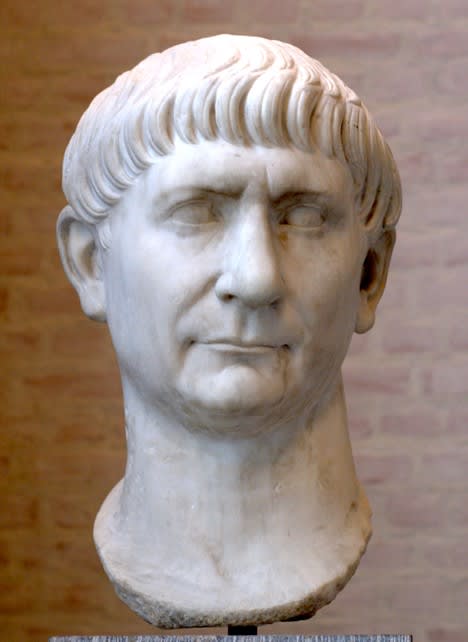
The greatest changes came in Spain. Vespasian granted the “Latin Right” to all Spanish communities, spurring rapid urbanization and the spread of Roman culture. His policy broadened the base of his rule; thanks to it, a powerful “Spanish faction” emerged in the Senate, which in 98 raised to the throne the first provincial-born emperor, Marcus Ulpius Trajan.

Vespasian’s chief task on coming to power was to restore the treasury, depleted by Nero and the civil war. He acknowledged that he needed enormous funds. He began with strict economy: cutting expenses for praetorians and the army, and reducing the imperial household’s costs. Silver content in the denarius was lowered by 5%, allowing more coinage.

At the same time, he boosted revenues by every available means, even those deemed degrading. He abolished tax exemptions granted by predecessors and compelled cities that had received them to pay arrears. He taxed previously privileged towns and introduced new imposts.
The most famous example of his pragmatism was the tax on public latrines. When his son Titus reproached him, Vespasian held a coin from the first proceeds to his nose and asked whether it smelled. Hearing “no,” he replied, “Yet it comes from urine” coining the saying pecunia non olet (“money doesn’t stink”).
He sold public offices, took bribes in the courts, and promoted the greediest officials to high posts, then prosecuted them to confiscate their wealth. The eastern provinces, which had supported his rise, were the first to feel the increased tax burden. After the Jewish War the treasury was replenished through plunder, and a yearly tax was imposed on the defeated Jews.
Despite harsh measures, Vespasian’s financial policy succeeded. He did not ruin private individuals but filled the fisc. He spent generously on public needs, revived ancient festivals, staged lavish banquets, paid stipends to rhetoricians, and aided the needy winning great popularity and shoring up his rule.
Vespasian inherited a Rome badly scarred by fires. He launched a grand building program to restore the capital: he rebuilt the Temple of Jupiter Capitolinus, the Theater of Marcellus, the Temple of Claudius, and other key structures. He also allowed people to build on vacant lots when owners failed to do so.
Under Vespasian new monumental works began: the Temple of Peace and the famed Flavian Amphitheatre better known as the Colosseum erected on the lake of Nero’s Golden House. The Colosseum became Rome’s first permanent venue for gladiatorial games, seating about 50,000 spectators.

Ancient authors praised the grandeur and practicality of Vespasian’s building program; under the Flavians, Rome assumed its definitive form.
His religious policy was traditional and served to reinforce his rule. Lacking the divine lineage claimed by the Julio-Claudians, his cult was formalized: he promoted the cult of Roma and the living emperor and renewed the veneration of deified predecessors. Official propaganda nonetheless worked the theme of his divine favor, recounting miraculous omens that foretold his greatness.
Vespasian supported the cult of Serapis and even spent the night before the Jewish triumph in the Temple of Isis marking a turn in policy, as Egyptian cults had not previously been encouraged.
Vespasian died on June 24, 79. Despite illness he handled state business to the end. Sensing death approach, he is said to have quipped, “Alas, I think I am becoming a god.” Declaring that “an emperor ought to die standing,” he tried to rise and died in his servants’ arms. Rumors of poisoning by his son circulated, yet the transfer of power to Titus passed without incident.


