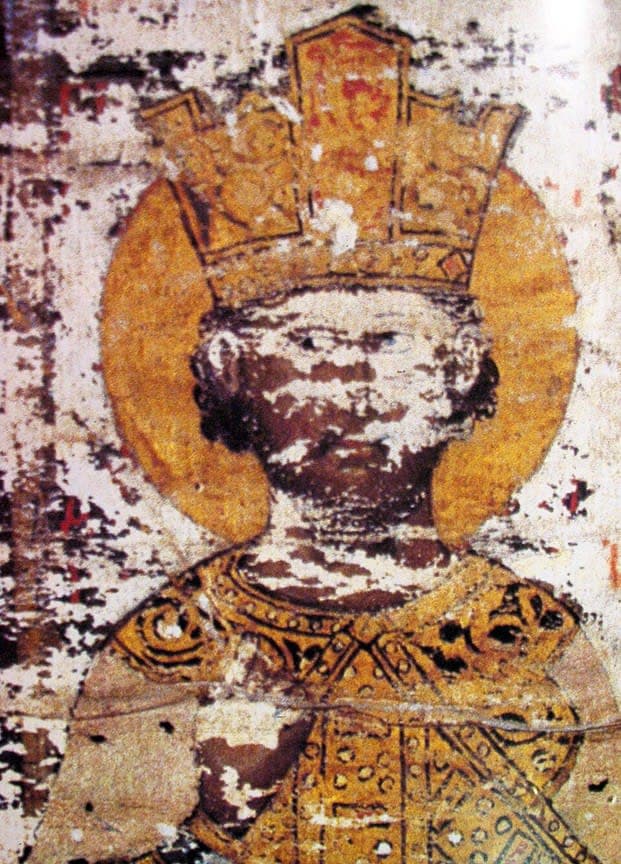

The young Đurađ Branković received his political and military baptism in the crucible of the geopolitical catastrophes that shook the Balkans at the beginning of the 15th century.
Together with his uncle, Stefan Lazarević, he was forced to fulfill the burdensome obligations of a vassal, fighting under the banners of the Ottoman Sultan Bayezid I.
This involuntary alliance was put to the ultimate test during the great confrontation with the seemingly invincible hordes of Emir Timur, also known as Tamerlane.
Participation in battles of such magnitude not only hardened Đurađ as a military commander but also awakened profound political ambitions within him.

Returning to his homeland after Bayezid's downfall, Đurađ recognized the vulnerability of the existing government and decided to concentrate all authority over Serbia exclusively in his own hands.
This relentless desire for absolute power led to a bitter internal conflict with his uncle, Stefan Lazarević.
The country, which had barely begun to recover, was once again plunged into the chaos of internal warfare.
However, family ties and political pragmatism eventually prevailed over hostility.
For the sake of preserving the unity of the state, Stefan agreed to make concessions.
He officially recognized Đurađ as his legitimate heir and, during his own lifetime, transferred a portion of the Serbian territories to his nephew's full administration, thereby preparing him for the future burden of power.

The geopolitical situation in the Balkans was rapidly deteriorating.
The advance of the resurgent Ottoman Turks became so overwhelming that in 1426 both Serbian rulers, Stefan and Đurađ, were forced to flee to Hungary.
There, seeking protection from the Ottoman threat, they swore allegiance and acknowledged the supreme authority of Sigismund of Luxembourg, King of Hungary and Holy Roman Emperor.
In 1427, following the sudden death of Stefan Lazarević, Đurađ Branković officially ascended the throne, assuming the prestigious title of Serbian Despot.
However, his rule was overshadowed from the very beginning by geopolitical dependence.
Attempts to rely on Hungary failed to provide the expected security.
As early as 1428, in order to save his devastated country from complete destruction, the new despot was forced to bow before the sultan and resume paying heavy tribute to the Ottoman Turks.
The peace purchased with gold and humiliation proved short-lived.
In 1439, Sultan Murad II launched a massive invasion, unleashing the full might of the Ottoman army against Serbia.
The state collapsed, and Đurađ, deprived of his territories, once again entered bitter exile in Hungary.

However, the despot refused to accept the loss of his homeland.
Employing all his diplomatic brilliance, he succeeded in assembling a powerful coalition.
Only through the direct military support of King Władysław III of Poland and Hungary and the brilliant Transylvanian commander John Hunyadi, during the exhausting campaign known as the "Long Campaign," was Đurađ Branković able to wrest Serbia from Ottoman control and triumphantly return to his throne.
Soon after this triumph, one of the great tragedies of medieval European history unfolded.
A peace treaty had been concluded with the Ottomans, and King Władysław III had sworn a sacred oath upon the Gospels to honor its terms.
However, in 1444, yielding to the persuasion of papal legates, Władysław flagrantly violated his oath and resumed the war against the Ottoman Empire.
Đurađ Branković, as a pragmatic statesman, foresaw the disastrous consequences of this reckless decision.
Refusing to support his treacherous ally, he declined to provide troops for the new crusade.
His decision proved prophetic.
The campaign ended in absolute catastrophe at the Battle of Varna, where the Christian army was completely defeated and King Władysław himself lost his life on the battlefield.


Đurađ's political longevity was largely the result of his ability to maneuver between predatory neighboring powers.
However, this diplomacy sometimes demanded terrible sacrifices.
The darkest episode of his reign came in 1453.
Fulfilling his strict obligations as a vassal of Sultan Mehmed II, the despot was forced to send Serbian auxiliary troops to participate in the fateful siege of Constantinople — the capital of the Orthodox Christian world.
The historical irony lies in the fact that this Serbian contingent included Constantine of Ostrovica, a man whom fate would turn into a prisoner and a Janissary, and who would later become famous as the author of a unique historical document, Memoirs of a Janissary, preserving an insider's perspective on the Ottoman army.
The life of the Serbian ruler, spent in the saddle and on battlefields, ended as harshly as it had unfolded.
In his final years, Đurađ Branković once again became involved in an armed conflict, this time against his former allies — the Hungarians.
During one of the fierce clashes with Hungarian detachments, the aging despot suffered a serious wound that ultimately proved fatal.
He passed away, leaving behind a country that continued its desperate resistance against the seemingly inevitable advance of Ottoman domination.


