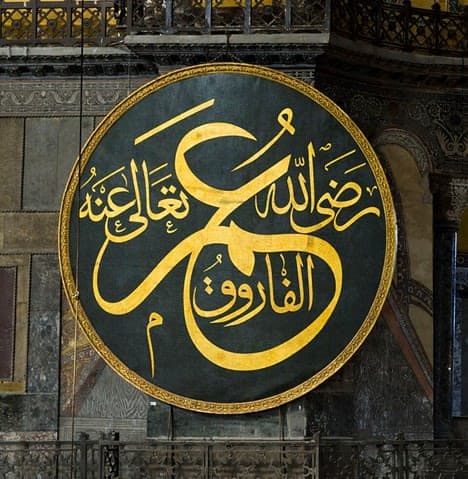

ʿUmar ibn al-Khaṭṭāb was born in Mecca around 585 into the family of al-Khaṭṭāb ibn Nufayl, a member of the Quraysh clan of al-ʿAdī. His ancestors traditionally acted as mediators in intertribal disputes, and ʿUmar himself inherited this gift of sound judgment, combined with extraordinary physical strength and blunt straightforwardness. His mother, Ḥintama bint Hāshim, raised her son with strict discipline. ʿUmar’s youth was typical of the Meccan aristocracy: he began as a shepherd, tempering his character in the harsh conditions of the desert, and later became a successful merchant.
Until 616, ʿUmar was one of the most formidable enemies of the Muslims. His devotion to the traditions of his ancestors was so strong that he regarded Islam as a threat to the unity of the Quraysh. It is said that the Prophet Muhammad even made a special supplication, asking God to strengthen the faith through one of the two strongest men of Mecca—Abu Jahl or ʿUmar. The story of his conversion became legendary: having resolved to kill the Prophet, ʿUmar learned on the way that his own sister and brother-in-law had secretly accepted Islam. Bursting in upon them in fury, he found them reciting Sūrat Ṭā Hā. His anger gave way to deep shock when he himself read the sacred verses. The heart of the stern warrior trembled, and on that very day, in the house of al-Arqam, he publicly testified to his faith, becoming an unshakable pillar of the Muslim community.

ʿUmar’s acceptance of Islam changed the balance of power. Whereas previously the Muslims prayed in secret, fearing persecution, ʿUmar immediately went to the Kaʿba after his conversion and openly performed the prayer, challenging the Quraysh. His fearlessness breathed new life into the community. While other believers left Mecca during the Hijra secretly, under the cover of night, ʿUmar departed openly, girded with his sword, declaring to his enemies: “Whoever wishes to leave his mother childless and his children orphaned—let him try to stop me.”
In Medina, ʿUmar became the shadow and the sword of the Prophet. He gave his daughter Ḥafṣa in marriage to Muhammad, further strengthening the bonds of kinship and loyalty. He did not miss a single major battle from Badr and Uḥud to Khaybar and the expedition to Tabūk everywhere setting an example of heroism. After the death of the Prophet in 632, it was ʿUmar’s decisiveness that helped prevent a split among the Muslims: he was the first to pledge allegiance to Abu Bakr, securing the legitimacy of the first caliph. For two years he served as Abu Bakr’s chief adviser, and in August 634, in accordance with Abu Bakr’s final will, ʿUmar himself assumed leadership of the ummah.
The years of ʿUmar’s rule became the “golden age” of the Caliphate’s expansion. Under his leadership, the Muslim state was transformed from a regional polity into a world empire. In 633, southern Palestine fell; in 635, after a long siege, Damascus surrendered. The decisive Battle of the Yarmūk in 636 permanently expelled the Byzantines from Syria.


In the east, a campaign against Sasanian Iran unfolded. The Battle of al-Qādisiyya in 636–637 opened the road to Ctesiphon the magnificent summer residence of the Persian kings and the capital of the entire Iranian realm. Despite ʿUmar’s initial caution, fearing overstretched lines of communication, the expansion continued, and in 642, after the victory at Nahāvand, the Persian Empire effectively ceased to exist. At the same time, the legendary ʿAmr ibn al-ʿĀṣ led armies into Egypt, and in 642 the key Byzantine stronghold of Alexandria fell. ʿUmar created a multinational state in which administrative institutions gradually replaced tribal structures.

ʿUmar proved himself a brilliant administrator. He introduced a system of state registers (dīwān), established regular stipends for soldiers, and allowances for the needy. It was he who, in April 637, instituted a new era of chronology beginning with the year of the Hijra, which Muslims use to this day.
In the conquered territories, he founded military settlements—amṣār (such as Fusṭāṭ and Kūfa) to preserve the fighting capacity of the army and prevent premature assimilation of the warriors. ʿUmar was just toward non-Muslims: he set clear regulations for the jizya (poll tax) and kharāj (land tax), and forbade the confiscation of land from the local population if they submitted voluntarily. By his order, the ancient Trajan’s Canal, connecting the Nile with the Red Sea, was restored, enabling Egyptian grain to be delivered rapidly to famine-stricken Arabia in 639.
A special place is held by his entry into Jerusalem. Dressed in a simple, worn cloak, the caliph received the keys of the city from Patriarch Sophronius. He guaranteed the inviolability of churches and personally took part in clearing the Temple Mount of debris, laying the foundations of a mosque on the site from which, according to tradition, the Prophet ascended to heaven.

Despite his greatness, ʿUmar remained an ascetic. He slept on the ground, ate simple food, and personally patrolled the streets of Medina at night to see whether anyone was in need of help. His life ended tragically in November 644. A Persian slave, Abu Luʾluʾa (Fīrūz), driven by personal grievance or by vengeance for the fall of his homeland, inflicted six knife wounds on the caliph during the morning prayer in the mosque.
Even as he lay dying, ʿUmar thought of the state. He refused to appoint a successor single-handedly, entrusting a council (shūrā) of six of the most eminent Companions to choose a new leader within three days. His final wish was that the governors he had appointed not be replaced for one year, in order to preserve stability. On November 7, 644, the second Rightly Guided Caliph died and was buried beside the Prophet Muhammad and Abu Bakr.
ʿUmar ibn al-Khaṭṭāb left behind not merely conquered lands, but a functioning system of law, administrative governance, and an example of a ruler for whom justice stood above personal gain. He was called al-Fārūq— “the one who distinguishes truth from falsehood”—and this name has remained forever attached to him in history.


