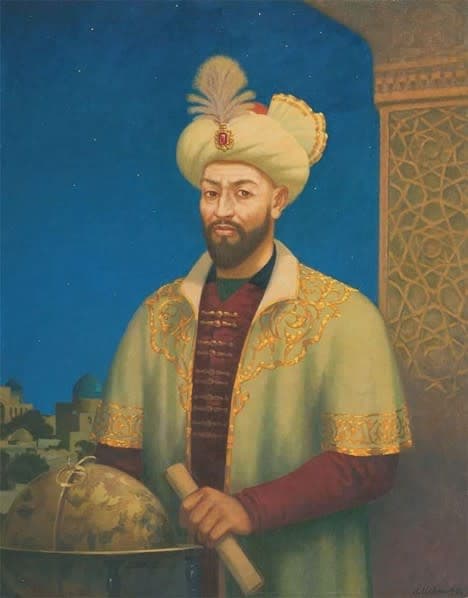

Mirzo Ulugh Beg was born on March 22, 1394, in the city of Sultaniyah, during the famous “five-year campaign” of his grandfather, the great conqueror Tamerlane (Timur). His given name was Muhammad Taraghay, after Timur’s father, but he entered history as Ulugh Beg. He was the eldest son of Timur’s younger son Shahrukh and his wife Gawharshad Begim. As a child Ulugh Beg had the chance to visit the ruins of Nasir al-Din al-Tusi’s renowned observatory at Maragha, which, tradition says, determined his lifelong passion for astronomy.
After Timur’s death in 1405 and the ensuing civil strife, Ulugh Beg’s father Shahrukh inherited the greater part of the Timurid Empire. In 1409 he appointed Ulugh Beg governor of Transoxiana with his capital at Samarkand. From 1411 Ulugh Beg ruled in his own right, turning Samarkand into one of the world’s centers of science and culture.
Unlike his grandfather, Ulugh Beg was less a warrior than a scholar-ruler and patron of the arts. He actively pursued the restoration and development of higher learning. Between 1417 and 1420 he built a madrasa in Samarkand that became the core of the scientific ensemble on Registan Square. On the portal of another madrasa, he built in Bukhara was engraved an Arabic inscription: “Seeking knowledge is a duty for every Muslim man and woman,” reflecting his commitment to learning.


Ulugh Beg’s chief passion and achievement was astronomy. In 1428 construction was completed on his famous observatory, which surpassed all others of its time in precision. The observatory’s principal instrument was a gigantic mural quadrant with a radius of 40 meters.

Under Ulugh Beg’s direction, eminent astronomers such as Qadi-Zadeh al-Rumi, al-Kashi, and al-Qushji compiled by 1437 the Gurgani Zīj—a star catalog describing 1,018 stars. They also determined with extraordinary accuracy the length of the sidereal year (with an error of only 58 seconds) and the tilt of the Earth’s axis.

The Gurgani Zīj became a standard astronomical manual in both Europe and the Islamic world. It was translated into Latin and used in observatories alongside the works of Ptolemy and Alfonso X. Its observational accuracy was surpassed only in the seventeenth century by the astronomer Tycho Brahe.

Beyond astronomy, Ulugh Beg cultivated poetry and history, and as a patron supported Turkic literature, fostering a cultural flowering in Transoxiana.
Ulugh Beg’s political rule was less successful than his scientific work. After his father Shahrukh died in 1447, civil wars broke out in the empire. Ulugh Beg faced strong opposition from his eldest son, ‘Abd al-Latif, dissatisfied with his father’s lenient policies. Their conflict escalated into open war. In October 1449, at a battle near Dimishk, west of Samarkand, Ulugh Beg’s forces were defeated.
After the defeat, Ulugh Beg was betrayed and killed on the road to Mecca by order of his son ‘Abd al-Latif.
Ulugh Beg’s scientific legacy proved far more enduring. His student ‘Ali al-Qushji moved to Istanbul, where he helped advance astronomy in the Ottoman Empire. In 1569 an observatory was built in Istanbul modeled on Samarkand’s. Ulugh Beg’s own observatory was destroyed at the end of the seventeenth century.
In Europe Ulugh Beg’s works became known after their publication at Oxford in 1648. His star catalog was highly esteemed by European scholars. Ulugh Beg’s name was immortalized when the German astronomer Johann Heinrich von Mädler named a lunar crater after him. In 1908 the Russian archaeologist V. L. Vyatkin discovered and excavated the observatory’s remains, restoring the memory of the great scholar. Today Ulugh Beg is honored as one of the greatest astronomers and educators of the East. His personal belongings, such as a jade goblet and cup, are held in the world’s leading museums.



