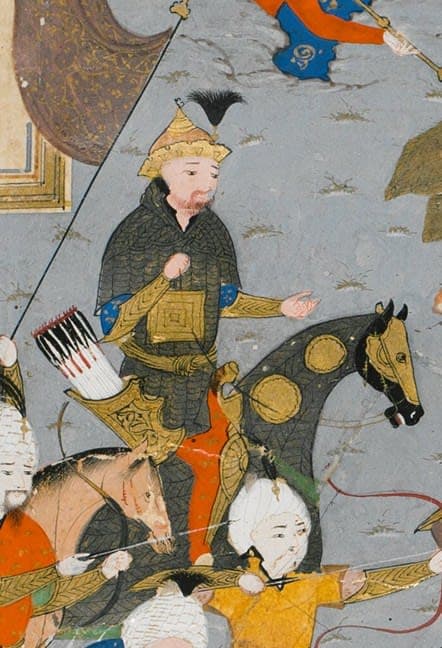

Ubaydullah was the son of Mahmud-Sultan, the younger brother of Shaybani Khan, and was named after the Naqshbandi leader Ubaydullah Khwaja Ahrar, who was his father’s spiritual mentor. From childhood Ubaydullah Khan received an excellent education. He studied hadith with Khwaja Mawlana Isfahani and jurisprudence with Mahmud Azizan. His spiritual guides included renowned Sufi shaykhs such as the Yemeni Sayyid ʿAbdallah al-Yamani and, from the Yasawiyya order, Shaykh Khudaydad Wali and Shaykh Mansur.
Ubaydullah accompanied his uncle, Shaybani Khan, on campaign and received the Bukhara region as his appanage. In November 1510, however, he failed to reach Shaybani in time to help him, which led to Shaybani’s defeat and death in battle against the forces of Ismail I Safavi.

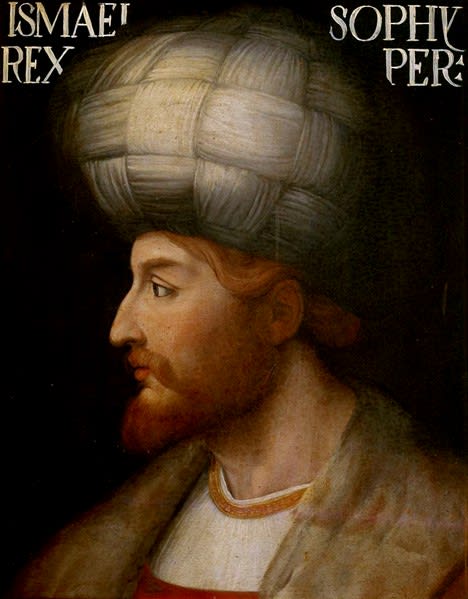
After Shaybani Khan’s death, his uncle Kuchkunji Khan (1510–1530) was proclaimed the formal ruler of the Shibanid state. Yet, as the historian Mirza Muhammad Haydar notes in his Tarikh-i Rashidi, it was Ubaydullah Khan—despite the ancient custom of passing power to the eldest—who set the state’s main policy. He respected tradition and passed the khanly title to those older than himself until, after Abu Saʿid Khan’s death in 1533, he was himself the eldest and ascended the throne.
Ubaydullah Khan’s reign fell in a critical period when the fate of Transoxiana and Khurasan hung by a thread. After taking Herat in 1510, Shah Ismail I Safavi ordered the Shiʿi formula inserted into the khutba, provoking fierce resistance. Many religious figures were executed for refusing, including the shaykh al-Islam of Herat, a great-grandson of the famed theologian Saʿd al-Din al-Taftazani.

At this decisive moment Ubaydullah Khan mustered his forces and in 1512 crushed the combined army of the last Timurid, Babur, and the Safavids in the famous Battle of Ghijduvan. The victory was of immense historical importance: it not only saved the country from Iranian conquest but also preserved the traditional Sunni orientation of Islam in Central Asia. It was likely after this triumph that Ubaydullah Khan received the epithet Muʿizz al-Din (“one who exalts the faith”).
Ubaydullah Khan sought to expand his state’s frontiers. He waged a protracted struggle with Ismail I Safavi that lasted about a decade. Twice in 1529 and 1536—he managed to seize Herat. He invaded Khurasan five times, though his attempts to annex it permanently did not succeed.
To weaken the Safavids, Ubaydullah Khan forged an alliance with the Ottoman sultan Selim I. Their combined pressure especially after the Battle of Chaldiran in 1514 put serious strain on Iran. Ubaydullah also maintained diplomatic relations with China, to which his envoys traveled in 1536.


Despite the difficult military situation, Ubaydullah Khan devoted great attention to learning and culture. Highly educated, he was fluent in Turkic, Persian, and Arabic. He wrote poetry under the pen name “Ubaydī,” and collections of his works survive, including the poems Sabr-nama, Shawq-nama, and Ghayrat-nama. He was a master reciter of the Qur’an and even wrote a commentary on it in Turkic.
Ubaydullah Khan was not only a poet but also a calligrapher, musician, and singer. Under his rule, Bukhara became a major cultural center, comparable to Herat in the time of Sultan Husayn. He is regarded as the founder of the first true kitābḵhāna (library) in Bukhara and a patron of the local school of miniature painting.
At his order, the famous Mir-i Arab Madrasa (1530–1536) was built in Bukhara as a gift to his spiritual mentor ʿAbdallah al-Yamani. Another madrasa was erected in 1515 in the Syr Darya town of Sauran; within its walls was found an autograph of Sulūk al-mulūk (“Rules of Conduct for Rulers”), written by Fazlallah ibn Ruzbihan Isfahani for Ubaydullah in 1514.
Ubaydullah Khan died in 1540 and was buried in the north wing of the Mir-i Arab Madrasa in Bukhara, beside his teacher ʿAbdallah al-Yamani al-Hadrami. His passing intensified political fragmentation: numerous Shibanids began to contend for the throne, ushering in a period of internecine strife. Even so, his reign left an indelible mark on history, and he is remembered as an outstanding ruler who not only defended his people’s independence and faith but also fostered the flourishing of science and culture.


