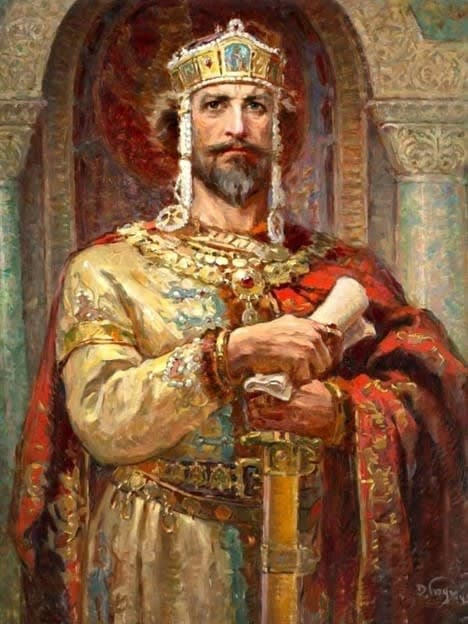
Simeon was born in 864 or 865, at a turning point in history when Bulgaria was only beginning to embrace Christianity. As the third son of Prince Boris I, he was not considered an heir to the throne — instead, he was destined for a religious career. Boris, who dreamed of establishing an educated and enlightened church, sent his son to the famous Magnaura School in Constantinople. There, the young Simeon became so deeply immersed in Byzantine culture, philosophy, and rhetoric that his contemporaries would later call him "the Half-Greek."
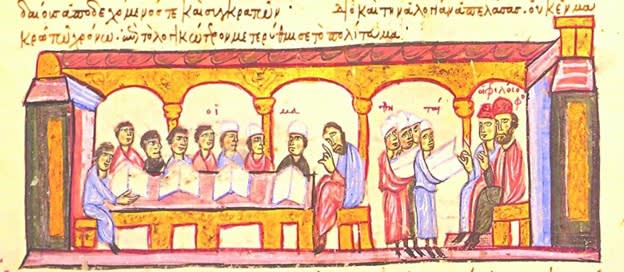

Around 888, Simeon returned to his homeland and took monastic vows at the Preslav Monastery. However, history had other plans for him. While Boris I lived in prayerful seclusion, his eldest son, Vladimir-Rasate, attempted to turn back the clock by restoring paganism. In 893, the elderly Boris emerged from monastic retirement, overthrew Vladimir, and convened a historic church and national council. The council's decisions changed everything: the capital was moved to Veliki Preslav, the Slavic language became official, and Simeon, exchanging his monastic robes for princely garments, ascended the throne.
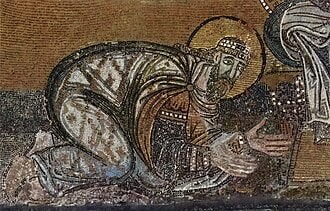
Peace with Byzantium collapsed almost immediately afterward. Emperor Leo VI the Wise made a disastrous economic decision: he transferred the trading activities of Bulgarian merchants from Constantinople to Thessaloniki and imposed excessive customs duties on them. Simeon, understanding that economics was another battlefield, invaded Thrace in 894. Bulgarian troops defeated the Byzantines near Adrianople, and Simeon ordered the noses of captured Khazar guardsmen serving the emperor to be cut off — a gesture expressing his contempt for Byzantine arrogance.
Byzantium responded with cunning. The empire incited the nomadic Magyars against the Bulgarians. In 895, Simeon found himself in a difficult position: while the renowned Byzantine general Nikephoros Phokas the Elder threatened Bulgaria from the south, the Magyars devastated its northern territories. Simeon was forced to seek refuge in the fortress of Dristra. Yet it was precisely here that his strategic genius emerged. He formed an alliance with the Pechenegs and, in 896, inflicted such a devastating defeat on the Magyars in a major battle along the Southern Bug River that they were forced to migrate permanently to the territory of modern-day Hungary. Immediately afterward, Simeon struck the Byzantines at the Battle of Boulgarophygon, virtually wiping their army off the face of the earth. The outcome was inevitable: Byzantium restored Bulgarian merchants' trading privileges in the capital and began paying Bulgaria an annual tribute.

The military confrontation reached its climax in 917. The Byzantine Empire, exhausted by Simeon's ambitions, decided to pursue a "final solution to the Bulgarian question." An enormous army was assembled, with officers summoned from provinces stretching from Italy to Armenia.
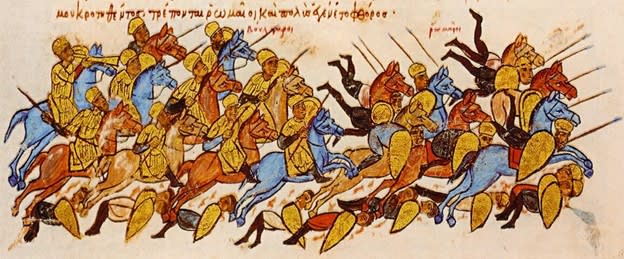
On August 20, 917, one of the greatest battles of the Middle Ages unfolded near the Achelous River. Simeon employed a classic but risky maneuver: a feigned retreat lured the Byzantine forces into a trap. At the decisive moment, Simeon personally led a heavy cavalry charge against the enemy's flank. His horse was killed beneath him, but this only intensified the Bulgarians' determination. The Byzantine army was driven toward the sea and almost completely destroyed. According to Leo the Deacon, even 75 years later, piles of bones along the banks of the Achelous still testified to the scale of the catastrophe. The road to Constantinople lay open, and the subsequent nighttime victory at Katasyrtai further consolidated Simeon's triumph.

Simeon no longer wished to remain merely a "prince." He proclaimed himself "Autocrat of All Bulgarians and Romans." His ultimate goal was the throne of Constantinople. He conducted complex negotiations with the Fatimid Caliphate in Tunisia, attempting to secure a fleet that would enable him to impose a naval blockade on the Byzantine capital. However, Byzantine diplomacy successfully intercepted the Arab envoys.
In the west, Simeon imposed order with an iron fist: in 924, he finally conquered Serbia. In 926, confronting the Croatian king Tomislav, Simeon suffered a rare defeat in the Bosnian mountains but quickly restored the status quo. His authority was so great that Pope John X officially recognized his imperial title and the patriarchal status of the Bulgarian Church in 926.

Death came for the great tsar on May 27, 927, while he was preparing for another siege of Constantinople.
Simeon understood that an empire without culture was merely a vast horde. Under his rule, Veliki Preslav became a rival to Constantinople. John the Exarch enthusiastically described its palaces, adorned with marble, gold, and silver.
However, Simeon's greatest cultural legacy was the Cyrillic alphabet. It was at the Preslav Literary School that this writing system was developed, becoming a foundation of Slavic civilization. The tsar personally participated in compiling literary collections, translated texts, and supported a remarkable generation of intellectuals: Clement of Ohrid, Constantine of Preslav, John the Exarch, and the mysterious Chernorizets Hrabar. The Bulgarian language became a language of Christian worship, taking its place alongside Greek and Latin.

"Tsar Simeon was the Charlemagne of Bulgaria, but more educated... for he laid the foundations of a unified national literature," wrote historian Alfred Rambaud in his assessment of Simeon's achievements.
Simeon's legacy outlived him. In October 927, his son Peter I concluded a peace treaty under which Byzantium officially recognized Bulgaria as an empire (tsardom) and its church as a patriarchate.


