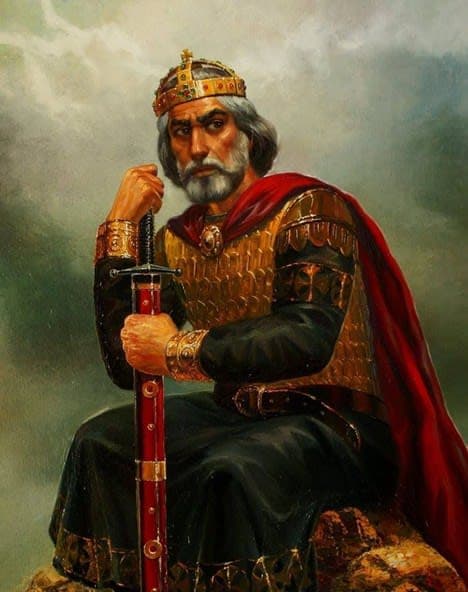

History has preserved only fragmentary evidence of Samuel's early years, much of it carved in stone. The famous "Samuel's Inscription," discovered near Lake Prespa, and the chronicles of John Skylitzes indicate that he was the son of Nikola — an influential comes (governor) who ruled Sredets (modern-day Sofia). His mother, Rhipsime, appears to have been of Armenian descent, judging by her name, while Nikola himself was probably related to the declining dynasty of Krum.
Photograph of the Tombstone Bearing Samuel's Inscription, from the "Proceedings of the Russian Archaeological Institute in Constantinople."

The beginning of Samuel's political career coincided with a catastrophe. In 968–969, Bulgaria found itself trapped between the ambitions of Prince Sviatoslav of Kiev and the might of the Byzantine Empire. Following the death of Tsar Peter I in 969 and the Byzantine capture of the capital, Preslav, in 971, the eastern part of the country was effectively annexed. However, in the west, among the mountains of Macedonia and Albania, the spirit of resistance remained alive. It was here that four brothers, known as the Comitopuli, emerged onto the historical stage: David, Moses, Aaron, and Samuel.

Between 971 and 976, while the legitimate tsar Boris remained in humiliating captivity in Constantinople, the brothers effectively divided the independent western territories among themselves, establishing a unique system of government. David took control of the south (Thessaly), Moses ruled Strumitsa, Aaron governed Sredets, and the youngest brother, Samuel, established his stronghold in Vidin. Their objective was not merely to defend their territories but to prepare for a great counteroffensive.
The favorable moment arrived in 976, following the death of Byzantine Emperor John I Tzimiskes. The Bulgarians immediately launched an offensive. However, the unity of the brothers proved short-lived. Moses was killed during the siege of Serres when he was struck by a stray stone, while David was murdered under mysterious circumstances near Prespa. Some historians still suspect that their ambitious younger brother may have been involved in his death.
Nomisma of John I Tzimiskes. The Reverse Depicts the Emperor Being Blessed by the Virgin Mary, While the Obverse Features an Image of Christ.

In 978, the sons of the late Tsar Peter — Boris and Roman — escaped from captivity and returned to Bulgaria. Boris was tragically killed by his own border guards in a case of mistaken identity, while Roman was recognized by Samuel as the legitimate tsar. However, this arrangement was largely a formality: Samuel, who remained the supreme military commander, concentrated all real power in his own hands.
The true test came in 986. The young and ambitious Emperor Basil II, the future "Bulgar-Slayer," decided to crush Sredets. The siege lasted twenty days, but the Bulgarians resisted fiercely. When the Byzantines began their retreat, Samuel launched a devastating attack against them on August 17, 986, in the Ihtiman Gorge (the Pass of Trajan's Gate). The Byzantine army was almost completely destroyed, and the emperor himself barely escaped with his life.
Byzantine Emperor Basil II Being Crowned by Angels. Reproduction of a Miniature from a Psalter Specially Created as a Gift for Basil II.

This victory, however, exposed internal divisions. Samuel's brother Aaron began secret negotiations with Basil II, hoping to secure sole power in exchange for peace. When Samuel discovered the betrayal, he did not hesitate: on June 14, 987, Aaron was killed in the Battle of Dupnitsa. His entire family was executed, with the sole exception of Ivan Vladislav, who was spared after Samuel's son, Gavril Radomir, intervened on his behalf. From that moment onward, Samuel became the undisputed ruler of Bulgaria.
By 989, his state had reached the height of its power, gaining access to three seas: the Black Sea, the Aegean Sea, and the Adriatic Sea. However, the enemy to the south was gathering strength.
In 997, after receiving news of the death of the captive Tsar Roman in Constantinople, Samuel officially proclaimed himself Tsar of Bulgaria. He moved the capital to Ohrid, transforming its fortress into an impregnable stronghold. Seeking to legitimize his authority independently of Constantinople, he appealed to the Pope in Rome and obtained recognition of his imperial title.
Samuel skillfully combined warfare with diplomacy. His daughter Theodora Kosara married the captured Serbian prince Jovan Vladimir, turning him into a loyal vassal. Their story later became the basis of the first Serbian novel, Jovan and Kosara. Another daughter, Miroslava, married the Byzantine defector Ashot Taronites, while his son Gavril Radomir established an alliance with Hungary by marrying a daughter of its ruler, Géza.

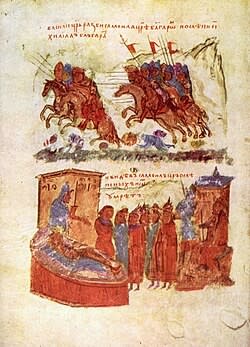
Beginning in 1001, Basil II launched a systematic and relentless campaign to destroy the Bulgarian Empire. One after another, Pliska, Preslav, and Silistra fell. In 1002, after an eight-month siege, Vidin was captured following the betrayal of its local metropolitan. In 1003, Samuel attempted to strike back at Adrianople, but the Byzantines defeated him near the Vardar River, repeating their success at the Battle of Spercheios in 996, where Samuel had barely escaped the massacre carried out by Nikephoros Ouranos.
In 1005, Samuel's son-in-law Ashot surrendered Dyrrhachium to the Byzantines. By 1013, the Bulgarian forces had been exhausted to their limits, but Samuel was preparing for one final, decisive confrontation.
On July 29, 1014, the fateful Battle of Kleidion took place near the village of Klyuch. Samuel had constructed powerful defensive walls across the mountain gorge, hoping to halt the invaders. However, the Byzantine commander Nikephoros Xiphias discovered an alternative route through the mountains and attacked the Bulgarians from behind. The defeat was absolute. Approximately 15,000 Bulgarian soldiers were taken prisoner.
Basil II committed an act of extraordinary cruelty that would forever associate his name with the title "Bulgar-Slayer." He ordered all the prisoners to be blinded, leaving one man with a single functioning eye for every hundred captives to guide the others.
When this horrifying procession of blinded soldiers reached Prespa, Samuel's heart could no longer endure the shock. Seeing his army in such a devastating condition, the great tsar collapsed and died of a heart attack on October 6, 1014.
With his death, Bulgaria lost the central figure who had held the state together. Although the empire survived for another four years, its fate had already been sealed.


