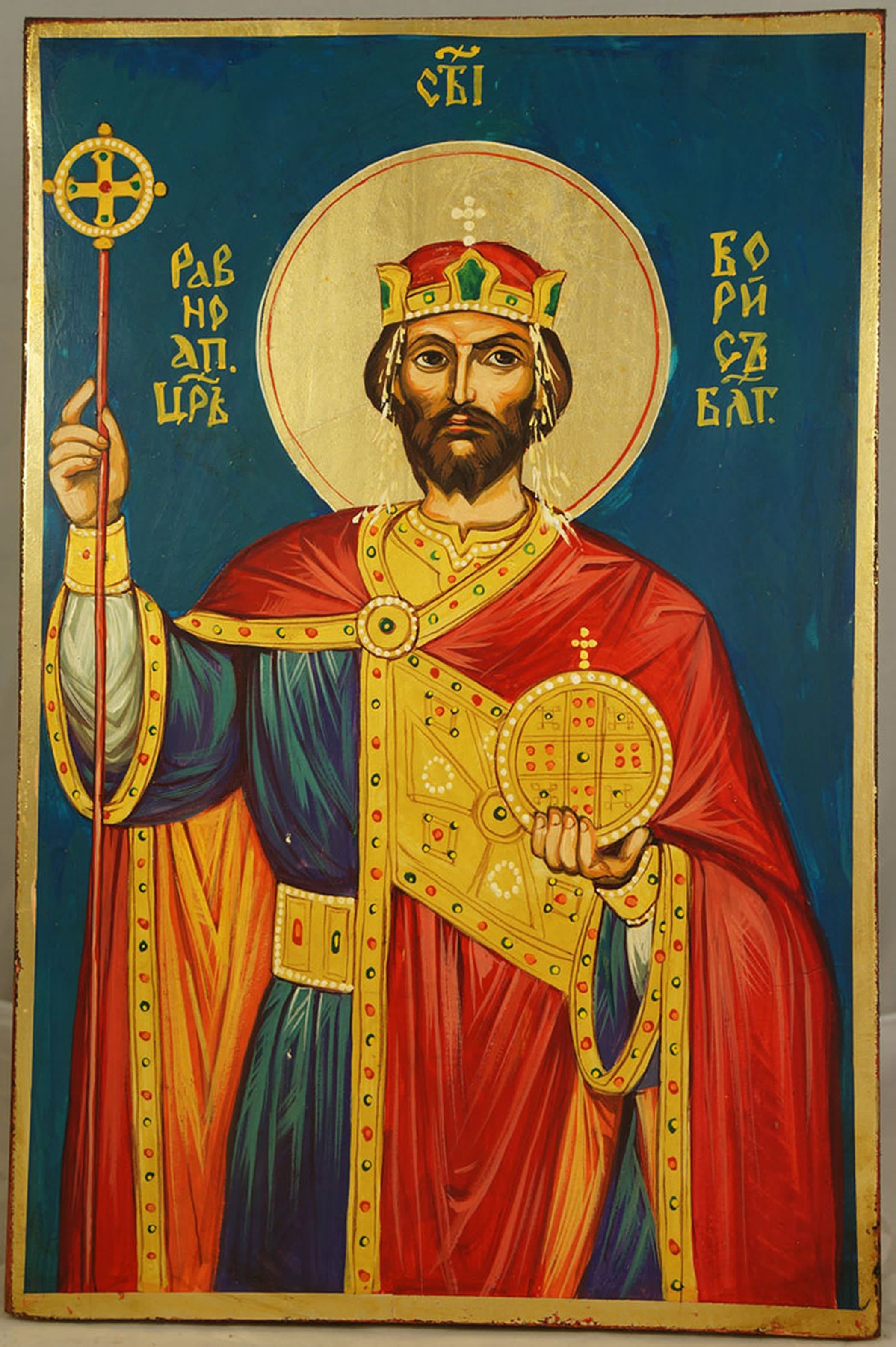

Boris ascended the throne in the mid-9th century, when Europe was engulfed in a struggle for influence between Byzantium and the Frankish Kingdom. In 854, Prince Rastislav of Great Moravia persuaded the Bulgarian ruler to form an alliance against the East Franks. However, this strategic calculation proved unsuccessful: Louis the German, seeking to neutralize the threat, bribed the Croats, who launched a surprise attack on Bulgaria. Caught between two enemies, Boris was forced to retreat. In 855, peace with the Franks was restored, but at a high price — Bulgaria had to abandon its ally Rastislav, leaving him to face his enemies alone.

Misfortune also followed Boris on the southern front. In the war against Byzantium in 855–856, Bulgaria suffered a crushing defeat, losing the strategically important regions of Zagore and Philippopolis (modern-day Plovdiv). Even an alliance with Louis the German could not reverse the situation — the Byzantine military machine proved too powerful. At that moment, Constantinople introduced a condition that would change the course of history: in exchange for peace, the emperor demanded not additional territory but the personal baptism of the Bulgarian khan.

The situation in the west also remained unstable. In 860, attempting to take advantage of internal conflicts in the Serbian principality of Raška following the death of Prince Vlastimir, Boris invaded Serbian territory. However, he suffered another setback: the Serbs defeated the Bulgarian army and captured the heir to the throne, Vladimir-Rasate, along with twelve prominent boyars. Boris was forced to sign an unfavorable peace treaty to secure his son's release. Only in 867, taking advantage of internal turmoil within Byzantium itself, did the Bulgarians manage to retaliate by capturing the city of Ohrid.
Despite these military difficulties, Boris was a shrewd politician. He understood that Bulgaria needed a common foundation to unite its population. The country was suffering from famine, military defeats were undermining the authority of the government, and paganism hindered full diplomatic relations with Christian neighbors. Several individuals close to the khan played important roles in his spiritual transformation. The captive Greek monk Theodore Koupharas became his wise adviser, while Boris's sister Persika (baptized Eupraxia), who had been raised at the Byzantine court, served as a living example of the new faith.
According to one legend, Boris hesitated for a long time before making his decision. The turning point came through an encounter with a monk named Methodius, who was not only a preacher but also a talented painter. Boris commissioned him to create a painting for his country residence, wishing to see hunting scenes that would inspire admiration. However, Methodius persuaded the khan to trust his artistic judgment, promising to create something that would inspire "true fear." When the painting was completed, Boris found himself standing before a depiction of the Last Judgment. The sight of the righteous ascending toward the light and sinners being cast into the abyss shook the ruler so deeply that he finally resolved to accept baptism.
Around 865, Boris received holy baptism, taking the Christian name Michael in honor of his godfather, Emperor Michael III (son of Empress Theodora). This event was of enormous significance. Christianity helped overcome the ethnic divisions between the Turkic Bulgars and the Slavs, laying the foundation for the formation of a unified Bulgarian people. Furthermore, it deprived neighboring states of a formal justification for violating treaties under the pretext of fighting against "infidels."

However, accepting Christianity from Byzantium carried the risk of political dependence. Boris demonstrated exceptional diplomatic flexibility: after entering into conflict with Patriarch Photios, he placed the Bulgarian Church under the authority of Pope Nicholas I in 866. For four years, the Bulgarian Church remained in union with Rome, using this relationship as leverage against Constantinople. Ultimately, in 870, Bulgaria returned to the jurisdiction of Patriarch Ignatios, but this time with extensive autonomy.

The greatest cultural achievement of Boris I was his patronage of the disciples of Cyril and Methodius. In 886, when Clement, Naum, and Angelarius were expelled from Great Moravia, Boris welcomed them with great honors. He understood that Christianity had to be preached in the native language of the people. Under his protection, the great literary schools of Preslav and Ohrid were established. Bulgaria became home to a growing network of schools, monasteries, and churches, emerging as a major center of Slavic literacy and literature, from which learning and religious education would later spread throughout the Orthodox world.
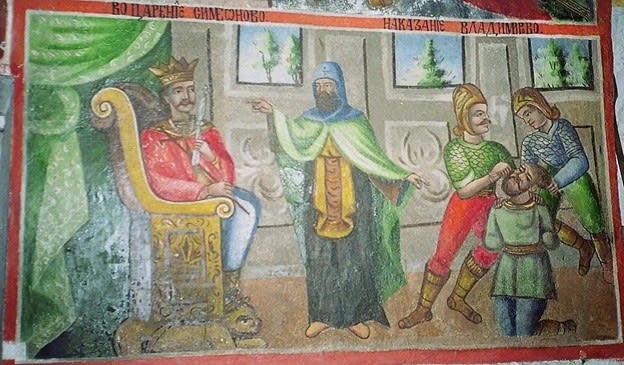
Toward the end of his life, Boris decided to withdraw from worldly affairs and enter a monastery, handing the throne to his eldest son, Vladimir-Rasate. However, Vladimir, raised in the old traditions, attempted to restore paganism and began persecuting Christians. Upon learning of this, the elderly prince cast aside his monastic robes, donned his armor once again, and, gathering his loyal followers, overthrew his impious son. Vladimir was blinded — a harsh punishment for betraying the cause to which his father had devoted his entire life.

In 893, at a great national assembly, Boris placed his third son, Simeon, who would later become known as "the Great," on the throne. Boris returned to the monastery, where he eventually passed away in peace, knowing that his life's work was in capable hands. The Bulgarian Orthodox Church canonized him as Saint Tsar Boris the Baptizer.


