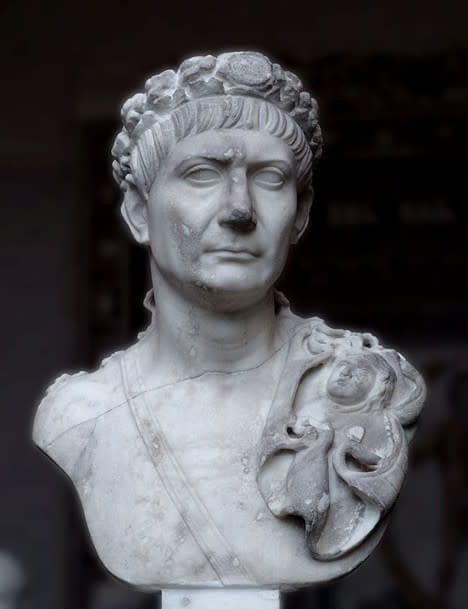

Trajan was the first Roman emperor born outside Rome. His family, the Ulpii, came from the city of Italica in Spain. His father, Marcus Ulpius Traianus the Elder, was the first of the line to attain senatorial rank. He had a brilliant military career, serving under such eminent commanders as Corbulo and Vespasian. For his merits he attained the consulship and, after his death, was deified. Trajan’s mother was Marcia, of noble birth.

Trajan was born on September 15, 53 CE. He began his career in 74, progressing through a series of administrative and military posts. He served as a military tribune in Syria and Germany and later as quaestor and praetor. In 87 he became legate of Legio VII Gemina in Spain and took part in suppressing Saturninus’s revolt in 89. For this he was rewarded with the consulship in 91.
After Domitian’s assassination in 96, the elderly senator Nerva came to the throne. His position was precarious due to discontent in the army and the praetorian guard, who had been loyal to Domitian. In October 97 the praetorians rose in revolt, demanding punishment of Domitian’s killers. Aware of his weakness, Nerva took the prudent course and allowed the assassins to be executed.

At the time, two factions in the Senate vied for influence one backing the governor of Syria and the other favoring Trajan. Realizing he needed a strong successor, Nerva devised a new method of transferring power: the emperor would adopt his heir, choosing him for personal qualities rather than blood. Nerva chose Trajan, then governor of Upper Germany, who had just brought a campaign against the Suebi to a successful close. In September 97 Trajan was adopted by Nerva. He received the title “imperator” and effectively became co-ruler. Nerva died on January 25, 98. Trajan did not immediately return to Rome but remained in Germany to secure the frontier, making a triumphal entry into the city only in September 99.
Immediately after his accession Trajan began preparing a Dacian campaign to secure the Danubian frontier once and for all against raids by the Dacians under Decebalus. He assembled a massive force of 12 legions and 78 auxiliary cohorts up to 200,000 men in total.
In March 101 the Roman army crossed the Danube by a pontoon bridge. The Dacians put up fierce resistance. In September a bloody battle was fought at Tapae. Rejecting Decebalus’s bid for peace, Trajan moved to aid the forts south of the Danube and won at Adamclisi, though with heavy losses. Even so, the Romans drove the Dacians back into the mountains.
At the end of 102 Trajan accepted peace, but on harsh terms for the Dacians. He also ordered the construction of a grand stone bridge over the Danube so that reinforcements could be brought up quickly in the event of renewed war.


The second Dacian campaign began on June 4, 105. The Romans invaded Dacia again, and in early summer 106 they besieged the Dacian capital, Sarmizegetusa. The Romans cut the aqueduct, and the city fell. The Dacians set it ablaze, and some nobles took their own lives. Decebalus fled but was overtaken and committed suicide; his head and right hand were sent to Rome.
By the end of summer 106 Dacia had become a Roman province. A new capital, Ulpia Traiana, and Roman colonies were founded there. Settlers poured into the new lands, drawn by their riches especially gold. The Dacian wars brought many able commanders to prominence. In 107 Trajan celebrated a triumph; the games lasted 123 days, and the war booty was immense.

After Dacia, Trajan turned his foreign policy to the East, where Rome could continue to expand. Immediately after the conquest of Dacia he annexed the Nabataean Kingdom, taking advantage of the death of its last king. In early 107 an army under Aulus Cornelius Palma Frontonianus seized Petra, the Nabataean capital, and the new province of Arabia Petraea was established.
To secure the province, Trajan ordered the construction of the via Nova Traiana, a road running north–south that marked the empire’s eastern frontier an engineering marvel.
After unsuccessful negotiations with the Parthian king Osroes in 113, Trajan prepared a major campaign. He assembled an army of eleven legions. In 114 he reached Antioch and then marched into Armenia, the key buffer between Rome and Parthia.

Trajan quickly occupied the Armenian highlands, annexed Armenia and part of Cappadocia, and formed a new province of Armenia. In 115 he advanced into northwestern Mesopotamia, encountering little resistance from local princes. By year’s end Mesopotamia was also proclaimed a Roman province.
In spring 116 Roman forces advanced along both the Euphrates and the Tigris. The Parthian capital Ctesiphon fell with little difficulty. Trajan achieved unprecedented success: he created a new province of Assyria and reached the Persian Gulf. According to legend, on seeing a ship bound for India he exclaimed, “Were I young, I would without doubt sail for India.”
But in 115, behind the Roman lines, Jewish uprisings broke out in Cyrenaica, Cyprus, and Alexandria. Rebels destroyed temples and clashed violently with the local populace. The following year Parthians and Jews mounted a guerrilla war across Armenia and Mesopotamia. Trajan struggled to keep control. He dispatched the commander Lusius Quietus, who stormed and burned the secessionist cities of Seleucia and Edessa. Elsewhere, however, the Romans suffered defeat, and Trajan was forced to negotiate.
In domestic policy Trajan continued the course begun by his predecessor Nerva. He held the consulship only nine times, often granting it to his friends. He admitted new senators from the eastern provinces and halted prosecutions for lèse-majesté.
Trajan also expanded the alimentary system launched by Nerva. He established local funds that paid monthly stipends to children from poor families. He required senators to invest part of their wealth in Italian agriculture, reducing Italy’s dependence on imported grain.
The victorious Dacian campaigns brought vast quantities of gold and silver into the treasury. Trajan remitted all taxes for the year 106 and gave each taxpayer 650 denarii.

Trajan undertook an enormous building program. Under the architect Apollodorus of Damascus, new monuments rose the Forum and Markets of Trajan and the famous Trajan’s Column, whose spiraling reliefs depict scenes from the Dacian wars. He also built the Aqua Traiana aqueduct and a new hexagonal harbor at Ostia, greatly improving Rome’s food supply. His building was so ambitious that many works such as the great bridge over the Tagus in Spain still stand today.

Trajan’s dealings with early Christians were complex but pragmatic, as shown in his correspondence with Pliny the Younger, governor of Bithynia. Christian communities (ecclesiae) were not registered with the authorities and were therefore illegal. In response to Pliny’s query about how to handle Christians, Trajan replied that they were not to be sought out and anonymous accusations were to be ignored. If someone was denounced and proven guilty, he should be punished, but only if he refused to worship the Roman gods; if he recanted, he was to be pardoned. For its time, this was a relatively mild policy.
In the Middle Ages a legend arose that Pope Gregory the Great, moved by a tale of Trajan’s virtue, prayed for his soul and was granted a vision that the pagan Trajan had been saved from hell.
Late in his reign Trajan fell ill during the siege of the fortress of Hatra in Mesopotamia poisoning was suspected. He lifted the siege, handed command to his relative Hadrian, and set out for Rome, but died on August 9, 117, in the city of Selinus. His ashes were brought to Rome and placed in the base of his triumphal column.


Tacitus called Trajan’s reign “the happiest age,” and later emperors were greeted with the wish that they be “more fortunate than Augustus and better than Trajan.” Trajan was an outstanding general, who subdued the Dacians, expanded the eastern frontier, and laid new roads. He was also a superb administrator, improving Rome’s provisioning and ensuring public safety.
Trajan was tall and well built. He loved hunting, swimming, and sport. He was modest and unassuming in manner, often visiting friends and freely mixing with ordinary people. It was said that once, setting out on campaign, he personally returned to court to help a woman who complained of injustice.
Cassius Dio wrote that Trajan was marked by justice, courage, and simplicity; he envied no one and committed no unlawful killings. He spent generously on public works such as roads and buildings. Though he had weaknesses fondness for wine and for youths they did not prevent him from being a wise and judicious ruler. Aurelius Victor praised his justice and loyalty to friends. Trajan trusted his men so much that, handing a dagger to the praetorian prefect, he said: “I give you this weapon to guard me if I rule rightly; if not, to use against me.” He did not allow orders issued after long banquets to be carried out, knowing that a drunk man cannot make sound decisions.


