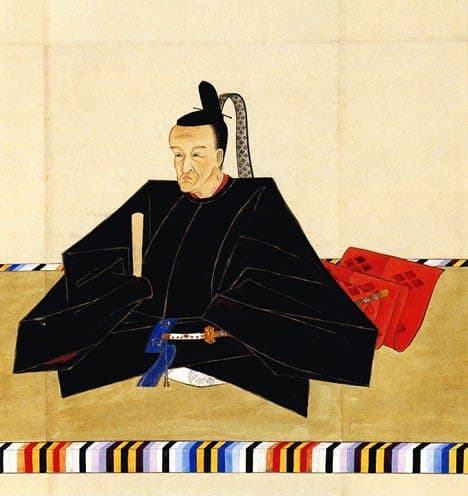

Tokugawa Ieyoshi was born as the second son of the great and long-ruling eleventh shogun, Tokugawa Ienari, whose era (1787–1837) was marked by outward splendor but deep internal decay within the state apparatus. Ieyoshi’s fate was predetermined by his birth: in April 1837, in a solemn ceremony, he was officially proclaimed the new shogun of Japan. However, for a long time this title remained little more than a formality. His father, Ienari, even after officially retiring, retained the status of ōgosho (retired shogun) and continued to hold all the threads of government in his hands from within his palace.

Ieyoshi’s actual rule began only in 1841, after his father’s death. By that point, the new ruler lacked not only political will, but even basic experience. Ienari, absorbed in personal pleasures and the intrigues of the harem, had made no effort at all to prepare his heir for the heavy burden of power. As a result, Ieyoshi entered history as the “shogun of ‘So be it.’” This bitterly ironic nickname arose from his habit of responding to officials’ reports, advisers’ proposals, and difficult affairs of state with the same indifferent phrase: “Well then, so be it.” He preferred to delegate responsibility rather than assume it himself, which created ideal conditions for the rise of ambitious reformers.
Realizing that the country was in deep crisis, Ieyoshi entrusted the conduct of government affairs to the energetic and hard-line politician Mizuno Tadakuni (1794–1851). Mizuno, who became head of the senior councillors (rōjū), initiated large-scale changes that entered history as the Tenpō Reforms (1841–1843). These reforms were not innovative; on the contrary, they were an attempt to turn back time by looking to idealized models from the past — namely, the Kyōhō and Kansei reforms.
The government’s main objective was to strengthen the weakened position of the samurai as the dominant social estate. Mizuno and the shogun who supported him believed that the country’s salvation lay in the strictest austerity and a return to the puritanical morals of the ancestors. Severe bans were imposed on every manifestation of luxury: lavish festivities, expensive fabrics, and even tobacco smoking were prohibited. At the same time, censorship was tightened: books and theatrical performances that, in the authorities’ view, might corrupt morals or undermine the authority of the bakufu were ruthlessly banned.
The sharpest aspect of the reforms was the struggle against the growing economic power of the merchant class, which by the mid-nineteenth century effectively held the country’s finances in its hands. In December 1841, a radical edict was issued ordering the dissolution of the kabunakama — monopoly merchant guilds and trade associations. The government hoped that abolishing monopolies would lead to freer trade and, as a result, lower prices for essential goods. However, the outcome was exactly the opposite: the destruction of established commercial networks caused chaos in the markets, disruptions in supply, and an uncontrolled rise in prices.
In 1842, pressure on the economy intensified: new edicts followed, banning all forms of wholesale associations. In addition, the government tried to solve the debt problems of its direct retainers — the hatamoto and gokenin — by forcibly eliminating interest on their debts to moneylenders. These measures provoked fierce, though mostly concealed, resistance from the merchant class. Merchants began to sabotage official orders, hide goods, and artificially create shortages.
The weakness of the regime became obvious very quickly. By September 1843, unable to withstand criticism and the consequences of economic collapse, Mizuno Tadakuni was forced to resign. The bakufu gradually began to repeal its most odious edicts, although the final abolition of the ban on the kabunakama did not take place until 1851. The failure of the Tenpō Reforms demonstrated that traditional methods of government no longer worked, and that the entrepreneurial class had become a force with which the shogunal government could no longer cope.
It is noteworthy that, against the background of the central government’s failures, some economically developed domains (han) succeeded in carrying out their own reforms. There, the transformations were led by capable men from the lower samurai ranks, who acted with greater flexibility and pragmatism. This only underscored the weakness of Ieyoshi’s reliance on conservative methods.
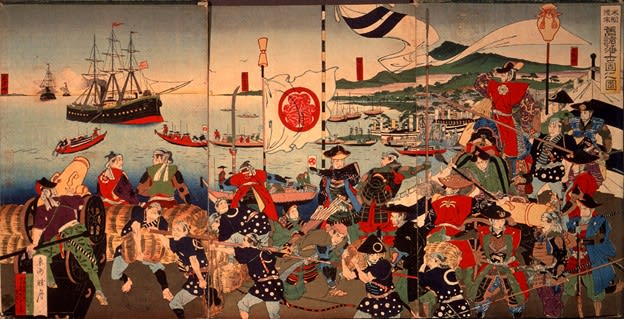
The end of Tokugawa Ieyoshi’s life and reign coincided with the beginning of the greatest foreign-policy crisis in Japanese history — the arrival of Commodore Perry’s “Black Ships.” The shogun, whose health was already weakened, did not survive this shock. On July 27, 1853, the sixty-year-old ruler died, leaving the country in a state of extreme uncertainty and on the brink of civil war. His ashes were laid to rest in the Buddhist temple of Zōjōji in Edo (modern Tokyo), while the heavy legacy and the emptying treasury passed to his son, Tokugawa Iesada, who was destined to witness the final collapse of the system his father had tried so desperately to preserve.