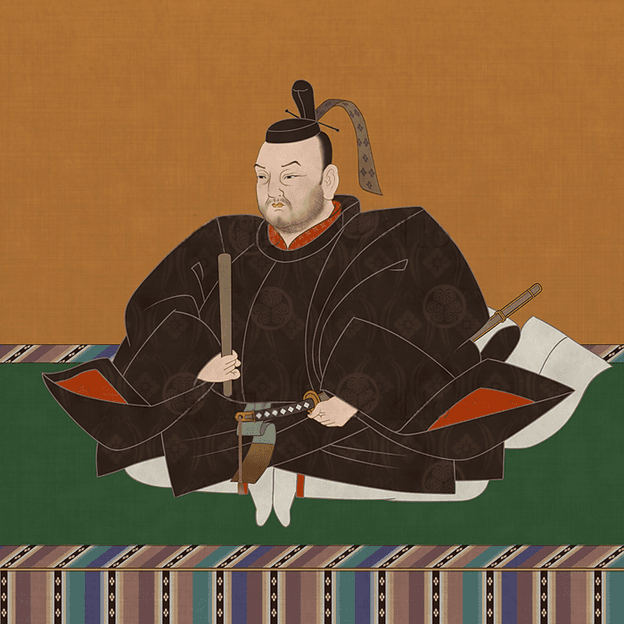

Tokugawa Ietsuna was born in 1641, becoming the eldest son of the formidable Tokugawa Iemitsu. His birth came at a time when the echo of the Shimabara Rebellion (1637) had not yet faded, and his father’s anti-Christian reforms were only gaining momentum. As the great-grandson of the great Ieyasu, Ietsuna seemed destined to inherit the iron character of his ancestors, yet fate decreed otherwise: the boy grew up as an extremely frail and sickly child. His poor health, from an early age, cast doubt upon the future of the dynasty, creating an atmosphere of тревога within Edo Castle.
When, at the beginning of 1651, Tokugawa Iemitsu died at the age of 47, the shogunate found itself in an unprecedented situation. For the first time, power passed to a child — Ietsuna was only ten years old. For samurai Japan, where the ruler’s authority rested upon his personal strength and military genius, the enthronement of a boy became a moment of the greatest vulnerability.
Understanding that a ten-year-old ruler would not be able to keep ambitious daimyo under control, a council of regents was formed. These men became the architects of stability, effectively governing the country in Ietsuna’s name until he reached adulthood.
The composition of the “Great Regency”:
Hoshina Masayuki: an illegitimate son of Hidetada and Ietsuna’s uncle, who became the moral compass of the government.
Matsudaira Nobutsuna: a brilliant strategist and a distant relative of the clan.
Sakai Tadakatsu and Sakai Tadakiyo: influential officials who represented the interests of the old aristocracy.
Inaba Masanori: an experienced administrator who ensured continuity with Iemitsu’s policies.
The first serious test for the new government was the Keian Uprising in 1651. Masterless samurai (ronin), led by Yui Shosetsu and Marubashi Chuya, planned a bold coup: the seizure of Edo Castle and the destruction of the Tokugawa house. Shosetsu, inspired by the example of Toyotomi Hideyoshi, dreamed of turning Japan into a meritocracy, where birth would no longer matter. However, the conspiracy was uncovered by the regents with ruthless efficiency. Marubashi was executed together with his entire family, while Shosetsu chose to commit seppuku rather than fall into the hands of the executioners. A similar attempted rebellion on Sado Island in 1652, involving around 800 ronin, was likewise crushed before it could develop.
If rebellions could be suppressed by force of arms, the shogunate was powerless against the forces of nature. In 1657, when Ietsuna was sixteen, Edo suffered catastrophe — the Great Fire of Meireki. The flames almost completely wiped the capital from the face of the earth, destroying even the main keep of Edo Castle. This event became a turning point: under the guidance of the regents and with Ietsuna’s formal approval, the city was not merely rebuilt, but redesigned according to more modern and safer standards. In 1659, the rebuilt Edo was officially inaugurated — a city that had transformed from a military fortress into a true metropolis.


In 1663, the regency formally came to an end, although the old advisers remained at court and retained enormous influence. It was precisely during this period that Ietsuna began to show himself as a legislator. One of his most important acts was the prohibition of junshi — the ritual suicide of a vassal after the death of his lord. This law dealt a crushing blow to medieval morality, shifting samurai loyalty from the sphere of mystical self-sacrifice into that of civil service to the state.
“The world no longer needs death for one’s lord; the world needs life in the name of order” — such was the unspoken slogan of this reform.
Yet the calm was only relative. In 1669, the Ainu rebellion broke out in Hokkaido, and in 1671 the shogun had to intervene personally in a prolonged inheritance dispute within the powerful Date clan (known as the Date Incident) in order to prevent the outbreak of a new civil war among the northern clans.
By 1671, most of the old advisers had died or retired. Ietsuna at last received the full plenitude of power, but his health continued to deteriorate. In his final years, he increasingly withdrew from affairs of state, which gave rise to new political intrigues.
In 1679, when it became clear that Ietsuna would not recover, Sakai Tadakiyo advanced a radical proposal: to invite the son of Emperor Go-Sai to assume the post of shogun. This would have turned the Tokugawa house into something resembling the Hojo regents, pushing them away from direct rule. However, the family council of the Tokugawa clan rejected this idea and appointed the shogun’s younger brother, Tsunayoshi, as heir.
On June 4, 1680, Tokugawa Ietsuna died at the age of 39. He was buried in Kaneiji Temple in Ueno. Despite his reputation as a “weak” ruler, it was under him that Japan finally completed the transition to civil government. He was not a conqueror, but he was a guardian of peace, who managed to preserve the country from chaos at its most dangerous moment — the moment of a generational transition.
His reign proved that the system created by Ieyasu was so strong that it could function even when a sickly child stood at its head, provided that loyal and wise advisers stood beside him. Ietsuna laid the foundation for the “Golden Age” of Genroku, which would arrive under his successor.


