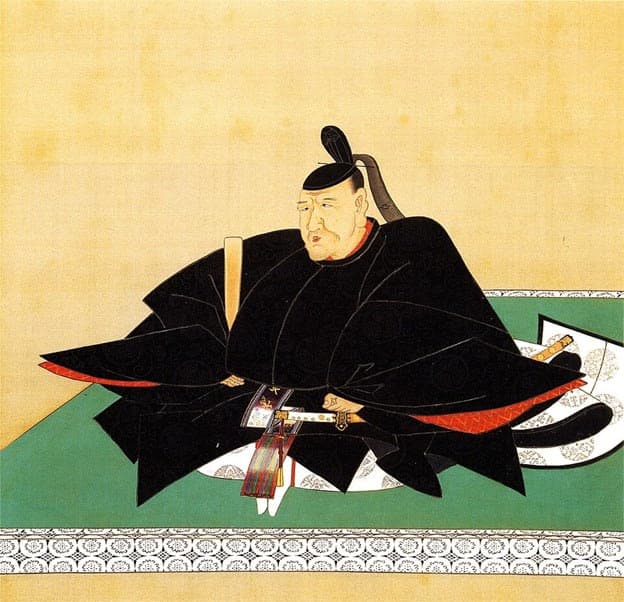

Tokugawa Ieshige was born into the family of the eighth shogun, Yoshimune, whose reign became the gold standard of administrative skill. Yet life was harsh to the firstborn son of the great reformer. From early childhood, Ieshige suffered from severe chronic illnesses, the most noticeable of which was a speech defect that made his words almost unintelligible to those around him.
Despite his obvious frailty, in the samurai state of that time the law of primogeniture stood above personal qualities. In 1745, when Yoshimune decided to abdicate voluntarily, it was Ieshige who was proclaimed the new shogun of Japan. This decision caused much controversy at court, for Ieshige’s younger brothers — Munetake (1716–1771) and Munetada (1721–1764) — possessed strong health, sharp minds, and seemed far better suited to the role of supreme ruler. Nevertheless, Yoshimune remained faithful to tradition and solved the problem of competition through an elegant political maneuver: he granted his brothers their own domains, thus creating new collateral branches of the clan. Thus Munetake became the founder of the Tayasu Tokugawa line (1731), and Munetada of the Hitotsubashi Tokugawa line (1746). Later, Ieshige’s own second son, Shigeyoshi, founded the third branch — the Shimizu Tokugawa line (1758). Together, these three houses formed the influential group known as the Gosankyō, which became a pillar of the dynasty for decades to come.

The first years of Ieshige’s reign passed under the unspoken supervision of his father. Until his death in 1751, Tokugawa Yoshimune continued to retain the real levers of power, though he had formally withdrawn from office. Ieshige, unable to participate fully in discussions and council meetings, gradually removed himself from state affairs.

After his father’s death, the shogun’s position became even more isolated. The sole link between the ruler and the outside world was his personal secretary, Ōoka Tadamitsu (1709–1760). Tadamitsu occupied a unique place in Japanese history: he was the only person who claimed to fully understand Ieshige’s “barely intelligible” speech. In effect, all state policy of that period passed through the filter of the secretary’s interpretation. When the shogun issued an order, Tadamitsu would “translate” it for the advisers. This gave rise to many rumors and intrigues, yet it allowed the administrative machine of the bakufu to continue functioning without disruption, preserving the momentum of Yoshimune’s reforms.
Deprived of the opportunity to shine in politics or on the battlefield, Ieshige found consolation in intellectual combat. He was a passionate devotee of shogi, Japanese chess. In this game, where words were unnecessary and only logic and strategy mattered, the shogun displayed remarkable ability. His skill was so great that he not only played at the level of professionals, but also left behind a theoretical legacy — a book devoted to the subtleties of shogi. For him, the board and its pieces were the only space in which he felt himself a complete and powerful ruler.
By 1760, Ieshige’s health had finally deteriorated beyond recovery. Realizing that his time was running out, he decided to relinquish power in favor of his eldest son, Tokugawa Ieharu. This transition took place peacefully, ensuring the preservation of stability in the country.
Tokugawa Ieshige died on July 13, 1761. His ashes were laid to rest in the Buddhist temple of Zōjō-ji in Tokyo, beside the graves of his ancestors. In the memory of posterity, he remained a tragic figure — the “silent shogun,” whose reign was more a period of preserving the existing order than a time of great change. And although he is often reproached for passivity, it was under him that the Gosankyō system was created, which later saved the dynasty from extinction, while his devotion to shogi is still honored by admirers of this ancient game.



