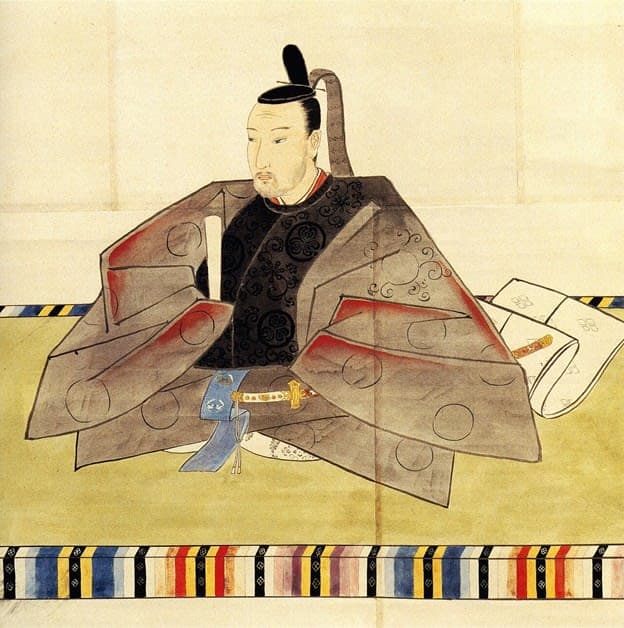
Tokugawa Iesada assumed the reins of power in June 1853, at the age of twenty-nine, immediately after the death of his father, the twelfth shogun, Ieyoshi. His accession at Edo Castle coincided with the gravest state crisis Japan had yet faced: one month earlier, the American squadron of Commodore Matthew Perry had entered Japanese waters and demanded that the country open itself to the outside world. Iesada found himself at the center of a political storm for which he was utterly unprepared — not only because of the circumstances, but also because of his fragile health.


From birth, Iesada was a sickly and physically weak man. His condition left a harsh mark on his style of rule: during his five years in power, he took almost no personal part in the exhausting diplomatic negotiations and council meetings. While the fate of the state was being decided beyond the palace walls, the shogun remained in the background, leaving his ministers and advisers to conduct the dangerous game on the international stage. This created a paradoxical situation: the supreme ruler of the country was the formal guarantor of its sovereignty, yet in practice he was little more than a spectator in a grand historical drama.
The period of Iesada’s rule entered history as the time of Japan’s forced opening to the outside world. Under pressure from the overwhelming military superiority of the Western powers, the bakufu government was compelled to sign a series of agreements that became known as the “unequal treaties.” The first major step was the Treaty of Kanagawa with the United States, signed on March 31, 1854, followed by a treaty of friendship with Great Britain in Nagasaki on October 14, 1854.

Relations with the Russian Empire played a particularly important role in this process. In January 1855, the first Russo-Japanese treaty was signed in the city of Shimoda, establishing official diplomatic relations and laying the foundations for territorial demarcation. However, the real “floodgate” for foreign influence opened in 1858, when an entire series of treaties of friendship and commerce was concluded: with the United States (the famous Harris Treaty of July 29), the Netherlands (August 18), Russia (August 19), Great Britain (August 26), and France (October 9).

These documents effectively dismantled the system of national seclusion (sakoku), but the cost was enormous. Japan lost its tariff autonomy, while foreigners received sweeping rights and privileges. This policy provoked fierce protest from the imperial court in Kyoto. Emperor Kōmei became the shogunate’s chief ideological opponent, sowing the seeds of the future conflict between the two centers of power and fueling the rise of nationalist sentiment under the slogan Sonnō jōi — “Revere the Emperor, expel the barbarians!”

Despite its political weakness, Iesada’s government understood the need for change. In 1855, with active Dutch support, the first naval training school was opened in Nagasaki. Instruction there was provided by experienced Dutch officers, and at first its cadets were recruited from the direct retainers of the bakufu, later also from samurai of various domains. This was the first cautious step toward the creation of a modern Japanese navy, which within a few decades would become one of the strongest in the world.
The shogun’s personal life was also subordinated to political interests. In November 1856, Iesada married Princess Atsu (Atsu-hime), the adopted daughter of the influential Satsuma daimyō, Shimazu Nariakira. This union was an attempt to strengthen ties between the central government and the powerful southern domains, which were increasingly expressing dissatisfaction with Edo’s policies. Princess Atsu would later become one of the most significant women in Japanese history, displaying remarkable strength of character during the years of the shogunate’s collapse.

Iesada’s life came to an abrupt and tragic end. On August 14, 1858, the thirty-four-year-old shogun died without leaving a direct heir. He was buried in the sacred Kan’eiji Temple in Ueno, but outside the temple walls a true political storm broke out.
The late ruler’s lack of children provoked a bitter struggle for power between two factions within the bakufu. A group of influential daimyō, including Tokugawa Nariaki of Mito and the rulers of Satsuma, promoted the candidacy of the talented and energetic Tokugawa Yoshinobu, the future last shogun. However, the conservative wing of officials and the influential women’s quarters of the shogun’s household, led by the powerful minister Ii Naosuke, prevailed. They succeeded in securing the appointment of the young Tokugawa Iemochi.
This success of Ii Naosuke’s supporters led to bloody consequences. In order to suppress the opposition and silence critics of the bakufu’s foreign policy, the large-scale Ansei Purge began. The persecution of political opponents only further destabilized the country, turning Iesada’s era from merely a “difficult time” into a prelude to civil war and the final fall of samurai rule.


