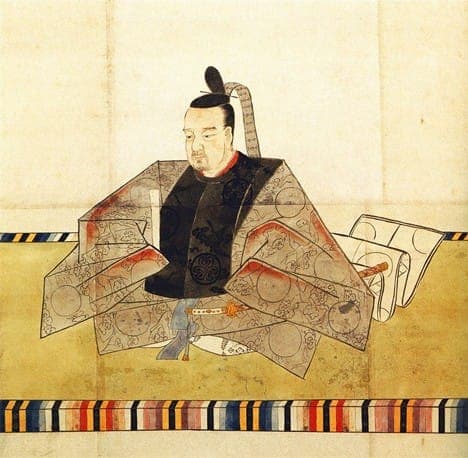

Tokugawa Ienari was not a direct heir to the shogunate by birth. He was born into the family of Tokugawa Harusada, head of the Hitotsubashi house — one of the three influential collateral branches (gosankyō). His father, Tokugawa Harusada, possessed not only political weight but also exceptional determination: he methodically removed rivals from other related houses, seeking to clear the path to power for his son. Fortune smiled upon the family in 1781, when the childless tenth shogun, Ieharu, officially adopted the young Ienari.

In 1787, after the death of Ieharu, the fourteen-year-old Ienari was proclaimed the eleventh shogun of Japan. His rule began with a significant alliance: in 1789 he married Tadako, the daughter of the powerful tozama daimyō of Satsuma, Shimazu Shigehide. This marriage was not merely a family matter, but a subtle political move designed to pacify the ambitious southern lords.
Since Ienari ascended the shogunate as a teenager, real control of the government from 1787 to 1793 remained in the hands of the regent, Matsudaira Sadanobu. Sadanobu, the grandson of the great reformer Yoshimune, saw his mission as the restoration of former strictness and Confucian morality. His policies, known to history as the Kansei Reforms, were an attempt to halt the decay of the state.

Sadanobu acted decisively and at times ruthlessly:
He demanded frugality from all social classes, fighting luxury, bribery, and fraud.
The daimyō were required to create strategic rice reserves in preparation for famine, which had tormented the country in previous years.
Education and scholarship were placed on the rigid track of Zhu Xi Neo-Confucianism, and any deviation from it was suppressed.
To ease the burdens of the samurai class, the regent issued decrees annulling the debts owed by Tokugawa vassals to merchants and moneylenders.
However, such policies provoked deep resentment. Merchants, whose economic power the government sought to restrict with administrative restraints, and the nobility, exhausted by endless austerity, became united in their rejection of the regent. In 1793, Matsudaira Sadanobu was removed from office, and Ienari at last began to rule independently.
After Sadanobu’s departure, the character of Ienari’s rule changed beyond recognition. This period became known as the Ōgosho jidai — the age of rule by the retired shogun, although in practice Ienari long remained firmly in control. The shogun lost interest in reform and immersed himself in personal affairs, turning Edo Castle into the epicenter of an extraordinarily complex web of kinship and patronage.
The names and numbers associated with Ienari’s private life are astonishing: he fathered fifty-five children by forty concubines. The maintenance of this enormous family, along with the endless army of courtiers, became a heavy burden on the state budget. Yet Ienari used his fertility as a political instrument: he skillfully arranged marriages between his sons and daughters and members of the most powerful daimyō houses, quite literally “binding” Japan to the Tokugawa clan through family ties. Many of his children, such as Narisuke Naruhiro and Tokugawa Narikatsu, later played key roles in the turbulent events of the late Edo period.
Behind the outward splendor of court life lay deep social wounds. In the 1830s, Japan was struck by the catastrophic Tenpō Famine. Tax revenues sharply declined, and the government could find no better solution than to return to the ruinous practice of debasing the currency. This triggered inflation, which finally crushed an already impoverished population.


The people’s despair erupted into one of the century’s most dramatic upheavals — the rebellion of Ōshio Heihachirō in 1837. A former Osaka official, outraged by the authorities’ inaction in the face of mass starvation, he rose in revolt against injustice. Although the uprising was quickly suppressed, the very fact that an official had turned against the system was a grave alarm for the bakufu.
Despite the policy of self-isolation, the penetration of Western knowledge continued under Ienari. In 1823, the German physician and naturalist Philipp Franz von Siebold arrived on the island of Dejima. He taught the Japanese medicine and botany, becoming a genuine idol among local scholars of Dutch learning.

However, in 1830 a scandal broke out: a map of Japan, forbidden for export, was found in Siebold’s luggage. The physician was expelled, and his Japanese colleagues, including Takahashi Kageyasu, who had given him the map, were subjected to repression. For a time, this event froze the development of Western sciences in the country, frightening the intellectual elite.
In April 1837, weary of the burden of power, Ienari officially abdicated in favor of his second son, Ieyoshi. However, true to the habits of his predecessors, he retained all real levers of influence as the “retired shogun” until his death.
Tokugawa Ienari died on March 22, 1841, at the age of sixty-seven. He was buried at Kan’eiji Temple, leaving to his successor a country standing on the threshold of great upheavals. His reign became the “swan song” of the old order: splendid, populous, and outwardly stable, yet inwardly already undermined by the inevitable course of history.


