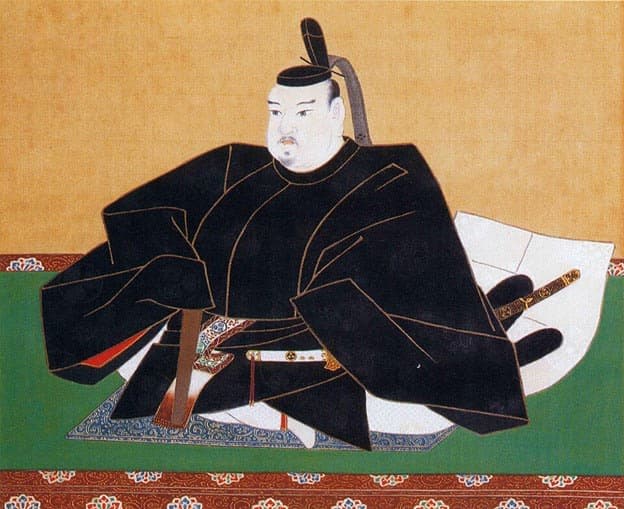
If the reign of Ieyasu was the time of foundation, and the reign of Hidetada the time of consolidation, then the era of the third shogun, Tokugawa Iemitsu, became the period of the final and severe “freezing” of the Japanese state into the form we know as the great peace of Edo. His life journey, which began on August 12, 1604, in the Western Court of Edo Castle, was marked not only by the splendor of supreme power, but also by deep personal dramas that shaped his harsh and resolute character. As the second son of Tokugawa Hidetada and his principal wife Azai Go, Iemitsu was paradoxically deprived of parental affection. All the love and hopes of the shogunal couple were directed toward his younger brother Tadanaga, while Iemitsu grew up under the exceptional care of his wet nurse, the powerful and devoted Kasuga no Tsubone.


Iemitsu’s fate as future ruler hung by a thread. After the premature death of his elder brother Chomaru, a silent but fierce struggle over succession broke out within the Tokugawa clan. His parents openly favored Tadanaga, and only the decisive intervention of Kasuga no Tsubone, who secretly went to the patriarch of the family — the great Tokugawa Ieyasu — changed the course of history. Ieyasu, faithful to the traditions of seniority, personally proclaimed Iemitsu the official heir, granting him his own childhood name — Takechiyo. This act of recognition forever fixed in Iemitsu’s soul the deepest reverence for his grandfather, whose cult he would later elevate to the rank of a state religion. In 1620, having undergone the coming-of-age ceremony and taken the name Iemitsu, he received from the Imperial Court the rank of Senior Counselor of State, preparing to assume the reins of power.

On August 23, 1623, Iemitsu officially assumed the office of shogun after a visit to Kyoto together with his father. However, as in the case of his predecessor, the first years of his rule were marked by a period of dual authority. While Hidetada was still alive and bore the title of daijo tenno (retired shogun), Iemitsu dealt chiefly with the social affairs of the Kanto region and with formal military procedures. During this same period, in 1625, he married Takatsukasa Takako, the daughter of an imperial counselor. Although this union produced no heirs, the shogun’s personal life was full: eight concubines bore him five sons and one daughter, ensuring the continuation of the dynasty.
Iemitsu’s true rule began on March 14, 1632, immediately after Hidetada’s death. Having become the full master of Japan, he at once set about eliminating any possible opposition. The first target was his own brother Tadanaga: Iemitsu confiscated his vast lands and, without hesitation, compelled him to commit seppuku, thus forever removing the shadow of competition within the family. In order to weaken the influence of the old guard of senior ministers, who still remembered his father, Iemitsu in 1634 created the post of junior elders (wakadoshiyori), appointing to it commanders of the guard personally loyal to him. His visit to Kyoto that same year at the head of a grand 300,000-man army was an unmistakable signal to all Japan: Tokugawa power was now absolute.

Iemitsu’s centralizing course was ruthless toward the regional lords — the daimyo. Between 1632 and 1636, he carried out a series of punitive land confiscations against the so-called tozama daimyo (“outside lords”), whose loyalty was considered doubtful. The famous case of Kato Tadahiro, stripped of Kumamoto Castle, became a lesson for the entire country. In 1635, Iemitsu tightened the Laws for the Military Houses, introducing the sankin-kotai system — the compulsory periodic attendance of daimyo in Edo. This arrangement, which forced the lords to maintain lavish residences at the shogun’s seat and leave their families there as hostages, effectively drained regional budgets and prevented any attempt at rebellion.
It was under Iemitsu that Japan finally slammed its doors shut to the outside world, entering the age of sakoku. Driven by the desire to protect the country from colonial influence and the “corrupting” effect of Christianity, the shogun turned the island state into an impregnable fortress. From 1633, Japanese subjects were forbidden to return from abroad, and by 1635, departure from the country was banned for all subjects under penalty of death. The decisive step was taken in 1639 after relations with Portugal were severed. The only remaining “window” to Europe was the artificial island of Dejima in Nagasaki, where the Dutch were permitted to trade under the strictest supervision.
Domestic policy in religious matters was equally severe. Christianity was declared illegal, and its adherents were subjected to the harshest persecutions. The climax of this resistance came in the powerful Shimabara Rebellion of 1637, which, although suppressed, forced Iemitsu somewhat to soften his methods. The great famine of 1641–1642 and the threat of social explosion compelled the government to shift from pure repression to attempts at stabilizing peasant life. The edict of 1649 became a kind of moral code for the countryside, prescribing diligence and frugality, forbidding wastefulness and even tobacco smoking.
Tokugawa Iemitsu died on June 8, 1651, at the age of 46, in the main court of his विशाल Edo Castle. His will was an act of final devotion to his grandfather: he asked to be buried at Nikko, beside Ieyasu’s mausoleum. His tomb, the Taiyu Mausoleum, still impresses today with its magnificence, reflecting the ambitions of the man who finally cemented the structure of Japanese society for more than two centuries.


Despite the image of a formidable autocrat, Iemitsu was a complex and deeply suffering man. His frequent illnesses, especially in the last decades of his life, led to the fact that the real governance of the country increasingly passed into the hands of the Council of Elders under the leadership of Matsudaira Nobutsuna. Historical tradition portrays him as a ruler constantly battling his inner demons, finding comfort only in falconry, martial arts, and conversations with the wise monk Takuan Soho. And although contemporaries sometimes saw in him merely a sickly shadow of his great ancestors, it was precisely his iron hand that created the administrative machine which secured for Japan a unique period of internal stability and cultural flourishing in isolation from the rest of the world.


