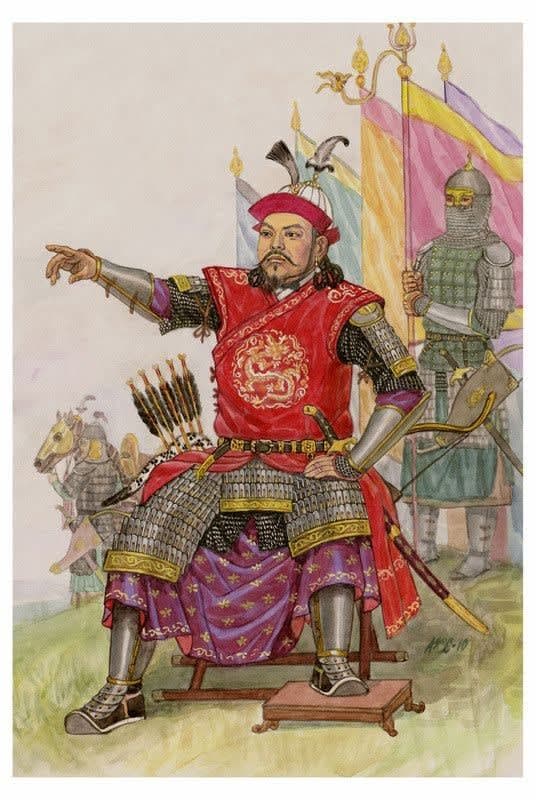

The Chinggisid Tokhtamysh was the son of Tuy-Khoja, the ruler of Mangyshlak. After his father was executed on the orders of Urus Khan, Tokhtamysh fled to the powerful ruler of Transoxiana, Timur (Tamerlane), and in 1377 received his support to seize the Golden Horde. Despite suffering two defeats at the hands of Urus Khan’s sons, Timur continued to back Tokhtamysh, even when Urus Khan threatened him with war. Finally, in 1378, after Urus Khan’s death, Tokhtamysh crushed his son Timur-Malik and became ruler of the White Horde.
He then invaded the western part of the Horde controlled by the temnik Mamai. By April 1380 Tokhtamysh had taken all of the Golden Horde, including the capital, Sarai-Berke. After the Battle of Kulikovo in September 1380, in which Mamai was defeated by the Russians, Tokhtamysh in October–November finished off Mamai’s remaining forces. Having become the legitimate khan, he sent envoys to the Russian princes, summoning them to the Horde to receive a yarlyk (patent of authority) from the new khan. Grand Prince Dmitry Ivanovich Donskoy of Moscow refused to go to the Horde for the yarlyk.
In 1382 Tokhtamysh decided to punish the Russian lands for disobedience and marched on Moscow. The prince of Nizhny Novgorod, Dmitry Konstantinovich, and the prince of Ryazan, Oleg Ivanovich, seeking to save their own territories, revealed to him a ford across the Oka River. Dmitry Donskoy and Vladimir Andreyevich the Brave rode off to gather troops.
On 24 August 1382 Tokhtamysh reached Moscow. After two days of fierce defense, the Muscovites were deceived by the princes of Nizhny Novgorod, who swore that the khan would do them no harm. On 26 August Moscow surrendered, but the promise was not kept: the city was looted and many people were killed. The Tatars then seized and devastated other towns, but after one of their detachments was defeated near Volok Lamsky by Vladimir the Brave, Tokhtamysh hastily retreated to the Horde. Dmitry Donskoy nevertheless sent his son to the Horde to receive the yarlyk and paid Tokhtamysh two years’ tribute that he had withheld.


After subjugating Rus’, Tokhtamysh turned against his former patron, Tamerlane. In 1385 he raided the South Caucasus and captured Tabriz. In the 1390s, however, Tamerlane dealt him two crushing defeats on the Kondurcha River in 1391 and on the Terek River in 1395. These battles undermined the Horde’s economy and manpower, and Tokhtamysh lost the throne.

In 1396 Tokhtamysh fled to the Grand Duchy of Lithuania and asked Grand Duke Vytautas for help, promising in return to renounce his suzerainty over the Russian lands. Seeing in Tokhtamysh a tool for expanding his influence, Vytautas formed an alliance with him. In 1399 the allied forces of Vytautas and Tokhtamysh met the army of Timur-Qutlug and the powerful emir Edigu at the Battle of the Vorskla. Edigu inflicted a crushing defeat on them, and Tokhtamysh’s troops were the first to flee the field. This battle marked the end of Tokhtamysh’s political career.
Having finally lost his former influence, Tokhtamysh spent his last years in constant struggle with Edigu. He was killed in 1406, in the sixteenth battle between them.


