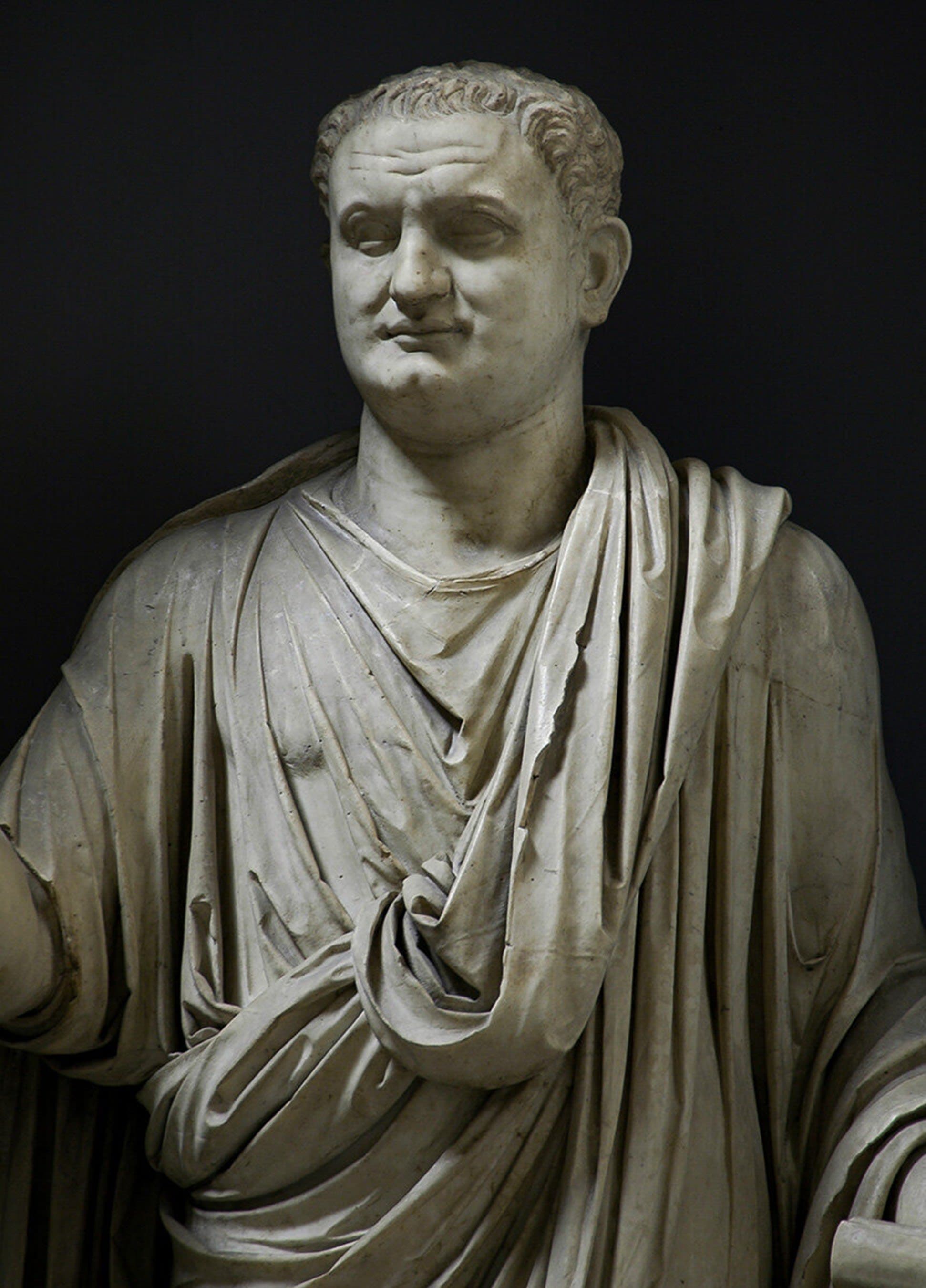

Titus Flavius Vespasianus, the future emperor of Rome, was born on December 30, 39 CE. He belonged to the undistinguished Flavian family from Reate. His great-grandfather was a veteran of Pompey’s army, and his grandfather a tax collector who managed to secure senatorial status for his sons.
Titus was the eldest child; he had a younger sister and a brother, Domitian. While his father, Vespasian, was advancing under Claudius, Titus was raised at court alongside the emperor’s son, Britannicus, and became his close friend. From youth Titus was broadly accomplished: physically strong, skilled in riding and combat, blessed with an excellent memory, and a talented musician, poet, and orator.

In 54, after Claudius’s death and Nero’s accession, the Flavian family’s fortunes declined. Britannicus was poisoned at a banquet, and Titus, reclining beside him, also tasted the poisoned drink. Vespasian then retired, and, as Suetonius says, Titus’s family lived in poverty.
After Agrippina’s death in 59, Titus began his military career, serving as a military tribune in Germany and Britain. On returning to Rome, he practiced law to build a good reputation.
In 66 a revolt against Rome broke out in Judea. Titus’s father Vespasian was appointed commander, and Titus went east with him. In 67 Vespasian invaded Galilee with an army of 60,000. Titus was his steadfast deputy: he took part in sieges, distinguished himself in battle, and was the first over the wall in the decisive assault on Jotapata. The city’s defender, Joseph ben Mattathias, surrendered and became close to Titus, receiving Roman citizenship and the new name Flavius Josephus.
In 68, as political crisis began in Rome and Nero killed himself, Vespasian paused operations. Titus set out for Rome, but learning of the new emperor Galba’s death, returned to aid his father. He played an important role in preparing the bid for power, securing the support of the Syrian governor Gaius Licinius Mucianus. When the eastern legions proclaimed Vespasian emperor, Titus became Caesar and his official heir.
After Vespasian departed for Rome, Titus took command of the army and in early 70 began the siege of Jerusalem. He faced fierce resistance from the Jews, who, despite famine and internal strife, defended the city desperately. After months of grueling fighting, the Romans broke through, seized the Antonia Tower, and reached the Temple. On August 5, 70, the Temple was set on fire and destroyed, although, according to Josephus, Titus wished to save it.


On September 8 Jerusalem fell. Enormous numbers died during the siege; survivors were sold into slavery. Titus left the city in ruins. The spoils he captured were displayed in Rome during a lavish triumph in which all three Flavians took part. The Arch of Titus was erected to commemorate the victory.
Under Vespasian, Titus held the position of designated heir. He was his father’s co-ruler, held the consulship and censorship, and headed the palace services and the praetorian guard. Yet in these years he had a very poor reputation accused of cruelty and debauchery. Because of his liaison with the Jewish princess Berenice, many feared he would be a new Nero.
After Vespasian’s death on June 24, 79, Titus became sole ruler the first time in Roman history power passed from father to son. He strove to overturn his bad reputation, sending Berenice away from Rome, punishing informers, and refusing purges of senators. For this he earned the reputation of an ideal ruler and the nickname “the darling and delight of mankind.”
During his reign the Senate continued to lose influence, and Titus, unlike his father, became more inaccessible to his subjects. He was exceedingly generous, staged splendid spectacles, financed large building projects, and reduced taxes for certain provinces.
In his brief two-year reign Rome faced two major catastrophes. On August 24, 79, Vesuvius erupted, destroying Pompeii, Herculaneum, and Stabiae. Titus entrusted the relief efforts to two consulars. In 80 a great fire in Rome destroyed much of the city; Titus declared, “All the losses are mine!” and financed the rebuilding from his own resources.


Titus died on September 13, 81. He fell ill with a fever and died at the same villa as his father. The people and the Senate mourned him deeply. Posthumous honors were paid to him in many cities of the empire. Rumors spread that he had been poisoned by his brother, Domitian, to whom he was forced to leave the empire. Domitian inherited supreme power without difficulty and was proclaimed emperor the day after his brother’s death.


