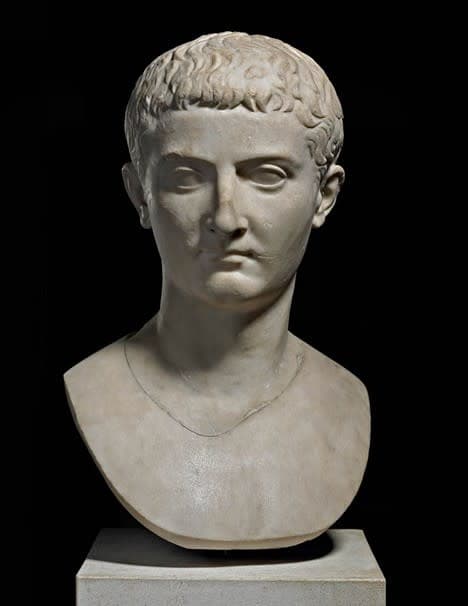

Tiberius Claudius Nero was born on November 14, 42 BCE, in Rome. His father was Tiberius Claudius Nero the Elder, a member of the ancient patrician Claudian clan. His mother, Livia Drusilla, also came from this family.
After Caesar’s assassination, Tiberius’s father supported the republicans, but during the civil war he was forced to flee Rome to Greece, where he joined Sextus Pompey. In 39 BCE Octavian (Augustus) proclaimed an amnesty, and Tiberius’s family returned to Rome. Soon Octavian, having fallen in love with Livia, compelled her husband to divorce her. On January 14, 38 BCE, Livia gave birth to a son, Drusus, and just three days later Octavian married her, though she was six months pregnant. Rumor had it that Drusus was in fact Octavian’s son.

Thanks to this marriage, his mother became the wife of the most powerful man in the Roman world, and Tiberius and Drusus became his step-sons.
After his father’s death in 33 BCE, nine-year-old Tiberius and his brother moved into Octavian’s house, and he delivered the funeral oration at his father’s funeral. In 29 BCE he took part in Octavian’s triumph celebrating victory over Mark Antony.
Tiberius’s political career began under his stepfather’s guidance. At seventeen he became quaestor (several years before the legal age) and then received the right to stand for other offices earlier than usual.
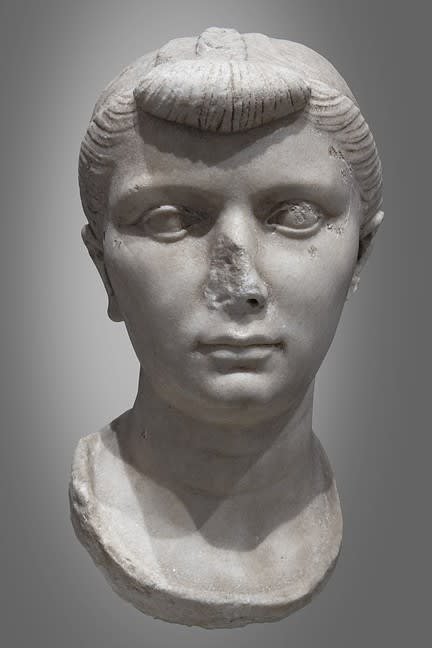
In 20 BCE Tiberius married Vipsania Agrippina, the daughter of Augustus’s ally Marcus Agrippa. Their marriage was happy, but in 12 BCE, after the deaths of Agrippa and Marcellus, Augustus who had no other obvious heirs forced Tiberius to divorce his beloved wife and marry his own daughter, Julia the Elder, Agrippa’s widow. This marriage was unhappy and weighed heavily on Tiberius.
In 19 BCE Tiberius was sent to the East, where as commander he secured the return of Roman standards lost in battles with the Parthians one of Augustus’s greatest diplomatic successes. He then commanded in Germany, where he conquered Pannonia, a new Roman province.
In 6 BCE, unable to bear the humiliations from Julia and his conflict with Augustus who increasingly favored her sons, Gaius and Lucius Tiberius withdrew into voluntary exile on the island of Rhodes.

In 2 CE misfortunes struck Octavian’s family: his grandson Lucius died, and he was forced to exile his daughter Julia for debauchery and treachery. In the same year he allowed Tiberius to return to Rome, and in 4 CE, after Gaius’s death, he adopted him and made him his official successor. In return, Tiberius was required to adopt his nephew Germanicus.
Tiberius’s former powers were restored, and he became the second man in the state. In 6 CE he assembled a huge army for a campaign against the Germans but had to suppress an uprising in Pannonia. He succeeded, and afterward he strengthened the frontier along the Rhine following the rout of the Roman legions in the Teutoburg Forest. In 13 CE he became Augustus’s co-ruler, and in 14 CE, after Augustus’s death, he peacefully ascended the throne, being the sole heir named in the will.
At the start of his reign, Tiberius faced the problem of legitimacy. He sought cooperation with the Senate and proclaimed the principles of a “free state,” but in practice gradually increased his own power. He transferred the election of magistrates from the popular assemblies to the Senate, making them effectively appointments. All major court cases, including those concerning offenses against majesty (maiestas), were also decided by the Senate, which was under the emperor’s complete control.
Tiberius was known for his frugality, which allowed him to greatly strengthen the state’s finances. He halted large-scale building projects and reduced spending on public games. Yet, when necessary, he did not stint on expenses, for example, to aid cities struck by earthquakes and fires.

In foreign policy Tiberius abandoned wars of conquest and preferred to consolidate existing frontiers. He recalled Germanicus from Germany and established defensive lines along the Rhine. He also successfully fought piracy at sea and quelled uprisings in the provinces, including Africa and Thrace. During his reign, in 33 CE, Jesus Christ was crucified by order of the prefect Pontius Pilate.
After the death of his only son Drusus in 23 CE, Tiberius became more suspicious. He withdrew from Rome to the island of Capri, leaving the administration of the state in the hands of the praetorian prefect Lucius Aelius Sejanus. Taking advantage of the emperor’s absence, Sejanus wove intrigues and plots, seeking to seize power.
In 31 CE, when Sejanus was consul, Antonia Minor, the mother of his accomplice Livilla, exposed the conspirators to Tiberius. At a Senate session a letter from the emperor denouncing Sejanus was read aloud. He was immediately arrested and executed along with his supporters.


Tiberius never returned to Rome. After unmasking the plot, he spent the rest of his life on Capri. He died on March 16, 37 CE, at the villa of Lucius Licinius Lucullus at Cape Misenum. In his will he divided power between his grandson Tiberius Gemellus and his nephew Caligula. However, upon coming to power, Caligula declared the will invalid and had Gemellus executed.


