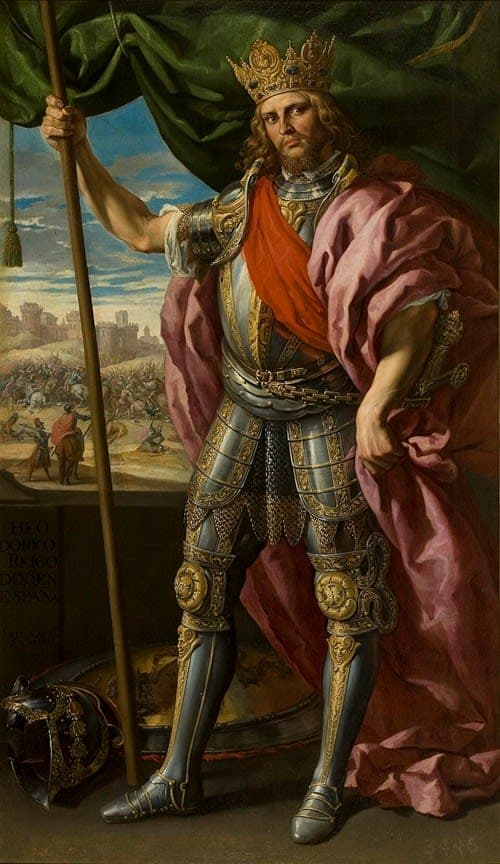

Theodoric the Great, one of the most outstanding rulers of the Migration Period, was born around 451 to the Ostrogothic king Theodemir and his concubine Erelieva. At the age of eight, in 459, under a peace treaty between the Ostrogoths and the Eastern Roman Empire, Theodoric was sent to Constantinople as a hostage.
After ten years at the Byzantine court, the young Theodoric received an excellent education. He not only mastered Latin and Greek, but also absorbed Roman culture, art, and administrative practice. This experience shaped his worldview and made him—unlike many barbarian leaders—a sincere admirer of the classical legacy. That respect for Roman traditions later became the cornerstone of his policy.
After the death of his uncle Valamir, the high king of the Ostrogoths, Theodoric returned home in 470. At the head of 6,000 warriors he won a brilliant victory over the Sarmatian king Babai, seizing his residence at Singidun (modern Belgrade). The 18-year-old Theodoric counted this victory as the start of his reign, marking the 30th anniversary of his rule in the year 500.
In 473 the Ostrogoths were forced to leave Pannonia. Part of the people went to Italy, while Theodoric and his father Theodemir moved to Macedonia, receiving foederati status and a favorable treaty with Rome. After his father’s death in 474, Theodoric became high king. He moved his people into Lower Moesia and entered into complex political maneuvers with Byzantium, balancing between two imperial courts and his namesake, the Ostrogothic leader Theodoric Strabo.
Unlike Strabo, who supported the usurper Basiliscus, Theodoric sided with the legitimate emperor Zeno, which brought him the titles of patrician and supreme commander. However, delays in promised payments and court intrigue led to a succession of wars and truces. In 481 the death of Theodoric Strabo removed his chief rival, and most of Strabo’s army passed under Theodoric’s command.

In 484 Theodoric was appointed consul—an unprecedented event for a barbarian leader. He received Roman citizenship and the name Flavius Theoderic, underscoring his new status.
In 488 Emperor Zeno, weary of Theodoric’s unpredictability, proposed that he march into Italy to depose the barbarian ruler Odoacer. The arrangement suited both sides: Byzantium rid itself of a dangerous neighbor, and Theodoric would gain a kingdom of his own. In the summer of 488 some 100,000 Ostrogoths set out for Italy.
They first defeated the Gepids and then, on August 28, 489, met Odoacer’s army at the River Isonzo, winning their first victory. Less than a month later, on September 30, Theodoric routed him again near Verona, forcing Odoacer to withdraw to Ravenna. Part of Odoacer’s army, along with his commander Tufa, went over to Theodoric. The war nevertheless dragged on, and Tufa betrayed Theodoric. The Ostrogoths found themselves besieged in Pavia, suffering from hunger and a Burgundian incursion. Only in mid-490, thanks to Visigothic help, did Theodoric turn the tide. He won a decisive victory over Odoacer at the River Adda on August 11, 490, driving him back into Ravenna for good. In 491 Theodoric finally established a full blockade of the city. After a two-year siege, on February 25, 493, a peace was concluded stipulating that Theodoric and Odoacer would rule Italy jointly.
But the peace was a ruse. On March 5, 493, Theodoric entered Ravenna and, ten days later on March 15, personally killed Odoacer at a banquet. This removed his last rival and made Theodoric sole ruler of Italy.


In 497 the new Byzantine emperor, Anastasius I, officially recognized Theodoric as king. Although Theodoric always called himself king rather than emperor and regarded his realm as part of the Roman Empire, he in fact governed Italy as an independent monarch, pursuing his own foreign and domestic policies.
Theodoric the Great proved a wise and far-sighted ruler. His internal policy aimed to preserve Roman traditions and build a unified state in which Goths and Romans could live in peace.
The Ostrogoths—alone among the “barbarian” peoples—retained the right to bear arms and serve in the army. The Romans, however, kept their civil, judicial, and financial institutions. Theodoric promulgated a common “Edict,” based on Roman law, binding both peoples.
A sincere admirer of Roman culture, Theodoric restored ancient monuments in Rome and adorned his capital, Ravenna, making it a new center of political and cultural life. His court became a haven for leading intellectuals such as the philosopher Boethius and the statesman Cassiodorus, Theodoric’s chief adviser. This cultural flowering is known as the Ostrogothic Renaissance.

Himself an Arian, Theodoric established full freedom of worship in his kingdom. He protected the rights of Nicenes (orthodox Christians) and Jews alike, restoring destroyed synagogues.
Theodoric skillfully used the marriages of his daughters and sisters to create a network of barbarian alliances and maintain a balance of power in Europe. His daughter Theudeigotho married the Visigothic king Alaric II; Ostrogotho married the Burgundian king Sigismund; and his sister Amalafrida married the Vandal king Thrasamund. Theodoric himself took Audofleda, sister of the Frankish king Clovis I, as his wife.
After Alaric II’s death in 507 in battle with the Franks, Theodoric led forces into Spain, attaching Visigothic lands to his realm and in effect becoming king of the two Gothic peoples.

At the end of his life Theodoric faced mounting internal problems. Despite all his efforts, cultural and religious tensions persisted between Goths and Romans. Suspicions of conspiracy led to trials against his closest advisers, including the philosopher Boethius and the senate president Symmachus, who were executed in 524 and 525 respectively. In 526 he ordered the arrest of Pope John I, who died in prison. These events darkened the final years of his reign and aroused anger in Byzantium, where the emperor began persecuting Arians.
Theodoric the Great died on August 30, 526. He was buried in a sumptuous mausoleum in Ravenna, which still stands as a testament to the grandeur of his rule.


