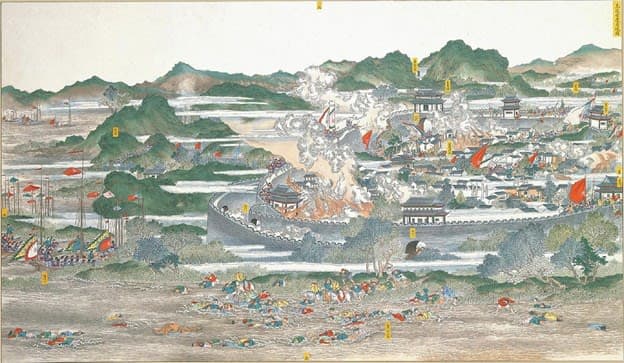

The history of the Taiping Rebellion, which shook China in the mid-nineteenth century, began in Guangxi Province in the summer of 1850. At the head of this vast movement stood the village teacher Hong Xiuquan, the ideologue and founder of the religious-political “God Worshippers’ Society.” His doctrine was a unique syncretic blend combining elements of Christianity, Daoism, and Buddhism. Members called themselves Christians, yet fiercely opposed traditional Chinese cults, preaching universal equality and brotherhood. Their ultimate goal was to create the “Heavenly Kingdom of Great Peace” Taiping Tianguo a name that evoked ancient Daoist teachings and imperial mottoes, symbolizing utopian ideals of harmony and justice.

Hong Xiuquan, who proclaimed himself the younger brother of Jesus Christ, in effect became the monarch of the insurgents, setting himself against the Manchu emperor Xianfeng, who ruled in Beijing.

In the summer of 1850 Hong judged the moment ripe. He gathered 10,000 followers near the village of Jintian in Guiping County (Guangxi). This event, known as the Jintian Uprising, became the starting point of a peasant war that would last until 1868. From the outset, Zhuangs joined the Han majority in the movement, responding warmly to Hong’s ideas. The forces of Hong were bolstered by detachments led by his associates Yang Xiuqing, Xiao Chaogui, and Wei Changhui; in August Shi Dakai broke through to them with a 4,000-man column.
By November 1850 the rebel army had grown to 20,000. Under slogans of equality, they began operations against Qing troops. In Jintian, Hong’s followers turned all their property over to “sacred storehouses,” from which food and clothing were then distributed. The religious sect became an army of iron discipline, with men and women living in separate camps. In defiance of Manchu authority, the rebels wore their hair long, earning the nickname “long-haired bandits.”
The insurgents’ strength grew rapidly, and by the end of 1850 they had inflicted several defeats on Qing forces. On January 11, 1851 Hong Xiuquan’s birthday an armed rising against the Qing was formally proclaimed in Jintian, and Hong took the title Tian-wang (“Heavenly King”).

In 1851 the Taipings continued their advance and on August 27 stormed the major city of Yong’an, where they immediately formed a government. Real power fell into the hands of Yang Xiuqing, who received the title Dong-wang (“East King”) and took command of the army and administration. Other leaders received high titles as well: Xiao Chaogui became Xi-wang (“West King”), Feng Yunshan Nan-wang (“South King”), Wei Changhui Bei-wang (“North King”), and Shi Dakai Yi-wang the “Prince-Assistant” (often rendered “Wing King”). Senior posts also went to other commanders, including the miner Qin Zhigang and the pirate Luo Dagan underscoring the movement’s popular character.
The Taipings forged an army of iron discipline. It was notable for humane treatment of civilians—looting and violence were strictly forbidden. Drawing on broad popular support, the rebels fought the Qing successfully and rapidly filled their arsenals with captured weapons; later they set up their own arms production.
Along their path the Taipings destroyed government institutions, executed Manchus and Chinese officials, and anyone who opposed them. Their property was confiscated, and “the rich” were assessed contributions. The Taipings promised peasants a three-year tax exemption, winning them broad loyalty.
In April 1852 the Taipings broke out of the encirclement near Yong’an and pushed north into Hunan, where their army swelled by another 50,000 men. From September to November, they besieged Changsha but failed to take it. On December 13 they took Yuezhou without a fight, seizing rich arsenals and reaching the Yangtze, where they created their own river fleet. By water and land Hong Xiuquan’s army moved east, constantly growing in size.
By late December 1852 the Taipings had captured Hankou and Hanyang, and on January 13, 1853, after a siege, they took Wuchang securing all three cities of Wuhan. The victory threw the Qing court into confusion, and the Taiping army’s numbers rose to half a million. In February they pressed on; on February 24, 1853, they took Anqing without a fight, and on March 19–20 they stormed Nanjing, where some 20,000 Manchus were massacred. The Taiping forces now numbered about one million. Nanjing was renamed Tianjing (“Heavenly Capital”) and became the center of Taiping Tianguo. The rebels then seized Zhenjiang and Yangzhou, cutting the Grand Canal and entrenching themselves in a strategic region.

Settling in Nanjing, the Taiping leadership published the program “Land System of the Heavenly Dynasty,” meant to serve as a kind of constitution. It proclaimed an utopian “peasant communism” based on full equality in production and consumption. Compulsory labor service was introduced. The Taipings rejected commodity-money relations, but recognizing trade’s necessity, created the post of “Heavenly Comprador” to handle dealings with foreigners.
Nominally Hong Xiuquan remained head of state, but he withdrew from worldly affairs and handed power to Yang Xiuqing. Claiming the gift of “embodying the spirit of God,” Yang became the de facto ruler, subordinating the other princes. Despite his despotic streak, he proved an able and determined leader.
The Taipings were intolerant of traditional religions, destroyed old books, and eliminated members of the former elite. They abolished estates and servile structures. The basic social unit became a platoon-commune of 25 families. Women received rights equal to men, and the ancient practice of foot-binding was banned. In controlled areas they also forbade opium and tobacco smoking, alcohol, and gambling. When they took cities, the Taipings destroyed state enterprises as symbols of Manchu rule.

The Taipings’ military successes and state-building dealt a heavy blow to the Qing regime. The government lost control over vast territories and faced a fiscal crisis. Trying to save the treasury, it issued unbacked paper money that quickly depreciated and was abolished by 1861. To cover deficits new taxes were levied, and some old bans were lifted to avoid further escalation of the war.
When it became clear the regular Manchu and Green Standard troops could not cope, Chinese landlords and officials came to the dynasty’s aid, creating private armies. The most famous was the “Xiang Army,” formed in Hunan in 1852 by the Qing official Zeng Guofan. This professionally trained force, up to 50,000 strong, became one of the Taipings’ chief foes. A “Hubei Army” followed in 1853.

In 1854 these private armies moved against Taiping Tianguo. The fighting was fierce, and only the carnage within the Taiping camp in 1856 saved Zeng Guofan from total defeat. Fearing Zeng’s rise, the Qing court threw its weight behind other forces, including the North- and South-Bank camps established around Nanjing in 1853. These pinned down the main Taiping forces and prevented an advance on Beijing.
In May 1853 the Taipings attempted to seize Beijing. Two armies under Lin Fengxiang, Li Kaifang, and Ji Wenyuan marched north. Unable to cross the Yellow River at once, they made a wide detour west. Part of the force failed to ford the river and returned south. The remainder reached the Tianjin area, sowing panic in Beijing. But the peasants of North China did not support the southerners, leaving the Taipings isolated.
The Manchus massed huge forces near Tianjin under Prince Sengge Rinchen. A harsh winter, lack of provisions, and constant enemy attacks weakened the Taipings. In February 1854 they began retreating south with enormous losses; Ji Wenyuan fell during the withdrawal. In May the Taipings fortified themselves at Lianzhen, but a relief army was almost annihilated. After a ten-month siege, Lin Fengxiang’s troops were crushed in March 1855; he was captured and later executed. Li Kaifang soon perished as well.


The failure of the Northern Expedition was the war’s turning point. The Taipings lost the ability to threaten Beijing and shifted to active defense, fighting not to overthrow the Qing but to preserve their state.
Despite the northern setback, the Taipings gained significant successes in the west. In May 1853 they began pushing up the Yangtze. By year’s end they had retaken many towns in Anhui, and in February 1854 they again secured Hankou and Hanyang. Yet they were constantly forced to redeploy troops against the Qing camps near Nanjing, enabling Zeng Guofan’s Xiang Army to win a string of victories.

The situation changed when Shi Dakai arrived in the west. In the winter of 1855, he smashed the Qing fleet and regained control of eastern Hubei. In spring he moved into Jiangxi, seizing over fifty-five counties. In April 1856 the Taipings crushed the Manchus’ North-Bank camp and in June won a complete victory over the South-Bank camp, whose commander committed suicide. Nanjing’s blockade was lifted and Taiping territory expanded sharply.
The Taipings’ advance sparked a chain of other uprisings. In late 1852 the Nian rising began in the north, drawing significant Qing forces. Secret societies rose in the coastal provinces; in May 1853 the Xiaodaohui society seized Xiamen, and in September that year, Shanghai, where rebels proclaimed the Great Ming Taiping Tianguo. Although Qing armies suppressed these uprisings, they diverted government resources. From summer 1854 the “Red-Head” rising flared in Guangdong; from 1855 the Miao rose in Guizhou, followed by Muslims in Yunnan. All these centers of revolt helped the Taipings hold out by dispersing Manchu strength.
From 1856 to 1860 the international situation favored Taiping Tianguo. In foreign policy the Taipings advocated equality and trade with Western powers while banning the opium trade. Britain, France, and the United States initially adopted a wait-and-see neutrality, hoping the Taipings would break China’s isolation.
That hope spurred the Western powers to accelerate their blow against the weakening Qing Empire. Seizing on a pretext, Britain and France launched the Second Opium War. Thus, Qing forces were further distracted by an external conflict, creating favorable conditions for the Taipings to continue their struggle.


But once the Taiping state consolidated, internal rivalry began to tear it apart. By the mid-1850s the camp was riven by contradictions between the “old brothers” (from Guangxi and Guangdong) and the “new” (natives of the central provinces). The “old brothers” also quarreled among themselves. Until 1856 Yang Xiuqing (“East King”) held the leading role and oppressed the Guangdong faction headed by Hong Xiuquan. Enmity was especially bitter between Yang and Wei Changhui (“North King”).
Yang’s arrogance and despotism turned the other princes against him. In July 1856 he openly humiliated Hong Xiuquan, forcing him to pay royal honors to Yang. Fearing for his power, Hong summoned Wei Changhui to Nanjing. On the night of September 2, 1856, Wei’s soldiers carried out a bloody coup. In the ensuing slaughter Yang Xiuqing and all his supporters were killed. Wei and Qin Zhigang murdered up to 30,000 people in short order, including all of Shi Dakai’s family. Seeing a new threat to his throne, Hong ordered Wei and Qin executed.
Late in November Shi Dakai (“Prince-Assistant”) reached the capital. Appointed head of state and army, he temporarily stabilized the situation. Yet Hong, fearing to lose power, soon removed him as well, transferring authority to his own family and favorites. This prompted a split; in June 1857, fearing for his life, Shi Dakai left Nanjing with an army of over 100,000. From then on, his forces acted independently a serious blow to rebel unity.

The death of Yang Xiuqing and the departure of Shi Dakai weakened Taiping Tianguo, and by late 1856 Qing forces were on the offensive. On December 19 they finally captured the Wuhan tri-city, forcing the Taipings onto the defensive.
At this critical moment new talented commanders came to the fore: Li Xiucheng and Chen Yucheng. Li, who rose from common soldier, received the title “Loyal King” and became the Taiping state’s outstanding general; Chen was given the title “Brave King.” They inflicted a series of defeats on Qing armies, but the rebels’ disunity allowed the enemy to restore the South- and North-Bank camps, encircling Nanjing. In May 1858 the Xiang Army captured Jiujiang, and its fleet gained control of the Yangtze, sharply shrinking Taiping territory.
In response Li Xiucheng showed his generalship. Restoring coordination, he drove the Taiping armies into a counteroffensive. On September 25–26, 1858, the combined forces of Li Xiucheng and Chen Yucheng routed the Qing near Pukou, eliminating the North-Bank camp. On November 15 they encircled and destroyed Zeng Guofan’s strike forces around Sanhe. These victories temporarily stabilized the situation, as Qing troops were distracted by the Second Opium War.

From 1857 Shi Dakai’s army fought independently, seeking to break into the rich province of Sichuan and establish a state there. From October 1858 his 200,000-man army, divided into two columns, drew off major government forces. But after failing to break into Sichuan, both columns retreated into Guangxi.
In May 1859 Shi’s army again had to withdraw, and in 1860 another split occurred: about 50,000 men detached and tried to break into Anhui, but most were destroyed on the march. This eased the crushing of the “Red-Head” state in Guangxi and allowed Qing forces to concentrate on Shi Dakai’s remnants.
In February 1862 Shi’s army, again up to 200,000 with new supporters, reached the Yangtze but could not cross it. He maneuvered for about a year, and only in May 1863 did his army ford the river on the Sichuan–Yunnan border. But the Qing bribed Yi chieftains, who set an ambush. In early June 1863 Shi Dakai’s exhausted troops were trapped at the Dadu River. Surrounded and starving, the Taipings laid down their arms and were then slaughtered; Shi was executed. His death foreshadowed the rebellion’s end.
Despite isolated victories, the Taiping state’s overall position worsened. Rebel territory became a battlefield, bringing ruin to towns and villages and a collapse in agriculture and trade. Unpopular measures such as tax hikes alienated the peasantry, which increasingly longed for peace.
Religious fanaticism and intolerance toward traditional Chinese faiths also estranged potential allies, including influential shen-shi and members of other secret societies. The Taipings handed their enemies potent ideological weapons, allowing them to lead a movement to defend Chinese spiritual values from the “barbarian doctrine.”
In 1860 the Taipings won a brilliant victory, smashing the South-Bank camp and lifting the blockade of Nanjing. Then, in their Eastern Expedition, they seized large areas of Jiangsu and Zhejiang, reaching Shanghai only to meet a new force: the Western powers.
By the early 1860s the Western states realized the Taipings would not overthrow the Qing. Moreover, their ban on the opium trade made them an obstacle. The Europeans therefore chose to back the Qing government. Taiping troops approaching Shanghai were met with artillery fire.


The American adventurer Frederick Townsend Ward, funded by Chinese merchants, created the “Ever-Victorious Army,” which, together with Anglo-French contingents, fought actively against the Taipings. Western powers also ferried Qing troops along the Yangtze in their ships.
The Qing government, for its part, recognized the need for modernization and entrusted the fight to strong leaders such as Zeng Guofan and Li Hongzhang. In the early 1860s eight provincial armies including the Xiang and Huai were equipped with modern weapons, while the Taipings largely retained outdated swords and makeshift muskets.
In autumn 1860 the Taipings launched a Second Western Expedition, which failed due to poor coordination. On September 5, 1861, Zeng Guofan’s troops captured Anqing, the chief fortress shielding Nanjing. This opened the road to the Taiping capital; in May 1862 Chen Yucheng was betrayed and executed. The Xiang Army reached Nanjing and sealed it off.
Even so, Li Xiucheng scored successes in the Eastern Expedition, taking Ningbo and Hangzhou in 1861. Early in 1862 he again approached Shanghai but was driven back by “foreign-arms contingents.” Prolonged fighting in Zhejiang and Jiangsu where many cities changed hands repeatedly wore the Taipings down. In 1863 Qing forces and the Ever-Victorious Army under Charles Gordon began a decisive offensive. Suzhou fell in November 1863 after the betrayal of Taiping commanders. Hangzhou fell in April 1864, and Changzhou in May.
The noose around Nanjing tightened. From summer 1863 famine gripped the city. Li Xiucheng directed the defense, but his breakout plan was rejected by Hong Xiuquan. On June 1, 1864, the “Heavenly King” took his own life. Li Xiucheng held out another six weeks. On July 19, 1864, Zeng Guoquan’s troops blew a breach in the wall and poured into the city. A horrific massacre followed, in which some 300,000 people died. Li Xiucheng and other leaders were captured and executed so fell the Taiping state.


After Nanjing’s fall, the remaining Taiping forces split into two large groups. The southern, about 100,000 strong, was destroyed by October 1864; its remnants including the armies of Li Shixian and Wang Haiyang were wiped out by February 1866. Some Taipings under Liu Yongfu broke through into Vietnam and later fought on the Qing side against the French.
The northern group, united with the Nian Rebellion, continued the struggle. In May 1865 they routed Qing forces, killing the Mongol prince Sengge Rinchen. In 1866 the rebels split into two columns. The eastern, under Lai Wenguang, was crushed in January 1868. The western, led by Zhang Zongyu, launched a lightning march on Beijing in January 1868, causing panic in the capital; but in March they were checked and in April pushed back to Tianjin. On August 16, 1868, Zhang Zongyu’s last detachments were surrounded and annihilated; Zhang took his own life. This marked the final end of the great Taiping Rebellion.


