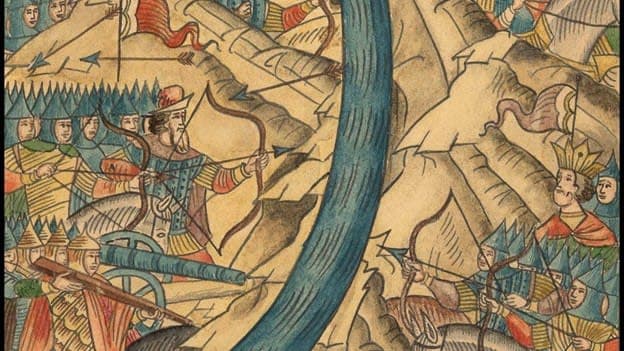

By the mid-15th century, the power of the Great Horde had weakened considerably. By contrast, the Muscovite principality under Grand Prince Ivan III was growing stronger. In 1472 Khan Akhmat of the Great Horde attempted to invade Rus’ lands, but his advance was stopped in the battle near Aleksin. After this failed campaign, the Muscovite principality ceased paying tribute to the Horde.

After his defeat, Khan Akhmat sought new allies against Ivan III. He formed an alliance with the Polish-Lithuanian king Casimir IV, who also had territorial claims against Ivan. In response, Ivan III concluded a treaty with the Crimean khan Mengli I Giray, a long-standing enemy of Akhmat. This proved decisive, as it threatened Casimir IV’s rear and prevented him from providing Akhmat the promised military aid.

In 1480, as Akhmat prepared his campaign, Ivan III’s own brothers—Boris of Volotsk and Andrei the Elder—rebelled against him, accusing the grand prince of infringing their rights. The revolt could have seriously weakened Ivan, but he reconciled with his brothers, who in the end brought their troops to his aid at the crucial moment.
In the autumn of 1480, avoiding a direct clash with Russian forces drawn up along the Oka River, Khan Akhmat decided to bypass them through the lands of the Grand Duchy of Lithuania and there secure Casimir’s support. But raids on the Grand Duchy by Mengli Giray’s Crimean Tatars prevented Casimir from sending additional forces to Akhmat, forcing him to change course toward the Ugra River. Moscow’s intelligence acted swiftly, and Ivan III dispatched his regiments to the Ugra to block all possible fords.

On October 8, 1480, Akhmat’s troops made several attempts to cross the river. Russian soldiers armed with pishchali (early firearms) inflicted heavy losses on the Horde, preventing a crossing. This fire—unexpected by the Horde—forced them back from the bank, and the famous “standoff” began.
The two armies took up positions facing one another on opposite banks. Akhmat expected Ivan III to be cowed by his army and accept his terms, as Ivan’s predecessors had done; he also still awaited aid from his ally Casimir. But Ivan III, backed by the metropolitan and the boyars, held firm.
During the standoff Ivan III sent a small detachment under Vasily Nozdrovaty and Prince Nur Devlet deep into the Horde’s rear. Moving along the Volga, this force sacked Akhmat’s capital, New Sarai—completely catching Akhmat off guard.
With the onset of cold and the risk of the river freezing, Ivan III ordered a pullback to Borovsk to offer a general battle under more favorable conditions. Learning, however, of the raid on his capital, of supply problems, and of Casimir IV’s failure to assist, Khan Akhmat did not pursue the Russian troops. On November 11, 1480, he decided to lead his army back to the Horde. Soon after, on January 6, 1481, he was killed in a sudden attack by the Nogais and Siberian Tatars. This led to the final collapse of the Great Horde, which ceased to be a serious political force.
The Standoff on the Ugra is traditionally regarded as the end of the Mongol-Tatar yoke, which had lasted for more than two centuries.


