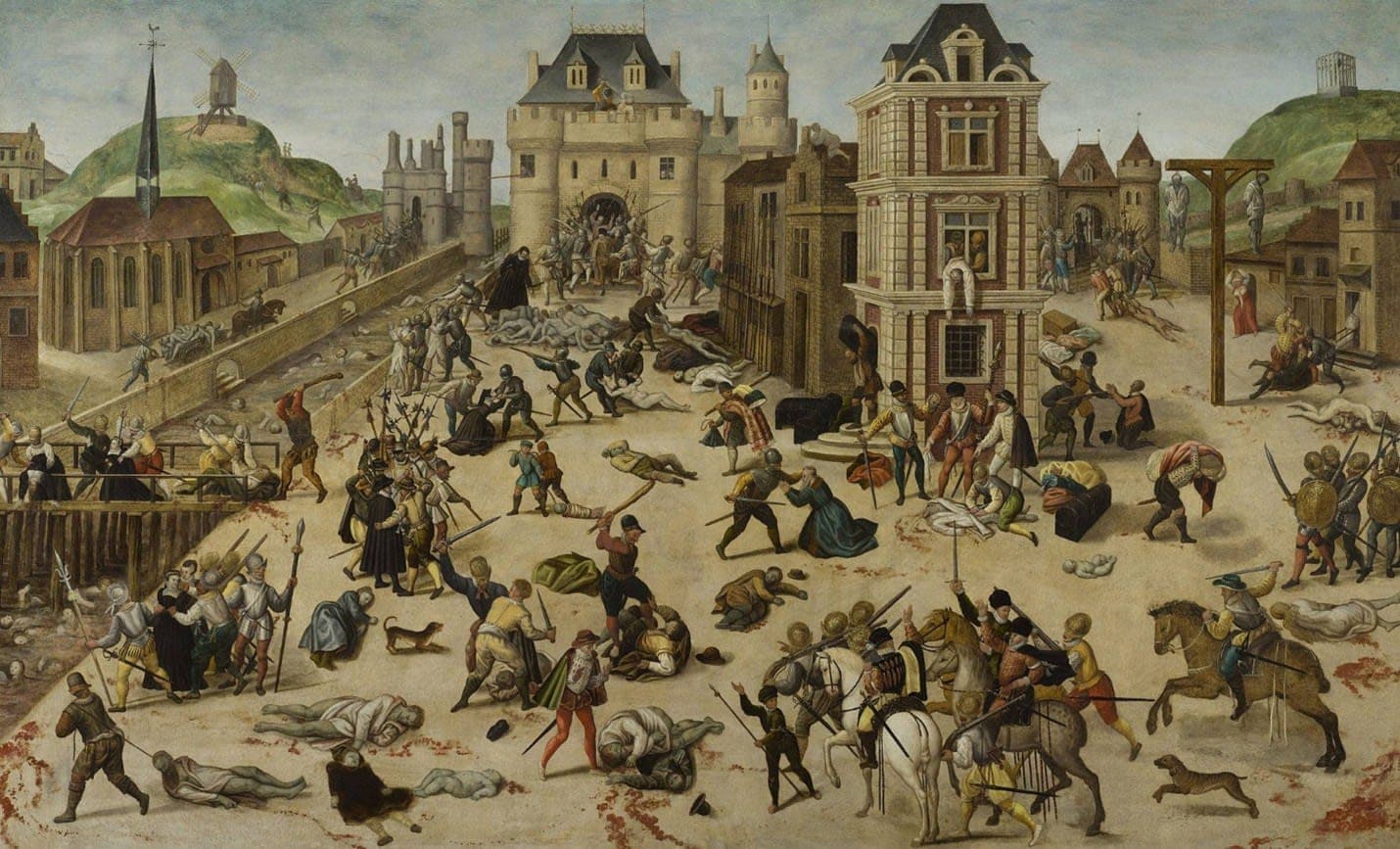

The tragedy known as the St. Bartholomew’s Day Massacre was not a sudden outbreak of violence but the culmination of long-standing conflict between Catholics and Protestants (Huguenots) in France. The immediate events leading to the massacre were the Peace of Saint-Germain (1570), the royal wedding of August 18, 1572, and the failed assassination attempt on Admiral Coligny on August 22, 1572.
The Peace of Saint-Germain ended the Third French War of Religion, but the peace was fragile. Radical Catholics, led by the powerful Guise family, refused to accept its terms and resented the presence of Huguenot leaders at court. Meanwhile, the Huguenots, though a minority, had a strong army, noble allies, and control of several fortified cities. The situation was volatile and further complicated by foreign interference Spain supported the Catholics, while England backed the Protestants.
Queen Mother Catherine de’ Medici and her son, King Charles IX, sought to preserve peace but faced financial crises and the growing influence of Admiral Gaspard de Coligny over the king. Coligny, viewing Spain as a threat, urged a military campaign in Flanders to aid the Protestants there. This plan clashed with Catherine’s desire to stabilize relations with Spain and risked dragging France into another war it could not afford.

To seal a fragile reconciliation between Catholics and Protestants, Catherine arranged the marriage of her daughter, Margaret of Valois, to the Protestant prince Henry of Navarre (the future Henry IV). The ceremony took place on August 18, 1572. This union was intended as a symbol of peace, but it was met with outrage from the Pope, King Philip II of Spain, and zealous French Catholics.

The wedding brought many prominent Huguenot nobles to Paris, which inflamed anti-Protestant sentiment among the city’s Catholic majority. The people resented the presence and wealth of the Protestant aristocrats, especially amid famine and high taxes that worsened popular discontent.
On August 22, 1572, just four days after the wedding, an attempt was made on the life of Admiral Coligny. The conspirators were likely the Guise family and, possibly, Catherine de’ Medici herself, alarmed by Coligny’s growing influence over her son. The attempt failed — Coligny was wounded but survived. The attack, however, became the spark that ignited the massacre.
The failed assassination placed Catherine and her advisors in a precarious position. The Huguenots were enraged and believed the royal family had ordered the attack. Fearing retaliation, Catherine allegedly decided to eliminate not only Coligny but also several key Huguenot leaders gathered in Paris.
The official signal for the massacre came with the tolling of the bell of Saint-Germain-l’Auxerrois Church in the early hours of August 24, the feast day of Saint Bartholomew. The long-standing hatred of Paris’s Catholics toward the Huguenots, combined with the old feud between the Coligny and Guise families, turned a targeted political assassination into a citywide slaughter. Easily identifiable by their black attire, Huguenots became targets for mobs who spared neither old men, women, nor children.


Paris descended into chaos. The killings were accompanied by looting and the settling of personal scores debts were canceled, rivals eliminated, and enemies murdered under the guise of religious zeal. At one point, King Charles IX, horrified by the bloodshed, ordered the violence to stop, but the rampaging crowds could no longer be controlled.
The wave of violence spread throughout France, engulfing Toulouse, Bordeaux, Lyon, Rouen, and other cities. The massacres continued for several weeks. The number of victims remains disputed, but historians estimate between 5,000 and 30,000 deaths.
The St. Bartholomew’s Day Massacre was a turning point in the French Wars of Religion. The Huguenots suffered devastating losses, losing many of their leaders. The event shocked all of Europe and permanently scarred Protestant perceptions of Catholicism, reinforcing its image as a treacherous and bloodstained faith.


Around 200,000 Huguenots fled France, seeking refuge in England, the German states, and elsewhere. Among the survivors were Henry of Navarre and his cousin Henry de Condé, who were spared because of their royal blood and ties to influential Catholic families.
International reactions were mixed. England, Poland, and the German principalities condemned the massacre. Even Tsar Ivan the Terrible of Russia, infamous for his own brutality, expressed shock. But Pope Gregory XIII viewed the massacre as a triumph over heresy — he ordered a commemorative medal to be struck bearing the inscription “Ugonottorum strages” (“Slaughter of the Huguenots”) and celebrated a thanksgiving mass in Rome.
The St. Bartholomew’s Day Massacre remains one of the darkest episodes in European religious history a symbol of fanaticism, betrayal, and merciless violence that forever changed the course of French and European politics.


