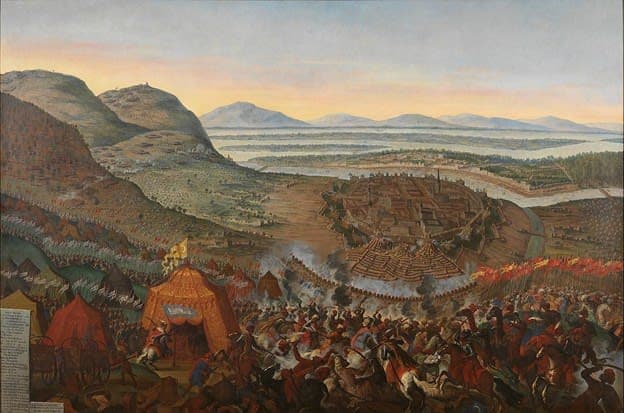

By the late 17th century, the Ottoman Empire, though in decline, remained a formidable power intent on pushing deeper into Europe. Its primary target was Vienna a strategically vital city controlling key trade routes and the Danube. Capturing Vienna would have meant not only mastery over Central Europe, but a severe blow to the Catholic world.
Preparation for war was careful and years in the making. The Ottomans repaired roads and bridges, stockpiled arms, supplies, and artillery and deftly exploited internal conflicts among their rivals. In Habsburg-ruled Hungary, resentment of Emperor Leopold I and his Counter-Reformation policies toward Protestants boiled over into open revolt under Imre Thököly, whom the Ottomans recognized as “king of Upper Hungary,” promising him a “Viennese kingdom” in return for help taking the city.

In 1681–1682 clashes between Hungarian insurgents and Austrian troops escalated, giving the Ottomans a pretext for war. The grand vizier Kara Mustafa Pasha persuaded Sultan Mehmed IV to launch a campaign against Austria. On 6 August 1682, the Ottoman Empire formally declared war.

Knowing a major offensive would take time to assemble, the Austrians prepared for a siege and sought allies. In this period Leopold I concluded a defensive pact with the Polish-Lithuanian Commonwealth: he would aid the Poles if the Turks threatened Kraków, and King John III Sobieski would aid Austria if Vienna were besieged.

In March 1683 the Ottoman army set out for Vienna; by 7 July, forty thousand Tatar horsemen were encamped east of the city. Outnumbered, the Austrians fell back. Leopold I fled to Linz with some 80,000 refugees.
On 14 July the Ottoman host up to 175,000 strong arrived beneath Vienna’s walls. The garrison commander, Count Ernst Rüdiger von Starhemberg, with just 16,000 soldiers and militia, flatly refused to capitulate. The defenders knew Ottoman ruthlessness all too well: the people of Perchtoldsdorf, who had surrendered without a fight shortly before, were treacherously massacred.
Rather than storm the city at once, the Ottomans chose what they deemed a less costly approach siege. They dug trenches and mined the walls. This deliberation proved a fatal mistake, buying the European allies time to gather.
Weeks of siege wore down the defenders with hunger and exhaustion. Still, the Austrians fought on, desperately counter-mining to prevent breaches. On 6 September the Polish army crossed the Danube and, within days, joined the forces of the Holy League, blessed by Pope Innocent XI.

The decisive battle began at dawn on 12 September 1683. The allied Christian army Poles, Austrians, and Germans numbered about 84,000. Opposing them stood the Ottoman host, hampered by unreliable partners: the Crimean khan, affronted by Kara Mustafa, refused to attack the Poles; Moldavians and Wallachians, dragged into the war, quietly sabotaged Ottoman efforts.
All day the fighting swayed back and forth. German and Austrian infantry repelled desperate Ottoman assaults. The Ottomans committed their main strength to storming Vienna’s defenses rather than destroying the approaching field army a critical tactical error.
Around 5 p.m., with the Ottomans spent, John III Sobieski personally led a massed cavalry charge including the famed Polish winged hussars. Roughly 20,000 horsemen thundered down from the hills, smashing through the Ottoman lines. Demoralized and exhausted, the Turks collapsed into rout. In under three hours, the battle was won.


Afterward, Sobieski paraphrased Julius Caesar: “We came, we saw—God conquered.”
The victory at Vienna had immense consequences for Europe. It ended Ottoman expansion and marked the turning point of the Great Turkish War, which continued for sixteen more years. In the end the Ottomans lost Hungary and Transylvania and signed the Treaty of Karlowitz.
For the Commonwealth, Vienna was a last great triumph. John III Sobieski, hailed as the savior of Europe, gained little tangible reward; the later belittling of his role by German allies and Austria’s participation in Poland’s partitions led some historians to call the victory tragically ironic for Poland’s fate.
For Austria, by contrast, the victory marked the start of its ascent. It recovered lost lands and emerged as a leading European power.
The battle also bore religious significance. In memory of the victory over the Muslims, Pope Innocent XI proclaimed 12 September the Feast of the Holy Name of Mary.
As for Kara Mustafa Pasha, held responsible for the crushing defeat, he was executed in Belgrade on the sultan’s orders.


