
After the First Opium War, the power of the Manchu Qing emperors weakened significantly. In 1851, the Taiping Rebellion broke out in China, posing a serious challenge to the imperial government. At first, the European powers Great Britain, France, and the United States remained neutral, though they closely monitored the situation.
In 1850, Emperor Xianfeng ascended the Manchu throne and changed his father’s policy toward Europeans. He intensified persecution of Chinese Christians and began violating the terms of earlier trade treaties. The greatest tension arose in Canton (Guangzhou), where local officials restricted the expansion of foreign factories and forbade foreigners from entering the Chinese part of the city.

Seeing China’s growing weakness, the European powers presented a joint demand to revise the treaties. They insisted on unrestricted trade, the right of diplomats to reside in Beijing, and the legalization of the opium trade. The Chinese government rejected these demands, but open conflict did not break out immediately, since Britain was then engaged in wars with Russia and Persia.
In 1856, two incidents triggered war. In Guangxi province, French missionary Auguste Chapdelaine was arrested and tortured to death, violating treaty provisions. That same year, on October 8, the Chinese authorities seized the British-registered ship Arrow in the Pearl River, suspecting it of smuggling and piracy. The crew was arrested, and the British flag was hauled down.

The British consul in Canton, Harry Parkes, demanded the immediate release of the crew and an official apology for the insult to the flag. The Chinese viceroy Ye Mingchen remained defiant. Only after a British ultimatum did he release twelve sailors, but he still refused to issue a written apology. Outraged, the British governor of Hong Kong, John Bowring, ordered Admiral Michael Seymour to seize the Pearl River forts, which he did in late October 1856.
Soon after, France joined Britain, using the death of Chapdelaine as a pretext. By late 1857, the combined British-French forces launched an offensive on Canton. After intense naval bombardment and a two-day assault, the allies captured the city. Chinese resistance was weak, and the European forces easily occupied the strongholds.


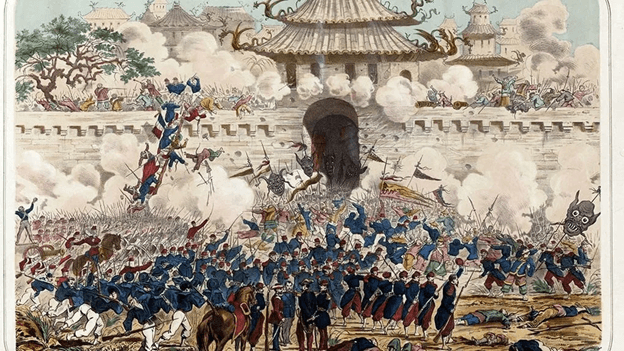
After taking Canton, the allies hoped for negotiations, but the Chinese government delayed. The Anglo-French command then decided to shift operations northward. In May 1858, they captured the Dagu (Taku) Forts and advanced up the Hai River, occupying Tianjin, the main supply route to Beijing.
In a desperate position, the Qing government agreed to concessions. The Treaties of Tianjin were signed, opening six new ports to European trade, granting freedom of movement to missionaries, and obliging China to pay an indemnity.

However, the Chinese used the truce to rebuild the Dagu Forts. When British and French envoys arrived in 1859 to ratify the treaties, they were met with fierce resistance. Admiral James Hope’s attempt to storm the forts failed, and the allied forces, suffering heavy losses, were forced to retreat.
Public opinion in Europe demanded retribution. In 1860, a new and far more powerful Anglo-French expedition was assembled, commanded by General James Hope Grant (Britain) and General Charles Cousin-Montauban (France). In August 1860, the allies landed at Beitang, outflanked the Dagu Forts, and captured them from the land side. They then occupied Tianjin without resistance and marched toward Beijing.
On September 21, at the Battle of Baliqiao, the allies defeated a 50,000-strong army led by Prince Sengge Rinchen, clearing the road to the capital. Emperor Xianfeng fled Beijing, leaving his brother, Prince Gong, to negotiate peace.


Before entering Beijing, the allied troops looted and burned the magnificent Old Summer Palace (Yuanmingyuan) the artistic and cultural treasury of the Qing dynasty. On October 24–25, 1860, the Convention of Peking was signed.

The Convention of Peking ended the Second Opium War. Under its terms: China was to pay large indemnities to Britain and France. Tianjin was opened to foreign trade. Britain received the southern part of the Kowloon Peninsula. The opium trade was officially legalized.
The Second Opium War dealt another devastating blow to the Qing Empire, accelerating its decline and paving the way for its eventual collapse. The spread of opium caused widespread social decay and population decline. Meanwhile, Russia, taking advantage of China’s weakness, signed the Treaties of Aigun (1858) and Peking (1860), securing control over the left bank of the Amur River and the Ussuri region.


