
The roots of the Second Fitna lie in the bloody events of 656, when the murder of the third caliph, ʿUthmān, opened a Pandora’s box. The First Civil War between the supporters of ʿAlī ibn Abī Ṭālib and the Umayyad house led by Muʿāwiya I formally ended in 661. After ʿAlī’s death and the abdication of his son Ḥasan, Muʿāwiya became the sole ruler, transferring the capital to Damascus.

Muʿāwiya’s twenty-year reign was a period of relative stability, yet the question of who would lead the community after him remained unresolved. In 676, Muʿāwiya made a decision that violated established Islamic norms by appointing his son Yazīd as his successor. This transformed the elective office of the caliph into a hereditary monarchy and provoked widespread outrage among the elite. The sons of the great Companions of the Prophet—Ḥusayn ibn ʿAlī, ʿAbdullāh ibn al-Zubayr, ʿAbdullāh ibn ʿUmar, and ʿAbd al-Raḥmān ibn Abī Bakr saw this as a desecration of foundational principles. While Muʿāwiya was alive, his diplomacy and gold restrained his opponents from open rebellion, but his death in April 680 became the signal for a new catastrophe.

Yazīd I began his reign by attempting to force dissenters into submission. Ḥusayn ibn ʿAlī and Ibn al-Zubayr fled to Mecca. While Ibn al-Zubayr waited, Ḥusayn responded to appeals from the people of Kufa, who promised him support. However, the Umayyad governor ʿUbaydallāh ibn Ziyād crushed the uprising with an iron hand before it could take shape.
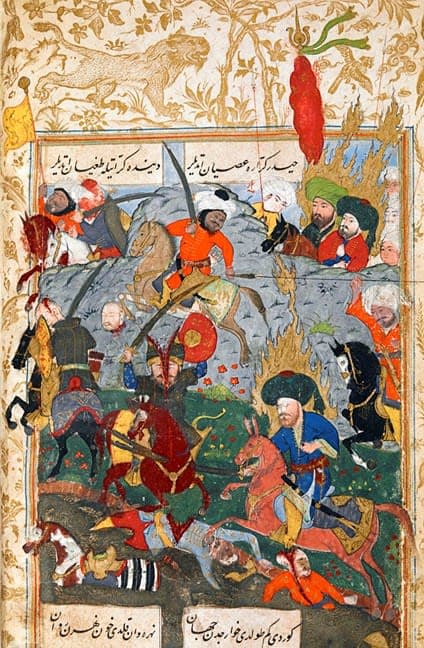
On October 10, 680, one of the most significant tragedies in Islamic history unfolded on the plain of Karbalāʾ. Ḥusayn and a small group of his followers (around seventy men) were surrounded and slaughtered by superior Umayyad forces. The death of the Prophet’s grandson did not pacify the community; on the contrary, it crystallized opposition. Shiʿism began to transform from a political movement into a powerful religious phenomenon grounded in the cult of martyrdom.


Meanwhile, in Mecca, ʿAbdullāh ibn al-Zubayr began secretly collecting oaths of allegiance, while Medina openly rebelled against the “impious” Yazīd, accusing him of indulgence in wine and music. Damascus responded mercilessly: in August 683, the Syrian army crushed the Medinans at the Battle of al-Ḥarra, after which Mecca came under siege. During the bombardment, the Kaʿba caught fire, but the assault was not completed. In November 683, Yazīd suddenly died, and the Syrian troops withdrew, leaving the caliphate in a state of power vacuum.
Yazīd’s death led to the collapse of Umayyad authority. Ibn al-Zubayr proclaimed himself caliph and was recognized by the Ḥijāz, Egypt, and Iraq. In Damascus, however, the young successor Muʿāwiya II died a few months later without leaving an heir. It seemed that Umayyad rule had come to an end.
Yet the clan elder Marwān ibn al-Ḥakam, supported by the Kalbid tribes and the counsel of Ibn Ziyād, decided to fight for the throne. In June 684, he was proclaimed caliph at Jābiya. Soon followed the decisive Battle of Marj Rāhiṭ (August 684), where Marwān defeated the pro-Zubayrid Qaysite tribes. This victory reunified Syria and enabled the Umayyads to launch a counteroffensive. Marwān managed to recover Egypt before power passed in April 685 to his son the energetic ʿAbd al-Malik.
While the Umayyads and the Zubayrids fought for power, Iraq became the arena for a third force the supporters of the ʿAlids. In 684, the movement of the Tawwābūn (“the Penitents”) arose, seeking to atone with their blood for the sin of failing to aid Ḥusayn. In January 685, they were almost completely annihilated by the Umayyad army at the Battle of ʿAyn al-Warda.


The torch was then taken up by the charismatic al-Mukhtār al-Thaqafī. He launched an uprising in Kufa under the banner of vengeance for Ḥusayn, proclaiming Muḥammad ibn al-Ḥanafiyya as the messianic Mahdī. Al-Mukhtār was the first to rely on the mawālī (non-Arab converts), granting them equality with Arab warriors. His general Ibrāhīm ibn al-Ashtar defeated the Syrians at the Battle of Khāzir (686), where the widely hated Ibn Ziyād was killed. However, al-Mukhtār’s alliance with the Zubayrids quickly collapsed. In April 687, the Meccan caliph’s brother, Muṣʿab ibn al-Zubayr, besieged Kufa and killed al-Mukhtār, carrying out a brutal purge of his followers.
By 691, ʿAbd al-Malik ibn Marwān had consolidated Syrian forces and, after concluding a truce with Byzantium, marched on Iraq. Muṣʿab ibn al-Zubayr’s position was undermined by Khārijite raids and internal discontent. In October 691, at the Battle of Maskīn, Muṣʿab was defeated and killed, after which all of Iraq pledged allegiance to the Umayyads.

The last stronghold of resistance was ʿAbdullāh ibn al-Zubayr in Mecca. ʿAbd al-Malik dispatched against him the ruthless commander al-Ḥajjāj ibn Yūsuf. In March 692, the second siege of Mecca began. The city was bombarded by catapults for seven months. In October–November 692, Ibn al-Zubayr, abandoned by most of his supporters, was killed in battle. With his death, the Second Fitna officially came to an end.
ʿAbd al-Malik ibn Marwān’s victory in 692 marked not merely the end of the bloody Second Fitna, but a fundamental transformation of the entire Islamic world. From that moment, Umayyad power was not only restored but elevated to a new, imperial level. Hereditary rule—the very cause of so many disputes and wars—became firmly entrenched, enabling the dynasty to hold the throne for more than half a century, until the Abbasid Revolution of 750. Yet behind the outward triumph lay profound reforms that permanently reshaped state governance and the self-understanding of the Muslim community.
Before the civil war, the system of rule established by Muʿāwiya I resembled a confederation held together by the ruler’s personal charisma and diplomatic skill. Muʿāwiya governed through delicate networks of personal loyalty, relied little on his relatives, and preserved the existing administrative structures of the conquered lands. Officials who had served under the Byzantines and Sasanians remained in office, state administration was conducted in local languages Greek and Persian and foreign coinage continued to circulate. Across vast territories, tribal elites (ashrāf) acted as the sole intermediaries between the population and the state.
The experience of the Second Fitna during which large segments of the tribal elite readily defected to the enemy convinced ʿAbd al-Malik that Muʿāwiya’s decentralized model had outlived its usefulness and posed a threat to the state’s survival. The caliph embarked on radical centralization. The first step was the creation of a professional Syrian army used not only for campaigns against Byzantium but also as an instrument for maintaining internal order in rebellious provinces. Unlike the militias of the early conquests, these soldiers received fixed salaries from the state, while pension payments to veterans of the old guard were discontinued.
Alongside military reforms, a strengthening of the “vertical of power” took place. Key government posts were transferred to the caliph’s closest relatives, and governors were required to send surplus tax revenues directly to the capital in Damascus. To cement imperial unity at the cultural level, ʿAbd al-Malik introduced Arabic as the sole official language of the bureaucracy. Perhaps the most vivid symbol of sovereignty was the monetary reform: the issuance of the first gold Islamic dinar, replacing Byzantine and Sasanian coins. These measures gave Umayyad administration a distinctly Islamic character and created a model of governance later emulated by many Islamic dynasties.
Despite administrative successes, the Second Fitna left a heavy social legacy in the form of deep tribal rivalries. It was during this period especially after the Battle of Marj Rāhiṭ that a catastrophic split took shape in Syria and the Jazīra between the Qaysite and Kalbite tribal confederations. In Iraq, irreconcilable hostility emerged between the Muḍarites (led by Banū Tamīm) and the alliance of Azd and Rabīʿa.
Gradually, this rivalry crystallized into two vast political “supergroups”: the “Northern Arabs” (the Qaysite–Muḍarite bloc) and the “Southern Arabs” (the Yemenites), to whom even some northerners (such as Rabīʿa) aligned for political reasons. This division was less geographic than partisan in nature. For decades, Umayyad caliphs sought to balance these forces, aware that favoring one side would immediately provoke rebellion by the other. The constant struggle for influence and office became a chronic disease of the caliphate, destabilized the provinces, and ultimately acted as a catalyst for the Third Fitna, preparing the ground for the fall of the Umayyads.
The religious consequences of the war proved even more enduring. The tragic death of Ḥusayn ibn ʿAlī at Karbalāʾ in 680 resonated enormously, becoming a powerful symbol of resistance to Umayyad rule. It catalyzed the final transformation of Shiʿism from a political movement of ʿAlī’s supporters into a full-fledged religious phenomenon centered on ideas of redemption and martyrdom. To this day, Shiʿi Muslims commemorate the anniversary of Karbalāʾ on the Day of ʿĀshūrāʾ, recalling the events that permanently divided Islam into its two main confessions.

Moreover, it was during the Second Fitna that the idea of the Mahdī a messianic figure destined to restore justice—entered Islamic thought. The term in its messianic sense was first employed by al-Mukhtār al-Thaqafī, who proclaimed Muḥammad ibn al-Ḥanafiyya (ʿAlī’s son) the “hidden imam” and divinely guided ruler.
For many believers of the time, Ibn al-Zubayr’s rebellion in Mecca represented the last attempt to return Islam to its origins to the “golden age” of the early community and the ideals of the first caliphs. Ibn al-Zubayr’s defeat signified the collapse of that hope: the old world had fallen, and in its place arose a powerful but rigid secular monarchy, in which political expediency definitively prevailed over the ideals of the original faith.


