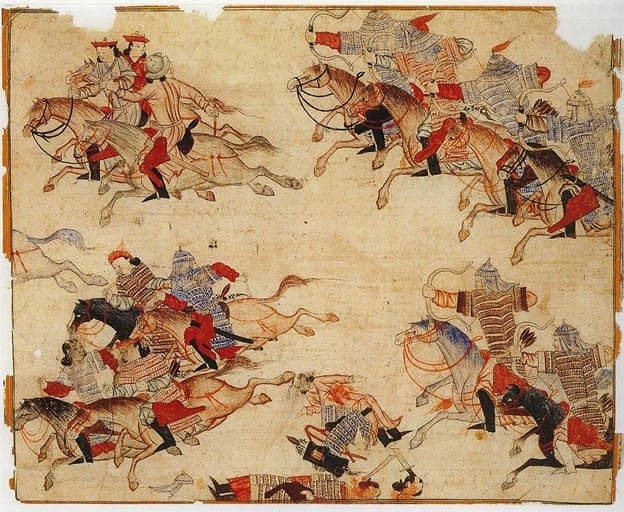

The Southern Song dynasty emerged after the Jurchens seized the northern territories of the Song and forced the imperial court to move its capital to Lin’an. From that moment onward, the Southern Song continually sought to recover its lost lands. When, at the end of the 12th century, the Mongols united under Genghis Khan, the Song became their natural ally in the struggle against the Jurchen Jin dynasty. The war ended with the destruction of Jin, and the Song were promised Henan as their reward.
However, hopes quickly turned to disappointment. Emperor Lizong, imagining he could demand greater compensation, attempted to seize Guanzhong as well. In the summer of 1234, Song troops entered Luoyang, but the Mongols reacted with lightning speed and ruthless efficiency. First, they destroyed one of the Song detachments, then forced the southern army to abandon Luoyang. At the same time, the Mongols opened the dikes of the Yellow River, unleashing an artificial flood in which almost the entire Song army near Bianliang drowned. Thus, the Song lost all their gains from the war.

This so-called “Small War” broke out in the autumn of 1234, when Ögedei sent a first reconnaissance expedition into Sichuan. At the kurultai of 1235, Southern China was officially included in the empire’s plans for expansion. In the spring of that year, two Mongol corps advanced: one under Koten moved into Henan, while the other, led by Kuqu and Shigi Qutuqu, invaded Hubei. The Mongols devastated the Xiangyang region, destroyed Zhaoyang, and besieged Yingzhou. Yet, due to stubborn resistance, they were forced to retreat, though they learned an important lesson.
Beginning in 1236, the Mongols shifted to a strategy of exhausting raids. In February they struck Mianzhou and Daan, in April they captured Xiangyang and other counties in Hubei. In the autumn they continued raids into southern Henan, central Hubei, and southern Shaanxi, even reaching Chengdu in Sichuan. In the autumn of 1237 the raids were repeated, though the fortified cities of Huangzhou and Anfeng withstood them.
Weakened, the Song sued for peace. In early 1238 a treaty was signed obliging them to pay an annual tribute of 200,000 taels of silver and 200,000 bolts of silk.
Throughout the 1240s, the Mongol Empire was preoccupied with internal disputes over succession, which gave the Song a temporary respite. Aside from sporadic raids by local Mongol commanders in 1242, 1245, and 1246, no large-scale invasions took place.
The lull did not last. At the kurultai of 1251, Möngke was elected Great Khan and immediately launched grand plans, with Southern Song as a primary target. Instead of a head-on assault, which would have been suicidal, Möngke decided on a multi-front strategy. To this end, he first had to subdue the Kingdom of Dali (in modern Yunnan) to create a base for operations. In 1252 he sent his brother Kublai on a campaign against Dali, which was successfully concluded in 1253.

Recognizing that Chinese cities were formidable fortresses, the Mongols enlisted Chinese and Muslim engineers to construct siege weapons. Möngke divided his forces into four armies. He personally led one through Sichuan; Kublai was to advance from Kaiping and cross the Yangtze near Ezhou; Uryankhadai, son of Subutai, would march from Dali; and a fourth army, under a grandson of one of Genghis Khan’s brothers, was directed toward Xiangyang.
Möngke’s campaign along the most difficult route soon faced obstacles. By March 1258, his forces captured Chengdu but stalled at Hezhou, where the Song general Wang Jian offered fierce resistance. Möngke besieged the city for five months, but after repeated failures and the onset of the rainy season, he suddenly died on 11 August 1259—whether from a wound, dysentery, or cholera is disputed. His death was a turning point: the Mongols suspended operations to settle the matter of succession.
Meanwhile, Kublai, who had begun his campaign in December 1258, advanced steadily south. By August 1259 he crossed the Huai River and reached the northern bank of the Yangtze. Within days he received news of Möngke’s death. Despite calls to return, Kublai pressed on to demonstrate his resolve.
In September his troops forced the Yangtze and laid siege to Ezhou. Song chancellor Jia Sidao offered peace and tribute, but Kublai rejected the proposal. Yet the outbreak of civil war with his brother Ariq Böke compelled him to withdraw most of his forces, leaving only a token garrison.
In 1260 two rival kurultais elected different khans: one chose Kublai, the other Ariq Böke, sparking a Mongol civil war. The Southern Song seized this chance to strike back. Jia Sidao ordered attacks on Kublai’s reduced forces, driving them out. Exaggerating the victory, Jia stiffened the court’s resolve to resist compromise.
Kublai, too preoccupied with Ariq Böke, could not retaliate. On 21 May 1260 he instead sent a diplomatic mission led by Hao Jing, which Jia Sidao detained.
Discontent also simmered under Mongol control. On 22 February 1262, the Chinese defector Li Tan, tasked with defending Shandong, revolted, slaughtered Mongol troops, and delivered Lianzhou and Haizhou to the Song. The rebellion was crushed by April; Li Tan attempted suicide in Jinan that August, but survived only to be executed.
The Song themselves struggled with internal crises. Great landowners evaded taxes, driving the state into financial collapse. Jia Sidao attempted reforms but met fierce opposition from officials and landlords, dividing society.
Kublai, in contrast, pursued conciliation. He released captured Chinese merchants (75 in 1261, 40 in 1262, 57 in 1264, 45 in 1269) and punished excessive cruelty among his commanders. His policy of attracting defectors bore fruit.


The decisive moment came with the siege of Xiangyang in 1268. Together with nearby Fancheng, it guarded the approach to the Yangtze. Command of the Mongol forces was given to Aju; the defense was led by Lü Wenhhuan. The Mongols aimed to starve the city, cutting its supply lines along the Han River. In early 1268, 600 boats were built to blockade it.
In 1269 Kublai, dissatisfied with the slow progress, sent 20,000 reinforcements. Stronger fortifications were constructed on the advice of Shi Tianze, but still the stalemate continued.
Seeking a breakthrough, Kublai appealed to Abaqa, the Ilkhan of Persia. In 1271 Muslim engineers Ismail and Ala-al-Din arrived, constructing powerful trebuchets. Under a barrage of massive stones, Fancheng fell in days. Realizing Xiangyang could not hold, Lü Wenhhuan surrendered after nearly five years of resistance.
With Xiangyang secured, the Mongols prepared the final invasion. In summer 1273, Bayan was appointed supreme commander. By late 1274–early 1275 he advanced inexorably, deploying heavy siege artillery. In March 1275, near Dingjiazhou, his army clashed with that of Jia Sidao, where Mongol siege engines proved decisive.
Defeated, Jia was stripped of office and exiled, only to be killed en route.
The Song capital, Lin’an, plunged into turmoil. Emperor Duzong died on 12 August 1274, leaving three young sons. His four-year-old son Zhao Xian ascended the throne, with power in the hands of Grand Empress Dowager Xie.
Bayan, under Kublai’s orders not to loot conquered lands, marched rapidly on Lin’an. Desperate, the empress sent an envoy on 23 December 1275 offering tribute, but Bayan refused. On 11 January 1276 a more generous offer was also rejected. Only when the emperor himself acknowledged Kublai’s suzerainty did Bayan agree to negotiations. By late January the dynasty’s imperial seal was surrendered, and the Song officially capitulated.
Resistance persisted. Loyalists in the south crowned the seven-year-old Zhao Shi on 14 June 1276, with Chen Yizhong taking control. But factionalism and disunity eroded popular support, and many officials defected to the Mongols.
Conquest of the south was entrusted to Ariq Khaiya, who advanced from July 1276, reaching Guangxi by April 1277. In the east, Sodu pursued the fleeing imperial family, seizing Fuzhou by year’s end. The ministers fled to Quanzhou, but even there found no refuge: its governor Pu Shougen defected to Kublai in April 1277.
From city to city the loyalists fled, yet Sodu relentlessly pursued them. In November 1277 he took Guangzhou, by February 1278 he captured Chaozhou. On 6 January 1278 the imperial fleet was struck by a storm, and the child emperor Zhao Shi died on 8 May.
His death was a devastating blow, but Zhang Shijie rallied the loyalists and enthroned Zhao Bing. They found temporary refuge on Yashan Island.
In early 1279 the Mongols assembled a fleet off Yashan. On 19 March, during the Battle of Yamen, the Mongol navy won a crushing victory. As the imperial ship began to sink, minister Lu Xiufu took the young Zhao Bing in his arms and leapt into the sea.
Thus, in the waters of the South China Sea, the final act of tragedy was written—the Song dynasty ceased to exist, its lands absorbed into the Mongol Empire, soon to form the Yuan dynasty.


