The Kara-Khitai were descendants of the Khitans, who had once ruled China during the Liao dynasty (907–1125). Their state was destroyed by the Jurchens of the Jin dynasty, and the remnants of the people, led by a relative of the last Liao emperor — Yelü Dashi — went far to the west. In 1124, Yelü Dashi, still young, a learned man and a connoisseur of ancient Chinese poetry, without waiting for the final fall of his state, led forty thousand warriors. This migration marked the beginning of a new state — the Kara-Khitai Khanate.
Settling in the valleys of the Talas and Chu rivers in Semirechye, Yelü Dashi subdued scattered Turkic tribes, established control over the Karakhanid lands, and seized the fortresses of Kashgar and Khotan. The Khitans, who in Central Asia came to be called the “Black Khitans,” quickly took a leading role in the region. In 1141, at the Battle of Qatwan, their forces dealt a crushing defeat to the Seljuks of Sultan Sanjar and their allies, the Karakhanid rulers. This victory secured for the Kara-Khitai the reputation of a formidable power in Central Asia.


However, as often happened with nomadic states, their power gradually weakened. Constant uprisings of subjugated peoples, internal strife, and dynastic disputes drained the state. By the early 13th century, the khanate had become vulnerable to external attack.
After the defeat of the Naimans in 1204 by Genghis Khan, Prince Küchlüg, the son of the Naiman ruler, fled westward. Seeking refuge, he arrived in the Kara-Khitai Khanate, where Gurkhan Yelü Zhulhu received him with honor, appointed him commander, and even married him to one of his daughters.
But Küchlüg was ambitious and unwilling to be merely a vassal. During the war between the Kara-Khitai and the Khwarazmshah, with the support of the Khwarazm ruler Muhammad II, he staged a coup d’état. The Gurkhan became only a nominal ruler, while actual power fell into Küchlüg’s hands.
After the death of Yelü Zhulhu in 1213, Küchlüg officially took the throne and became the sole ruler of the khanate.

Küchlüg was born into a Nestorian family, but after arriving at the Kara-Khitai court, he converted to Buddhism. This led to a sharp change in religious policy. The majority of the khanate’s population were Muslims, and the new ruler began to persecute them, demanding that they adopt Buddhism or Christianity.
Particular outrage was provoked by the murder of the Karluk ruler, Khan Buzar, and the siege of the city of Almalyk. Buzar’s widow, who considered herself a vassal of the Mongols, sent envoys to Genghis Khan seeking help. This became the pretext for Mongol intervention in the affairs of the Kara-Khitai.
In 1216, Genghis Khan sent his general Jebe with two tumens against the Kara-Khitai Khanate. At the same time, Subutai received orders to march against the Merkits with another two tumens. The two armies advanced together across the Altai and Tarbagatai mountains until they reached Almalyk. Here Subutai turned southwest to defeat the Merkits and protect Jebe’s flank from a possible Khwarazmian attack.
Jebe lifted the siege of Almalyk and then moved south of Lake Balkhash, deep into Kara-Khitai territory. His target was Balasagun, the capital of the khanate.
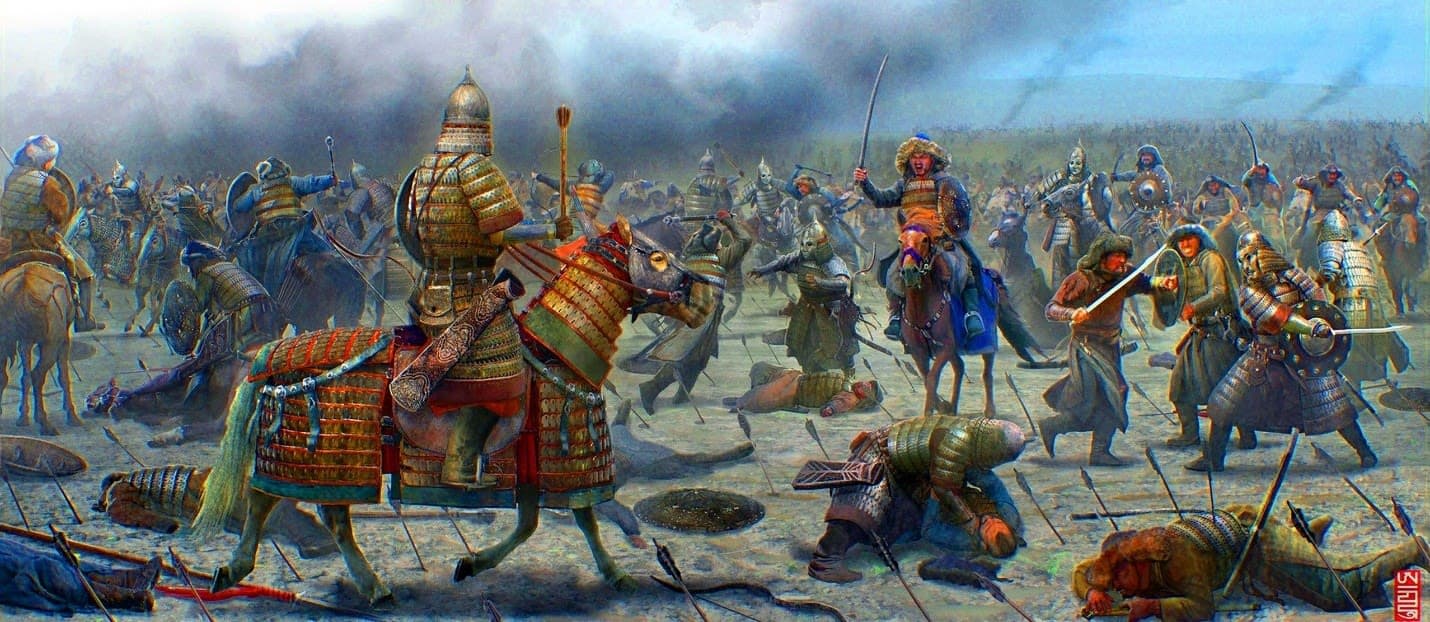
Near Balasagun, the Mongol forces encountered Küchlüg’s thirty-thousand-strong army. The battle ended in a complete rout of the khan’s troops. Realizing he could not hold the capital, Küchlüg fled to Kashgar.
Upon entering the conquered cities, Jebe immediately abolished religious persecutions, declaring that every inhabitant was free to practice their faith. This quickly won him the support of the Muslim population, long dissatisfied with Küchlüg.
In 1217, the Mongol army approached Kashgar. The townspeople, inspired by the promise of religious freedom, revolted and opened the gates to Jebe. Küchlüg fled once again, this time to the Pamir mountains in Badakhshan.
According to the historian Ata-Malik Juvayni, he was pursued deep into remote mountain regions until a group of local hunters tracked him down. Realizing that they had found Küchlüg, they handed him over to the Mongols. The prince, who once dreamed of ruling Central Asia, was immediately beheaded by the Mongols.
With the fall of Küchlüg’s rule, the Kara-Khitai Khanate effectively ceased to exist. The lands of the former khanate came under the control of the Mongol Empire, and the population accepted the new authority without resistance.


