In the mid-12th century, the steppes of Eastern Mongolia and the neighboring lands lived in constant tension. The emperors of the Jurchen Jin Empire, fearing the strengthening of the nomads, pursued a harsh policy known in the steppe as the “reduction of adults.” Every three years, elite Jin corps crossed the borders, burned nomadic camps, killed grown men, or drove them into slavery. For the Jurchens, this was a security measure; for the nomads, it was genocide and a cause of eternal enmity.
In response, Mongol tribes raided border districts. The Tatars were particularly troublesome to the Jin, as their sudden raids disrupted trade routes and forced border garrisons to remain on constant alert.
In 1196, to put an end to the Tatar threat, the Jurchens launched a campaign under Wanyan Xiang. Defeated near the Kerulen, the Tatars fled to the Ulz River, but were pursued by Wang Anguo’s corps. Then steppe allies intervened — the Kerait leader Tooril and the Mongol Temüjin. By combining their forces, they dealt the Tatars a decisive defeat near Lake Torey. The victory benefited all participants: Temüjin received from the Jurchens the rank of cha’utkuri, and Tooril the title of wang. In the steppe this was seen as recognition and strengthened their power.


Soon, however, internal unrest began within the Jin Empire itself. Its once active foreign policy declined, which opened the way for Temüjin to consolidate power in Eastern Mongolia. Within a few years, he crushed the Tatars in 1202, defeated his former Kerait allies in 1203, and subdued the Naimans and Merkits in 1204. In 1206, after a great kurultai, Temüjin was proclaimed Great Khan of all Mongols and took the new name Genghis Khan.
Genghis Khan understood that a direct strike against the Jin would mean war with the most powerful state in the region. First, he sought to secure his flanks. Between 1207 and 1209, he campaigned against the Tangut state of Western Xia, a neighbor of the Jin. Although the Tangut army resisted bravely, it ultimately capitulated, and its ruler recognized himself as Genghis Khan’s vassal and promised to be the “right hand” of Mongol campaigns. To seal the alliance, Tangut princess Chaka became one of Genghis Khan’s wives.
Meanwhile, his eldest son Jochi was dispatched northwest against the “forest peoples” of southern Siberia, bringing under Mongol control vast and rich hunting grounds. All this strengthened the economic base for the coming war with the Jin.
At the same time, new allies began to gather under the khan’s banner: the Uyghur idiqut Barchuq, long hostile to the Tanguts; the Karluks of Semirechye; and the Ongguts, who controlled frontier areas near the Great Wall. Mongolia was becoming the core of a wide coalition in which Mongol tumens were reinforced by Turkic, Khitan, and Chinese troops.
In 1208, the Jin emperor died, and Wanyan Yongji ascended the throne. His appointment violated traditional succession rules, causing turmoil at court. For Genghis Khan, this became another justification for war. He refused to perform the ritual of obeisance, declaring: “I recognize as emperor only the one marked by Heaven. But this man is ordinary and weak.”
This was not simply a breach of etiquette. The Mongols, still formally vassals of the Jin, openly demonstrated that they no longer recognized Jurchen authority. Meanwhile, the Jin’s main forces were tied down in war with the Southern Song, leaving their northern frontiers vulnerable.
In the spring of 1211, Genghis Khan assembled nearly 100,000 troops near the Kerulen. He was joined by Karluks, Uyghurs, and Ongguts. Onggut guides, who knew every path near the Great Wall, led the army to its first strike.
The Mongol army advanced southwest to the Yekhülin Ridge. There the first major battle occurred against frontier forces under General Ding Ce, ending in a complete Jin defeat. The Mongols seized the districts of Dashuile and Fengli, turning them into convenient bases for wintering and resting horses.
Meanwhile, Jebe led one of his famous raids: he suddenly approached the Jin Eastern Capital, was repelled, but then, abandoning his baggage and riding only the swiftest horses, returned and captured the city. This not only enriched the Mongols but also provoked a Khitan revolt under Yelü Liuge.
In August 1211, Jebe captured Baidengcheng fortress — an important pass through the Great Wall. The Mongols surged inside, dividing into separate corps. Jebe besieged the Western Capital, whose garrison fled, and the city fell.

Mongol detachments under Genghis Khan’s sons — Jochi, Ögedei, and Chagatai — swept along the Wall, ravaging district after district. Near Xuandefu the Mongols lured the main Jin forces into a trap and destroyed them, marking a turning point: the empire’s northern lands were left defenseless.
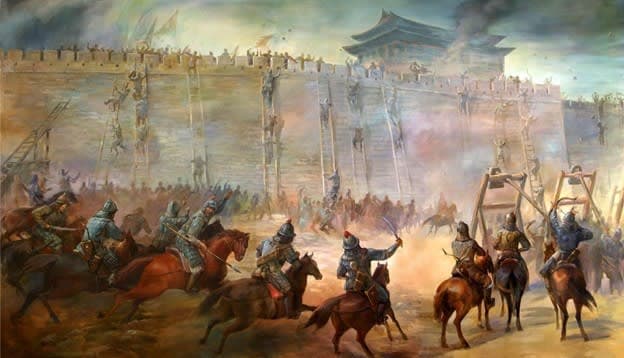
In 1212, the Mongols again took Xuandefu, but during the siege of the Western Capital, Genghis Khan was wounded, and the siege was lifted. The Jurchens shifted to defense, relying on their strong walls and artillery. The Mongols continued to devastate villages and smaller towns, undermining the enemy’s food reserves.
In 1213, Genghis Khan struck again. The Mongols reached the capital region, defeated Jin forces at Huailai, and then, through the Zijingkou Pass, outflanked the defenses and captured the Juyuyguan fortress from an unexpected direction. Dividing his army into three corps, Genghis Khan devastated almost all of northern China.
The frightened Jin court offered peace — a princess, gold, silk, 500 youths and maidens, and 3,000 horses. Genghis Khan accepted, but soon internal rebellions within the empire reignited the war.
In 1215, Zhongdu, the Central Capital (present-day Beijing), fell. The city was plundered in an organized manner: Genghis Khan personally appointed officials to register valuables to avoid chaos.
The Jin Empire was crumbling: Khitan and Chinese revolts, the creation of the state of Dong Xia under Puxian Wannu, and raids from the Southern Song all weakened it, while the Mongols secured new territories step by step.
In 1217, Genghis Khan appointed his companion Muqali as viceroy in China. Muqali acted methodically, occupying cities, leaving garrisons, and recruiting armies from the local population. By 1220, Mongol control extended over almost all of northern China, although Muqali’s death in 1223 slowed the advance.
Internal uprisings in Hebei and other fronts — especially the great western campaign — distracted Mongol forces, but the war with the Jin continued.
The death of Genghis Khan in 1227 gave the Jin a brief respite, but already in 1230 the new Great Khan Ögedei renewed the campaign. The Mongols advanced in two directions: the northern army of Ögedei and Tolui moved into Shanxi, while Subedei’s southern army marched into Shaanxi. The plan to encircle the Jin capital by crossing Southern Song territory failed, but the northern army succeeded, capturing several key cities.
In 1231–1232, the Mongols began the long siege of Bianjing (the Southern Capital, today’s Kaifeng). The battles involved the use of artillery and gunpowder. Epidemics and famine broke the defenders. In the spring of 1233, the city fell, and the emperor fled to Caizhou.
The Mongols, together with the Southern Song, besieged Caizhou. The defense was desperate, with even women fighting on the walls, but hunger and disease took their toll. In early 1234, the city fell. The last emperor committed suicide, and the Jin Empire ceased to exist. All its lands were absorbed into the Mongol Empire.


