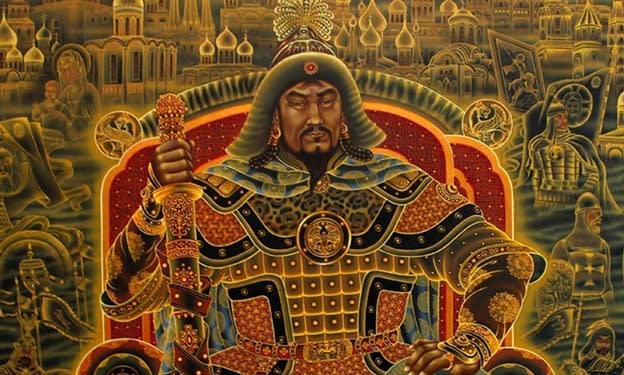
Even during the reign of Genghis Khan, the khan himself had intended to launch a campaign into the western lands. As part of this plan, Mongol armies under Subutai and Jebe had carried out a reconnaissance expedition into those territories. However, Genghis Khan did not live to see his plan realized, and by his will, this task was left to his descendants. In 1227, Genghis Khan died, and two years later, his third son by his first wife Börte, Ögedei, became Great Khan of the entire Mongol Empire.
Before his death, Genghis Khan had divided his empire into four uluses (territorial domains) for each of his sons by Börte. In theory, the western campaign was to be carried out by his eldest son Jochi, using the forces of his own ulus. However, Jochi died before his father, reportedly as a result of a conspiracy, and his lands were inherited by his son Batu.
After ascending the imperial throne, Ögedei held a kurultai in 1235, where he announced the start of the “Western Campaign” and ordered every ulus to provide troops for it. At this kurultai, it was also decided that Batu Khan would be supreme commander of the entire army, and that all lands conquered during the campaign would become part of the Jochi ulus.
With contributions from all uluses, a huge army of 100,000–140,000 warriors was assembled. Many princes of the Genghisid family took part, including: Jochi’s sons Orda-Ejen, Shiban, Tangqut, and Berke; Chagatai’s grandson Buri and his son Baidar; Ögedei’s sons Güyük and Qadan; Tolui’s sons Möngke and Büjek; Genghis Khan’s son Külikhan; and Arghasun, grandson of Genghis Khan’s brother. In autumn, this massive horde set out to conquer the western lands.
The first to face the Mongols’ might was Volga Bulgaria, a Muslim state on the Volga River. Despite the Bulgars’ preparations — fortifying cities and setting traps in the forests — these efforts proved useless. The Mongols swiftly crushed the Bulgar forces, and by spring 1237 the entire country lay in ruins, including its major city, Bulgar.
After destroying Volga Bulgaria, the Mongol army moved into the southern Rus’ steppes to deal a final blow to the Cumans (Polovtsians) and Alans. Most Cumans fled west into Hungary, while the Alans were either killed or joined the Mongol army. By autumn 1237, the Mongols controlled all the steppe lands and then advanced in full force toward the borders of the northeastern Rus’ principalities.


The Mongols reached the borders of the Principality of Ryazan. Batu initially offered peace, sending envoys to demand one-tenth of the inhabitants’ property in exchange for sparing the land. Prince Yuri Ingvarovich refused, sending his own embassy to Batu, led by his son Fyodor. Despite a cordial reception, Batu became enraged when Fyodor refused to give his wife to the khan in marriage. The entire Rus’ delegation was executed, which signaled the start of a full-scale invasion.
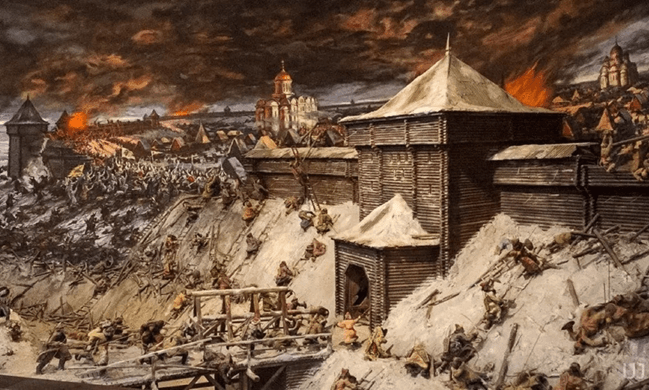
By December 16, the Mongols had reached the Ryazan capital. After a five-day siege, they stormed and captured it. Prince Yuri Ingvarovich was killed, the city was utterly destroyed, and its population nearly annihilated. With the fall of Ryazan, the entire principality was laid waste.
The Mongols then advanced toward Kolomna, where they encountered a united force of Vladimir troops, Novgorod detachments, and Ryazan survivors. The fighting was fierce, and during the battle Genghis Khan’s son Külikhan was killed. Despite heavy losses, the Mongols won, and Kolomna fell.

With Ryazan destroyed, the Mongols moved toward the heart of northeastern Rus’ — the Vladimir-Suzdal Principality and its capital, Vladimir. On February 4, 1238, they arrived at the city walls. After three days of brutal siege, they took the city. Vladimir was burned, looted, and reduced to ashes.
The Mongols then sought to destroy Grand Prince Yuri Vsevolodovich of Vladimir, who was gathering his army on the Sit River. Batu sent his top commander, Burundai, to capture him. On March 4, Burundai located Yuri’s camp and launched a sudden assault, killing nearly all his men. Yuri was slain, and his head was brought to Batu as proof of victory.
At that time Batu was far to the north, besieging the town of Torzhok. Deciding not to advance into the Novgorod lands — where spring swamps would hinder his largely cavalry army — Batu turned back.
He withdrew his forces to the steppe for rest and replenishment, as the army had lost nearly half its men. On the way, the Mongols besieged the small town of Kozelsk. Its inhabitants resisted fiercely, and the siege lasted seven weeks, costing the Mongols many lives. The town was eventually taken, its people massacred, and the settlement destroyed. Impressed by the defenders’ bravery, Batu called Kozelsk “the evil city.”
From summer 1238, the Mongol army remained in the steppes, fighting the Alans and surviving Cumans. Batu sent his relatives Güyük and Möngke to subdue the Caucasus. Once the main army had recovered, in winter 1239 it struck south at the remaining Rus’ principalities.
In December 1239, the Mongols annihilated the Principality of Pereyaslavl and its capital, which was burned and looted. They then moved on to the Principality of Chernigov, which suffered the same fate. The capital, Chernigov, was plundered, destroyed, and left desolate.
In spring 1240, Möngke returned from the Caucasus with his tumen and rejoined Batu. Together they advanced on Kiev, the leading city of Rus’. Struck by Kiev’s beauty, Möngke offered its people a chance to surrender to avoid bloodshed, but the citizens refused.
By November 1240, the main Mongol army, accompanied by yurts, livestock, and the warriors’ families, encircled Kiev. The siege lasted two months, as the city’s fortifications were formidable. Over thirty siege engines and catapults bombarded the walls. Once breaches were made, the Mongols stormed the city. In bloody street fighting, Kiev was captured; its people were either killed or taken prisoner. The city was completely destroyed and looted. Later visitors described Kiev as deserted and ruined, a shadow of its former greatness.


After Kiev’s capture, a message arrived from distant Mongolia: Great Khan Ögedei was gravely ill and required the return of Möngke and Güyük. The princes departed with their tumens.
Batu, unaffected by their absence, continued westward. He rapidly overran the Principality of Galicia-Volhynia, seizing its wealthy cities with little resistance, and allowed his army to rest there briefly. Soon after, Batu, Subutai, and other Genghisids began preparing for the next stage of the campaign, aiming for the “last sea” — a push deeper into Western Europe.
The Mongol invasion of Rus’ inflicted catastrophic damage. Many cities and cultural centers were destroyed; almost all major craft and trade hubs fell into decline. Traditional industries and arts collapsed, and countless people were killed.
The most significant long-term consequence was that all Rus’ lands became tributaries of the Mongol Empire, and later, after its fragmentation, of the Jochi Ulus — better known as the Golden Horde. This subjugation, known as the “Tatar-Mongol Yoke,” lasted for two centuries and had a profound influence on the development of Rus’.


