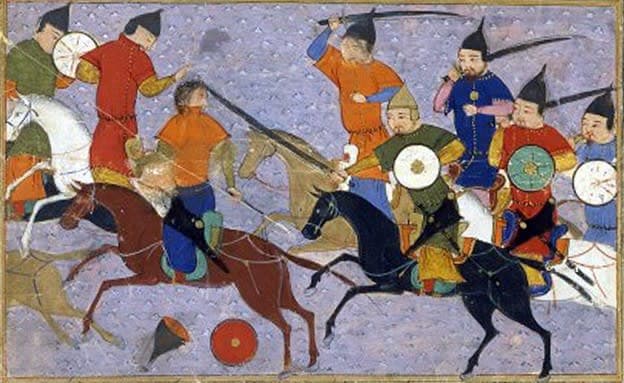
By the early 13th century, the Khwarazmian state, ruled by the Anushteginid dynasty, had reached the peak of its power. Sultan Ala ad-Din Muhammad II controlled vast territories stretching from the borders of India and Persia to the shores of the Aral Sea, including the ancient cities of Merv, Samarkand, Bukhara, and Urgench. It was a wealthy empire with flourishing trade, but also riddled with internal contradictions and a fragile political structure.


The Mongols under Genghis Khan, who had already subjugated Northern China and crushed the Kara-Khitans, approached the borders of Khwarazm seeking to establish trade and diplomatic relations. In 1218, Genghis Khan sent a large caravan of about 450 people to the city of Otrar, accompanied by several envoys. The caravan carried valuable furs, fabrics, silver, and gold, along with lavish gifts for the Shah.
However, the Khwarazmian governor of Otrar, Inalchuq (also known as Ghayir-Khan), suspected the caravan of espionage. He ordered the arrest of all merchants, confiscated their goods, and eventually had all the Mongol merchants and their companions executed. This was a blatant violation of diplomatic norms and a personal insult to Genghis Khan.
Still hoping to avoid war, Genghis Khan sent an embassy of three men to Khwarazm demanding the extradition of Inalchuq for trial. Muhammad II not only refused, but committed an even greater insult: he executed the chief envoy, had the beards of the other two shaved off, and sent them back. This act completely destroyed any chance of peace and became the immediate cause of war.
Genghis Khan began meticulous preparations. He gathered an army of 200,000–210,000 men, composed of the best warriors of the Mongol Empire, and divided it into several corps. The main commanders were Subutai, Jebe, Toghuchar, Chagatai, and Ögedei. The goal of the campaign was not merely punishment but the total annihilation of the Khwarazmian state. The Mongols devised a strategy involving simultaneous strikes on key cities, flanking maneuvers deep into enemy territory, and the blockade of rivers.

Otrar was the first to be struck. Genghis Khan dispatched his sons Chagatai and Ögedei to besiege the city. It was encircled and subjected to a long siege. The Mongols used battering rams, ladders, sappers, and catapults. The defenders fought fiercely, but betrayal proved decisive: one of the city’s commanders, Karadja-Hajib, surrendered part of the fortifications to the Mongols. Otrar fell. Inalchuq was captured and brought before Genghis Khan. Chronicles say he was executed by having molten silver poured down his throat. The population of the city was slaughtered or enslaved, and the city itself was burned to the ground.
In early 1220, Genghis Khan made a rapid march across the Kyzylkum Desert, allowing him to appear suddenly at the walls of Bukhara. The garrison, unprepared for such a move, was taken by surprise. After a short siege, the gates were opened by some townspeople unwilling to die.
Upon entering the city, Genghis Khan delivered his famous speech: “I am the scourge of God. If you had not committed great sins, God would not have sent me upon you.”
Bukhara was sacked. Its mosques were desecrated and turned into stables, while much of the population was enslaved. After Bukhara, the Mongol armies advanced to Samarkand, the capital of the Khwarazmian state.
Samarkand was heavily fortified and defended by up to 110,000 troops, including mercenaries—Turks, Iranians, even Georgians and Caucasian warriors. The Mongols encircled the city and deployed massive siege machinery: catapults, battering rams, and ballistae. Fierce fighting raged for several days along the walls. But when some mercenaries, realizing the hopelessness of resistance, defected to the Mongols, the defense collapsed.
The Mongols stormed into the city, unleashing a massacre. Chronicles report that tens of thousands of inhabitants were killed, while artisans and craftsmen were deported to Mongolia and the rest enslaved.
After the fall of his capital, Shah Muhammad lost control over both his army and his realm. Instead of rallying his forces for a decisive stand, he fled westward in panic. Genghis Khan ordered Subutai and Jebe to pursue him and bring him back.
Muhammad fled through Khorasan and Mazandaran, eventually reaching the Caspian Sea, where he hid on an island. There, in complete isolation, he died in the winter of 1220/1221, leaving power to his son Jalal ad-Din.
Jalal ad-Din tried to gather forces and resist. He won a local victory over a Mongol detachment at Parwan, but soon faced Genghis Khan himself at the Indus River. In the decisive battle, the Khwarazmians were utterly defeated. Chronicles describe how Jalal ad-Din, realizing he was surrounded, spurred his horse into the raging Indus and escaped by swimming across. The Mongols, admiring his courage, did not pursue him further.
By 1221, the Khwarazmian state had ceased to exist. Cities like Merv, Nishapur, and Gurganj were wiped from the map; their populations were slaughtered or enslaved. The Mongols showed extreme brutality, annihilating entire regions to prevent future resistance.
The conquest of Khwarazm opened the way for Mongol expansion into Persia, the Caucasus, and Eastern Europe, and demonstrated to the world that defying Genghis Khan meant complete destruction.


