
At the beginning of the 13th century, the Korean Peninsula was home to the state of Goryeo, founded in 918. This name gave rise to the modern term “Korea.” Despite its relatively small territory, the country achieved a high level of cultural development, and its state religion was Buddhism. Goryeo successfully resisted invasions from its northern neighbors—the Khitan Liao state and the Jurchen Jin Empire—while maintaining internal autonomy despite its formal vassal status.
However, the late 12th and early 13th centuries became a period of deep internal crisis. The country was shaken by political coups, uprisings, and peasant revolts. Central authority weakened, while the aristocracy actively seized peasant lands, turning free farmers into serfs (nobi). Intensified social oppression led to an increase in rebellions.
Tensions also grew within the ruling elite. Civil officials (munban) despised the military (muban), who received less land for service and were excluded from higher government positions. The culmination of this conflict was the coup of 1170, when the military, led by Jeong Jung-bu, seized power, deposed King Uijong, and established a military dictatorship. However, internal power struggles continued, and in 1196 the general Choe Chung-heon established a hereditary dictatorship of the Choe clan, resembling the Japanese shogunate. He formed his own army (Toban) to counter state forces, while the king’s role was reduced to ceremonial functions.
Meanwhile, in the Mongolian steppes, Genghis Khan emerged. After uniting the Mongol tribes, his army struck the Jin Empire, and in 1215 the Mongols captured Beijing. This forced the Khitans, formerly subjects of the Jin, to seek refuge. In the autumn of 1216, their army invaded northern Korea, followed by new invasions in 1217 and 1218. During the third incursion, the Khitans besieged Seogyeong (Pyongyang) but were repelled and took refuge in the fortress of Gangdong.
At the end of 1218, a 10,000-strong Mongol corps, supported by 20,000 Jurchens, invaded Korea under the pretext of providing assistance. After receiving food supplies and troops from Goryeo, the Mongols captured Gangdong fortress. All the spoils and 50,000 captives went to them. This became the first contact between Goryeo and the Mongol Empire.

After concluding a “friendly relations” treaty in 1219—which in fact meant vassalage for Goryeo—Mongol envoys began to visit Korea regularly, demanding massive tribute. This placed a heavy burden on Goryeo’s economy and caused widespread discontent. Choe U, the successor of Choe Chung-heon, grew weary of these conditions.
In 1225, the Mongol envoy Zhu Chu-yu was killed on his way back. The king of Goryeo denied involvement, but the Mongols did not believe him, and contact between the two states was severed for several years. The lull ended in 1231, when the new Great Khan Ögedei resumed campaigns against China and simultaneously sent part of his forces to conquer Goryeo.
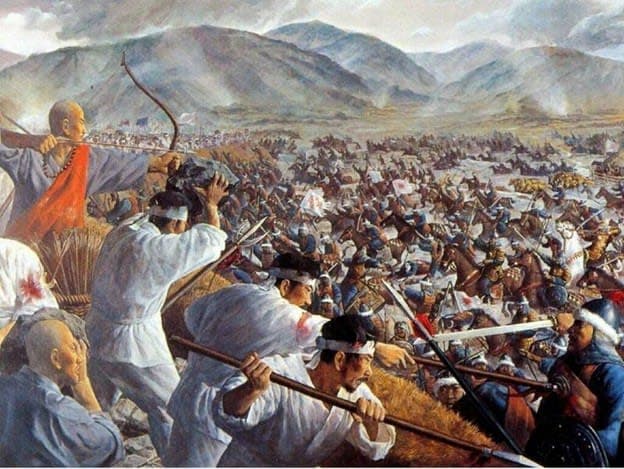
In the summer of 1231, the Mongol army under Sartai invaded Korea. Despite their rapid advance, the Mongols encountered fierce resistance. The defense of Kuju fortress, commanded by Pak Seo and Kim Gyeongson, became legendary. The defenders repelled all attacks using catapults and even heated iron rods. The warrior-monk Kim Yun-hu, who led the defense, became famous for shooting an arrow that wounded Sartai.

Sartai’s defeat forced the Mongols to retreat, but in 1232 the Goryeo government, fearing another invasion, moved the capital to Ganghwado Island. This provoked an uprising against the Mongol overseers (darughachi), leading to a new invasion under Sartai’s command. During the assault on the fortress of Choinson, monk Kim Yun-hu again distinguished himself by shooting Sartai with an arrow, forcing the Mongols to retreat.
In 1236, the third Mongol invasion began, which proved especially devastating. The Mongols burned cities and fortresses, capturing up to 200,000 people as slaves. Nevertheless, the people of Goryeo resorted to guerrilla warfare, and the fortress of Chukju put up heroic resistance, compelling the Mongols to withdraw. In 1239, Goryeo was forced to sign peace under humiliating terms: the king was to return to the mainland and leave his heir as a hostage. These terms were not fully implemented, and the death of Great Khan Ögedei in 1241 gave Goryeo a temporary respite.
In 1247 and 1253, the Mongols launched new but unsuccessful attempts to subjugate Goryeo. The city of Chungju, defended once again by Kim Yun-hu, offered valiant resistance.
The fifth invasion, beginning in 1254, was the most destructive. The Mongols invaded the southern provinces, which had until then been spared. According to the Dongguk Pyeon’gam, “more than 206,800 men and women were taken captive.” The devastation led to the collapse of agriculture, famine, and epidemics. Despite the external threat, the political elite of Goryeo remained divided.
The Choe clan, unable to protect the country, quickly lost authority. In 1258, commanders of the Sambyeolcho guard carried out a coup and killed Choe Ui, ending the 60-year dictatorship. The new government decided to negotiate peace with the Mongols. In 1260, the crown prince secured lenient terms of capitulation from Kublai, the future founder of the Yuan dynasty, and hostilities ceased.
However, in 1270 the Sambyeolcho guard refused to obey King Wonjong’s order to move the capital back to the mainland and disband. Led by Bae Jungson, they revolted, proclaimed their own king, and relocated to Jindo Island. Their goal was to resist Mongol domination.
Wonjong requested military assistance from Kublai. In the summer of 1271, joint Korean-Mongol forces crushed the rebels on Jindo, and in the spring of 1273 suppressed the last resistance on Jeju Island. The surviving rebels, led by Kim Tongjeong, committed suicide.
Jeju, ideally suited for livestock breeding, became one of the few Korean territories under direct Mongol rule. The Mongol conquest, which lasted more than 40 years, devastated the country, but thanks to Goryeo’s stubborn resistance, unlike many other states, it preserved its dynasty and statehood, becoming a vassal of the Yuan Empire.


