
After the destruction of the Rus’ principalities during the “Western Campaign” in 1241, the Mongols approached the borders of Eastern European kingdoms. At the time, the most powerful state in Europe was considered to be the Holy Roman Empire. However, Mongol scouts reported that in reality it was more of a loose confederation of semi-independent kingdoms, lacking centralized authority and unable to field a unified army. Realizing that the Holy Roman Empire posed no serious threat, the commanders of the Mongol army, Subutai and Batu Khan, decided to focus their efforts on the Kingdoms of Poland and Hungary.
The Kingdom of Hungary, ruled by King Béla IV, was indeed the strongest power in Eastern Europe at that time. Learning of the Mongols’ approach, Béla began preparing for defense and strengthening his borders. Considering that the Hungarian army was the most formidable in the region, the Mongol commanders decided to direct their main efforts against Hungary.
The Mongol army, numbering about 60,000 men, was divided into three main forces. The first, led by Baidar, the eldest son of Chagatai, and Orda-Ejen, Batu’s elder brother, marched into
Poland. Their task was to crush the local princes and then move on to Hungary. The second, under Kadan, son of Ögedei, and Buri, grandson of Chagatai, advanced through Moldavia into Transylvania, and from there deeper into Hungary. The main army, commanded by Batu and Subutai, moved directly toward the center of the Hungarian kingdom. After a short rest, the Mongol forces renewed their offensive, beginning a large-scale sweep of European kingdoms with the aim of destroying resistance and pushing their conquests further into Europe.

Upon invading Poland, the Mongols captured key cities in the east of the country almost without resistance, including Lublin, Zawichost, and Sandomierz. After the fall of Sandomierz, the Mongol army split in two: Orda-Ejen’s corps moved north, while Baidar’s headed southwest toward Kraków, the capital of the Polish kingdom. Before reaching Kraków, the Mongols inflicted a crushing defeat on the Polish forces at the Battle of Chmielnik, after which they occupied the city. Without staying long, they burned Kraków and continued toward Wrocław.
When the Mongols reached Wrocław, they began besieging the city, but soon abandoned the siege upon learning that one of the most powerful Polish princes, Henry II the Pious, was gathering an army at Legnica, and that King Wenceslaus I of Bohemia was marching to his aid with a force much larger than the Mongols’. Baidar, joining forces with Orda-Ejen, moved toward Legnica and arrived there one day before the Bohemian king’s army.
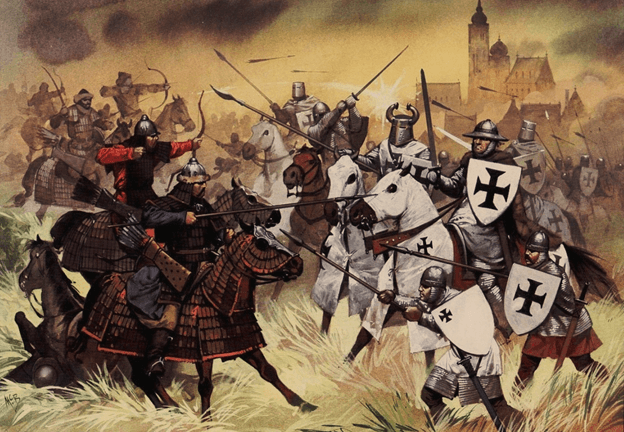
The Polish army consisted of knights from the western Polish duchies, as well as French Templars and Teutonic Knights — about 10,000 men in total. The Mongol force numbered between 7,000 and 8,000 warriors. During the battle, the Mongols used deception: a provocateur on the battlefield shouted in Polish, “Flee! Flee!” These cries sparked panic in the Polish ranks. At first, individual units began to retreat, but soon the entire army broke and fled in disorder.
Henry II himself was killed in battle. The Mongols decapitated him and mounted his head on a spear, using it to threaten the townspeople of Legnica into opening the city gates.

After the battle, Baidar’s corps marched south toward Hungary, plundering and devastating the lands of Moravia (in modern-day Czechia) along the way.
On March 12, 1241, the main Mongol army under Batu passed through the so-called “Rus’ Gate” in the Carpathians and entered the Kingdom of Hungary. They advanced rapidly, and by March 15, the vanguard had reached the city of Pest. By that time, King Béla IV had gathered an army significantly larger than Batu’s. Under pressure from his advisers, who urged a decisive battle, Béla decided to engage the Mongols.
This was Batu’s first encounter with an enemy that vastly outnumbered him. The Mongols, unwilling to risk an open battle, withdrew. Deciding they needed more forces for a decisive victory, they planned to face the Hungarians only once the bulk of their army had arrived.
On April 11, 1241, on the banks of the Sajó River, the famous battle between the Mongols and Hungarians took place. The Mongols surrounded the Hungarian camp and subjected it to intense archery and catapult fire. During the siege, the Mongols deliberately left a small gap in their lines. Seeing this apparent escape route, the Hungarians charged through it, believing they had found a path to safety. At that moment, they were met with a deadly barrage of arrows, after which the Mongols pursued the fleeing troops. The pursuit lasted several days, and the Hungarian army was completely annihilated.
Following the victory, the Mongols advanced into Pest, which was completely plundered and devastated. Despite the massacre, King Béla IV managed to escape, fleeing his country for Austria.
After the destruction of the Hungarian army, the Mongols remained in Hungary for six months, looting and ravaging the land. However, they were unable to cross the Danube River, which limited their advance into Central Europe. During this time, they established an administration in occupied Hungary and even began minting coins. Batu planned to make Hungary the center of his ulus, consolidating his position in Europe.
In December 1241, a severe winter set in, and the Danube froze over, forming a thick layer of ice that allowed the Mongols to cross. That same month, they captured Hungary’s capital, Esztergom. Around the same time, Kadan’s corps returned from Moldavia and seized the city of Buda. From Buda, Kadan moved into Dalmatia (modern-day Croatia), capturing and burning Zagreb as he advanced southward. His main goal was to capture King Béla IV, who was hiding in the region. Despite the Mongols’ efforts, Béla escaped, continuing his flight into Serbia and Bulgaria.
The main Mongol forces under Batu were preparing to invade the Holy Roman Empire. Their vanguard reached the vicinity of Vienna, raiding the surrounding villages. However, in March 1242, Batu received unexpected news: a messenger from distant Mongolia reported the death of Great Khan Ögedei. According to Genghis Khan’s law code, the Yassa, all princes of the royal house (Chinggisids) were obliged to participate in the election of a new khan, regardless of where they were.
As a result, Batu was forced to end his grand campaign and return to Karakorum to take part in the kurultai. On the way back, he plundered Wallachia (modern Romania) and Bulgaria, but further European conquests became impossible. Consequently, the Mongols never again carried out such a large-scale invasion of Europe, and their army never reached the fabled “Last Sea.”


