In 1251, after being proclaimed Great Khan of the Mongol Empire, Möngke decided to expand his domains by turning his attention to the Middle East. The formal pretext for the campaign was the complaints of the inhabitants of Qazvin and the mountainous regions of Persia against the Nizari Ismailis, also known as the “Assassins.” The Mongol general Baiju also complained about the Ismailis and the caliph of Baghdad. Möngke entrusted his younger brother Hülagü not only to deal with the Ismailis but also to subjugate the Lurs and Kurds, and to conquer the territories of the caliph if he refused to submit.
Hülagü’s army numbered between 150,000 and 170,000 men. Attached to his forces were Chinese engineers who operated siege machinery. Preparations for the campaign were thorough: bridges were built, roads repaired, and enormous food depots were established along the route of the army.
Although Hülagü personally sympathized with Buddhism, he skillfully used representatives of various religions for his own ends. His senior wife, Doquz Khatun, was a Nestorian Christian and actively patronized Christians. Her influence was so strong that Hülagü built churches and monasteries in the conquered territories. Another important Christian in his entourage was the general Kitbuqa, also a Nestorian. At Doquz Khatun’s request, during the sack of Baghdad the Mongols spared only the Christian monastery. The king of Cilician Armenia, Hetum I, entered into an alliance with the Mongols: in 1248 he sent his brother Smbat Sparapet to Karakorum, and later, at the invitation of the Great Khan Möngke, personally visited him. Receiving exemption from tribute and military support, Hetum I returned to Cilicia. He also persuaded Bohemond of Antioch to join the alliance.


Hülagü left Mongolia in October 1253, but his progress was slow due to opposition from Batu Khan, head of the Jochid Ulus, who considered the lands beyond the Amu Darya part of his sphere of influence. Batu did not wish to quarrel with Möngke, but his brother Berke openly expressed dissatisfaction. After Batu’s death in 1255, the campaign resumed. However, as early as August 1252, the vanguard under Kitbuqa, numbering 12,000, began operations against the Ismailis.
In January 1256, Hülagü crossed the Amu Darya and besieged the Nizari strongholds in Kuhistan. He used not only military force but also diplomacy, demanding the surrender of the Ismaili imam Rukn al-Din Khurshah. Under pressure from the pro-Mongol faction, which included the famous scholar Nasir al-Din al-Tusi and Muwaffaq al-Dawla, Khurshah agreed to submit. However, suspecting that the imam was stalling, Hülagü launched the assault on Maymun-Diz fortress. Khurshah was forced to surrender and was sent to Möngke, who apparently ordered him killed en route on March 9, 1257. Nasir al-Din al-Tusi became Hülagü’s personal advisor and astrologer.
Most fortresses surrendered without a fight. The famous Alamut capitulated on December 15, 1256. Only the fortress of Girdkuh resisted for many years. The historian Juvayni, who served Hülagü, studied Alamut’s rich library, preserved part of the manuscripts, but personally burned the Ismaili doctrinal texts.

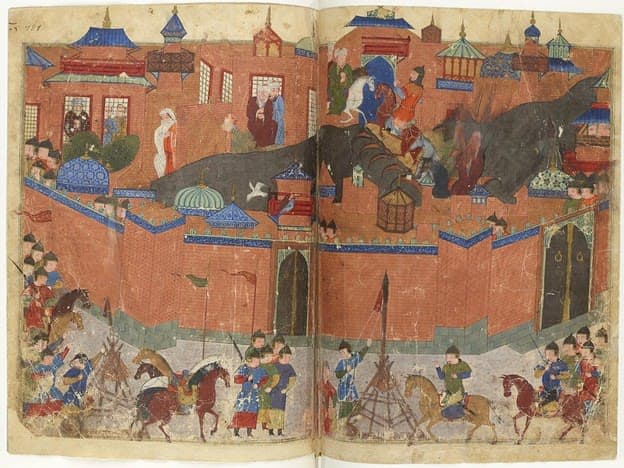
After the defeat of the Nizaris, Hülagü demanded submission from the Abbasid caliph al-Mustasim. The caliph, displaying overconfidence, refused to submit but did not have sufficient forces to resist. His field army was defeated by Baiju’s troops on the banks of the Tigris. In early 1258, Hülagü, Baiju, and Kitbuqa surrounded Baghdad. The siege began with the use of siege engines and ended with an assault. By mid-February the city fell, and the Mongols began looting it for two weeks. At Doquz Khatun’s request, the Mongols spared only the Christians. The caliph himself, who surrendered, was executed on February 20. The vizier and the sahib-divan were ordered to rebuild the city, while Buqa-Temür was dispatched to subjugate southern Iraq and Khuzestan.
From Baghdad, Hülagü marched north to Tabriz, which he intended to make his capital. There he accepted vassals and allies, including the rulers of Mosul and the Sultanate of Rum. The captured booty was sent to Möngke along with plans for an invasion of Syria.
The Mongols invaded Syria on September 12, 1259. The vanguard under Kitbuqa advanced westward. At the end of 658 AH (late 1259), the Mongols, supported by Armenian, Georgian, and Seljuk troops, crossed the Euphrates. In response to the refusal of al-Nasir Yusuf’s governor to surrender the city, the Mongols besieged Aleppo on January 18, 1260. The siege, in which Hetum of Armenia and Bohemond of Antioch took part, lasted a week. The city was taken and plundered, while the citadel held out until February 14 or 25. Hülagü returned the lands previously taken from Hetum and restored Bohemond’s possessions in Aleppo that had been seized by the Muslims.
After the fall of Aleppo, the Ayyubid sultan al-Nasir Yusuf retreated, and Damascus surrendered without a fight. On February 14 (or March 1), Kitbuqa entered the city.
In early spring 1260, Hülagü learned of the death of the Great Khan Möngke. He decided to withdraw to Iran with the greater part of his army, leaving Kitbuqa with a small force of 10,000–20,000. This move was likely prompted by underestimation of the Mamluk forces and the desire to prepare for the inevitable conflict with the Jochids over territories in the Caucasus.
Hülagü sent an ultimatum to Sultan Qutuz in Cairo, demanding submission and tribute. In response, Qutuz, on Baybars’ initiative, executed the envoys and began preparing for war.
Meanwhile, Kitbuqa continued his advance south into Palestine, capturing Baalbek and other towns. Mongol detachments occupied Gaza, and the Ayyubid sultan al-Nasir Yusuf was taken prisoner. To confront Kitbuqa, the Egyptian Mamluk army under Qutuz and Baybars advanced. On September 3, 1260, at the Battle of Ain Jalut, the Mongol army suffered a crushing defeat. Kitbuqa was captured and executed. This defeat marked the end of the Mongol campaign in the Middle East.


