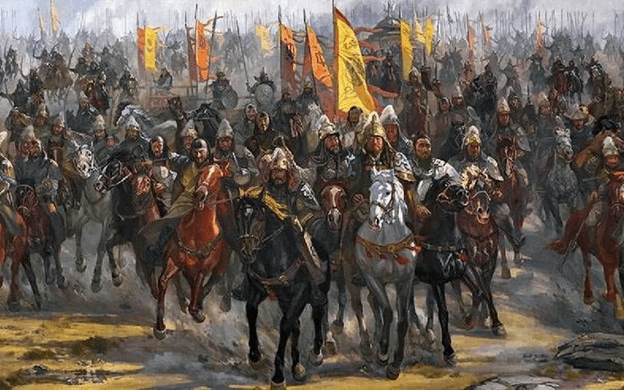

In 1218, when setting out on his Western campaign, Genghis Khan requested military assistance from the ruler of the Western Xia (Tangut) state. However, Emperor Zunxiang refused him. The commander Prince Asha-Gambu expressed this refusal in an insulting manner: “If you lack strength, then you have no right to be a khan!”
In response, the Mongols laid siege to the Tangut capital, Zhongxing. Emperor Zunxiang moved his residence to Silian, leaving the defense of the capital to the crown prince. The siege dragged on, as the Tanguts successfully resisted. Eventually, unable to take the city, Genghis Khan lifted the siege and marched westward, promising to return and punish the Tanguts.
In Genghis Khan’s absence, the ruler of Western Xia attempted to create an anti-Mongol coalition. In the spring of 1224, he sent embassies “to all tribes north of the sands,” proposing an alliance against the Mongols.
At this time, Mongol forces campaigned against the city of Shazhou, but after a month-long siege they failed to capture it. Meanwhile, another Mongol corps under the command of Bolu and Liu Heima defeated the Tangut army in the field near the city of Yinchou. The Tanguts lost several tens of thousands killed and captured. In the autumn of 1224, Yinchou was taken by the Mongols. News of Genghis Khan’s return crushed the Tanguts’ hopes of sparking tribal uprisings.
In February 1225, Genghis Khan returned from Central Asia. The Tangut ruler attempted to negotiate peace, but the Mongols set an unacceptable condition: the heir to the throne had to be handed over as a hostage. When the Tanguts refused, Genghis Khan recalled all their previous offenses, including their refusal of aid in 1218. In the spring of 1226, Genghis Khan personally led his troops against the Tanguts.

The first to fall, in March 1226, was the city of Khara-Khoto, whose entire population was exterminated. In the summer of that year, the major city of Suzhou was taken, where nearly the entire population was killed, except for 106 families.
After this, the Mongols advanced toward the center of Western Xia, the city of Ganzhou, which was captured quickly. The inhabitants of Ganzhou were spared thanks to the intercession of Chagan, Genghis Khan’s adopted son and commander of his personal tumen. The commander of the Ganzhou garrison, Juye Celiu, was Chagan’s father. Genghis Khan ordered the execution of only 36 people who had directed the city’s defense.
By the end of 1226, the situation for the Tanguts had become catastrophic. The country was suffering from drought, and the death of the ruler created turmoil in governance. Cities surrendered one after another. In November 1226, the Mongols approached Lingzhou, where they defeated the Tangut army under the command of Weiming Linggun. This defeat opened the way for the Mongols to the Tangut capital, Zhongxing.
The siege of Zhongxing began in December 1226 and lasted about a year. By this time, the entire remaining territory of Western Xia was already under Mongol control, with the Mongols systematically exterminating the Tangut population. In the summer, Genghis Khan withdrew to the Liupan Mountains, giving the Tangut ruler one month to make his decision.
In August 1227, Genghis Khan fell gravely ill and soon died. The last Tangut ruler surrendered at the mercy of the conqueror but was killed, and the Mongols carried out a massacre in Zhongxing. The Tangut state ceased to exist.


