In the 1860s the Russian Empire, renewing its push into Central Asia, sought to secure its southern frontier. Key regional fortresses were taken, and by 1867 the Turkestan Governor-Generalship had been created on the newly conquered lands.


At this time the Khanate of Kokand, weakened by civil strife and dependent on Bukhara, was ruled by Khudoyar Khan. Fearing his powerful Bukharan neighbor, he moved closer to Russia. In 1868 he signed a treaty recognizing Russia’s territorial gains and effectively renouncing an independent foreign policy.

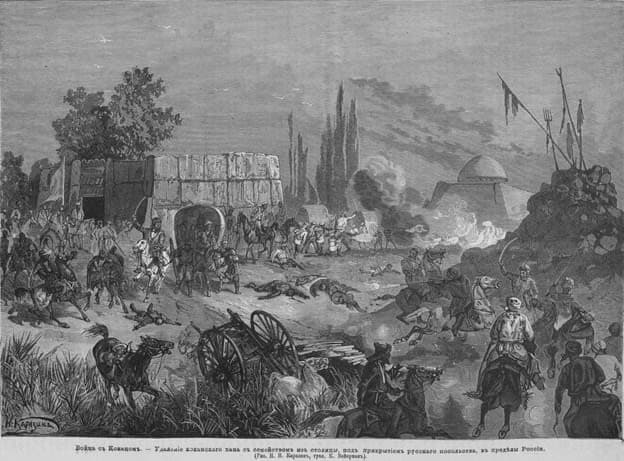
Domestically, however, the khan’s rule bred mounting tension. After decades of war, the treasury was empty. Khudoyar imposed crushing taxes and levies, provoking widespread resentment. The Kipchaks, once privileged, were stripped of influence as the khan favored the settled Sarts. Russian officials in Tashkent, aware of the danger of a social explosion, repeatedly urged lower taxes; Khudoyar ignored them. Matters came to a head in 1875 when a Russian diplomatic mission arrived in Kokand. Locals, seeing an armed escort, took it as proof of the khan’s collusion with Russia sparking an open revolt and a call for jihad.
The uprising was led by Abdurahman-Autobachi and Pulath Khan. Troops sent by Khudoyar to suppress the rebels went over to the insurgents en masse. Realizing he faced death, Khudoyar fled under Russian protection.

In August 1875 rebel forces, under the banners of Islam, crossed into Russian-held territory and besieged Khujand. The garrison, commanded by Colonel Savrimovich, beat back every assault.
In September 1875 General Konstantin von Kaufman struck back with a column of 16 infantry companies, eight sotnias of cavalry, and 20 guns, delivering a crushing defeat to Abdurahman-Autobachi’s 50,000-strong host at the Battle of Makhram. Kokand’s losses exceeded 2,000; the Russians lost just six killed.

Following the victory, Russian troops occupied Kokand. Nasriddin Khan, Khudoyar’s son, signed a peace accord, Kokand relinquished independent diplomacy and ceded the Namangan beklik to Russia. Peace, however, proved fleeting.

In October 1875 a new uprising erupted. Pulath Khan was proclaimed khan; Nasriddin fled. The rebels again struck at Russian outposts but met stiff resistance.
Now General Mikhail Skobelev took command of the suppression campaign. He routed the Kipchaks at Balykchi and stormed Andijan.
Broken, Abdurahman-Autobachi surrendered; Pulath Khan was captured and executed.
In January 1876 General Kaufman received Emperor Alexander II’s authorization to abolish the Kokand Khanate outright. On 20 February 1876 an imperial decree incorporated its lands as the Fergana Oblast of the Russian Empire. Skobelev became its military governor.

With Kokand’s liquidation, Russia declared itself the khanate’s successor state gaining not only the Fergana Valley but also southern Kyrgyz lands up to the Pamir foothills that had belonged to Kokand.
Thus, a revolt that began against an unpopular ruler ended with the total loss of Kokand’s independence and its final absorption into the Russian Empire.


