
In 1685 James II, the younger brother of the childless King Charles II, ascended the English throne. At first, a society weary of recent revolution accepted him; but James, an openly Catholic monarch, began pursuing policies that quickly alienated the Protestant majority.

Fearing rebellion, the king created a standing army, recruiting Irish Catholics. He dissolved parliament and actively promoted a policy of “religious toleration” that in practice strengthened Catholicism. Catholic monastic orders returned to the country, and James appointed Catholics to key posts in the state, including the Privy Council and the courts.
Anglican circles were especially alarmed by reports of the persecution of Protestants in France after the revocation of the Edict of Nantes in 1685. Society feared a Catholic restoration, which estranged the Tories normally the king’s natural allies.
The king’s opponents hoped that after his death the throne would pass to his Protestant daughter Mary, wife of William of Orange. But in 1688 the 55-year-old James II had a son. The event provoked shock and suspicions of a “papist imposture,” since the queen’s previous ten pregnancies had ended unsuccessfully. The birth of a Catholic heir was the last straw.
Opponents of the king both Tories and Whigs united and appealed to William of Orange. William, the Dutch stadtholder, feared the growth of English military and naval power and a possible Anglo-French alliance against his country. In June 1688 seven prominent English politicians secretly invited him to England, assuring him that most of the nation would support him.
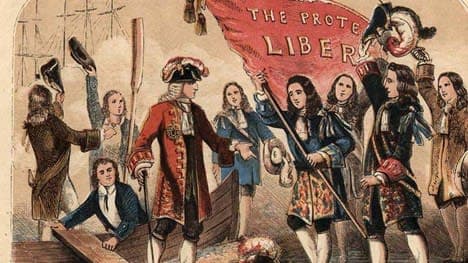
In November 1688 William landed at Torbay in the southwest of England with an army of 40,000. His standard bore the words: “I will maintain the Protestant religion and the liberties of England.” Armed risings against James II broke out across the country, backed by the bourgeoisie, the Protestant clergy, and part of the aristocracy.
James’s army, weakened by mass desertions, concentrated at Salisbury; but no major battle was fought. General John Churchill and most senior officers went over to William’s side. The king’s younger daughter Anne also abandoned her father.
Deserted by all, James returned to London and tried to flee to France. After his first failed attempt, William unwilling to turn him into a martyr helped him leave the country for good.


In January 1689 parliament proclaimed William and his wife Mary joint sovereigns of England and Scotland. These events entered history as the Glorious Revolution so called because it was virtually bloodless, without great battles or civil war, unlike the revolution of the 1640s.

During William III’s reign deep reforms were enacted that laid the foundations of Britain’s modern political and economic system.
Constitutional monarchy. The Bill of Rights finally limited the monarch’s power and enshrined the supremacy of parliament. This ended absolutism and established the constitutional monarchy that endures to this day.
Protection of property rights. The revolution safeguarded property rights across broad strata of society one reason historians cite for the onset of the Industrial Revolution and England’s economic rise.
Religious toleration. The Toleration Act reduced discrimination against Protestant dissenters. Discrimination against Catholics, however, remained and even intensified as they were barred from the throne.
Global ascendancy. After the Glorious Revolution, England entered a period of rapid ascent, becoming a powerful world state in the eighteenth and nineteenth centuries.


