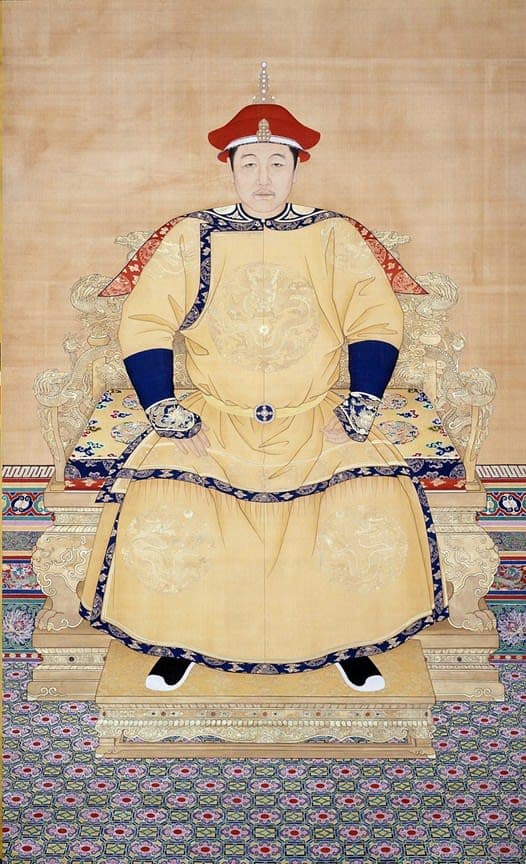

In September 1643, Khan Abahai died, and his five-year-old son Fulin ascended the Manchu throne under the reign title Shunzhi. However, real power fell into the hands of his relatives princes Dorgon and Jirgalang, who were appointed as regents. The talented commander Dorgon quickly concentrated authority in his own hands, and by 1644 he had demoted his rival, becoming the de facto sole ruler of the state.

Meanwhile, China was engulfed in a peasant war led by Li Zicheng, who by 1644 had captured Beijing and proclaimed a new dynasty Da Shun. The only force capable of resisting him was the “Eastern Army” of General Wu Sangui, who guarded the Great Wall against the Manchus. Wu Sangui saw in this chaos his chance: if he could defeat the rebels, he might become regent to the young Ming emperor. But to achieve that, he needed Manchu support.
Dorgon eagerly accepted his proposal, and on May 27, 1644, the decisive battle took place near the Great Wall. On Dorgon’s orders, Wu Sangui’s troops engaged the rebel army first, exhausting them in combat. At the climax of the battle, Manchu cavalry entered the field, outflanked Wu Sangui’s position, and struck a sudden, devastating blow against the weary rebel ranks. The powerful charge of these fresh forces shattered the peasant formations, and the rebels fled in panic.
Not wishing to allow Wu Sangui into the capital, Dorgon ordered him to pursue the retreating army of Li Zicheng. The regent himself entered the Forbidden City quietly on June 6, 1644. Manchu troops quickly seized full control of Beijing, expelling Chinese residents from the Inner City and imposing their authority. All inhabitants of the capital were ordered to shave their foreheads and wear a queue — a hairstyle symbolizing submission to the Qing dynasty. Dorgon declared Beijing the new capital of the Manchu state.


A few months later, on October 30, 1644, Fulin was ceremonially brought to Beijing and formally proclaimed emperor once again. The Ming throne was abolished, and the Qing Empire absorbed China.
Dorgon pursued a flexible policy to win over the Chinese elite. He promised official ranks and titles to all Ming officials who recognized the new regime. Landowners and merchants were guaranteed protection, while peasants were promised tax reductions. The Manchus declared themselves defenders of Confucianism, which helped them gain the trust of scholars and landlords. This pragmatic policy allowed the Qing Empire to take northern China “with little bloodshed.” Local militias and wealthy Chinese actively aided the Manchus in suppressing the rebels.
The conquest of the lands south of the Yangtze River was far more difficult, but by 1647 most of China had come under Qing control. However, in 1648–1649, a massive rebellion erupted even Chinese generals who had previously sided with the Manchus joined it. The Qing Empire lost control of most of its newly conquered provinces.
At this critical moment, Dorgon acted decisively. He eliminated the main centers of resistance in the north and redeployed his forces to the south. By 1650, the last remnants of the Ming Empire collapsed, though fighting continued. After Dorgon’s sudden death in 1650, military operations temporarily ceased.
In 1652, the rebels launched a counteroffensive, and for several years the Qing armies could not defeat their disciplined forces despite their numerical superiority. Only in 1655 did the Manchus finally turn the tide and crush the resistance. A decade of relative peace followed, but at a terrible cost: many cities lay in ruins, villages were deserted, and fields abandoned.

At the same time, Russian Cossacks penetrated northern Manchuria, into the Amur region. They began collecting tribute from local tribes who already paid taxes to the Manchus. This led to clashes: in 1652, the Manchus attacked Yerofey Khabarov’s winter camp, and in 1658 their fleet defeated the detachment of Onufriy Stepanov-Kuznets, forcing the Russians to withdraw from the middle Amur.
In 1654, a Russian embassy led by Fyodor Baikov arrived in Beijing. Baikov refused to perform the kowtow the ritual prostration before the emperor considering it humiliating for a Russian envoy. This offended the emperor, and in 1658, the mission left empty-handed. Soon after, the Qing Empire attacked Russian outposts, forcing the Cossacks to retreat.
In his later years, Emperor Fulin fell under the influence of a powerful clique of eunuchs, who seized control of the court. Their number exceeded five thousand, and they occupied key government positions. On the eve of his death in 1661, the seven-year-old Xuanye was declared his successor. The dying emperor established a regency council of four, led by Prince Oboi, to rule until Xuanye came of age. The regents immediately destroyed the eunuchs’ faction, executing their leader and restoring order at court.
Thus ended the reign of the first Manchu emperor, who, though only a child, became the symbol of conquest and the consolidation of the new dynasty upon the Chinese throne.


